



Most indie bookstore data problems don't announce themselves. There's no alarm. Sales just quietly leak — a marketplace listing that oversells because two ISBNs point to the same physical book, a "bestseller" report that's wrong because half your used stock never got tagged with a category, a reorder decision made on a number that turned out to be double-counting consignment.
The frustrating part is that none of this is a technology problem you can throw money at. You can't buy your way out of bad data. You have to govern it. And for a one- to three-person shop, "governance" sounds like corporate overkill — the kind of thing that needs a compliance officer and a wiki nobody reads.
It doesn't. What follows is a bookstore data governance roadmap sequenced across twelve months, built for teams where the same person handles receiving, the newsletter, and the register. The pacing matters as much as the tasks. Do these in the wrong order and you'll spend three months building dashboards on top of data that's still broken underneath.
Why data breaks in a bookstore specifically
Bookstores have a data problem that most retail doesn't: the product identity is genuinely ambiguous. A single title can exist as a hardcover, a trade paperback, a mass-market paperback, a special edition, a signed copy, and a used copy in three conditions — each with its own ISBN, or worse, sharing an ISBN because someone typed it wrong during intake.
This is the root of nearly everything downstream. When product identity is unstable, every report built on top of it inherits that instability. Your sell-through rate is wrong because sales are split across three ISBNs. Your reorder point is wrong because inventory is fragmented. Your margin analysis is wrong because the used copy and the new copy got merged.
In real operations this usually compounds silently for years. A shop opens, imports a catalog from a POS vendor or distributor feed, and inherits whatever mapping decisions that feed made. Then two more sales channels get bolted on — a marketplace, a website — each representing the same book differently. Now you have three systems that don't agree on what a book is, and every night some sync job tries to reconcile them and quietly gives up on the edge cases.
The shops that stay clean aren't the ones with better software. They're the ones that decided, early, on a single source of truth for what a book is — and then held that line every time a new channel wanted to do it differently.
The sequence problem: why order matters more than effort
The mistake almost every shop makes when they finally decide to "fix the data" is starting with the dashboard. It's the most visible, most satisfying part. You build a nice sales view, it looks great, and then someone notices the numbers don't match the bank deposits.
The correct order runs the opposite direction. You stabilize the contracts first — the agreements about what fields mean and which system wins in a conflict. Then you fix the pipes — the ETL steps that move data between systems. Then you assign ownership so fixes don't decay. Only then do you build the analytics layer, because now it sits on ground that won't shift.
| Layer | What it governs | What breaks if you skip it |
|---|---|---|
| Contracts | ISBN/edition rules, field definitions, source-of-truth priority | Every report disagrees with every other report |
| Pipelines (ETL) | How CSVs and feeds move and transform between systems | Data arrives late, malformed, or silently dropped |
| Ownership | Who fixes what, and by when | Problems reappear a month after you fix them |
| Analytics | KPIs, dashboards, reorder signals | You build beautiful views of wrong numbers |
The 12-month plan below moves down this stack deliberately. Months 1–3 are contracts. Months 4–6 are pipelines. Months 7–9 are ownership and quick-win KPIs. Months 10–12 are dashboard transforms and hardening. You can compress this if you have more hands, but don't reorder it.
Months 1–3: Stabilize the ISBN and edition contract
The first quarter is unglamorous and it's the most important. You're deciding, once, how your business represents a book — and writing it down so it survives staff turnover and new channels.
Start by defining your primary key. For most shops the answer is: ISBN-13 is the identity for new books, and a separate internal SKU handles anything ISBN can't — used copies, signed editions, sidelines, bundles. The failure pattern that shows up constantly is a shop trying to make ISBN carry all of that weight. It can't. A signed first edition and a beat-up reading copy are not the same product even if they share an ISBN, and if your system treats them as one, your condition-based pricing and margin reports both fall apart.
Then write the edition rules. A short, boring document that answers:
-
When a hardcover and paperback of the same title exist, are they separate products? (Yes.)
-
How do we represent a used copy — new SKU, or a variant flag on the ISBN?
-
Which system is the source of truth when the POS and the website disagree on price?
-
What happens when a distributor feed sends an ISBN we don't recognize — auto-create, or hold for review?
This is where a lot of the deeper cleanup work connects. If your catalog is already a mess of duplicate editions, the step-by-step metadata cleanup and inventory taxonomy work is the natural companion to this quarter — the contract defines the rules, and the taxonomy cleanup applies them to the existing catalog.
The Month 1–3 checklist:
-
Pick your primary key (ISBN-13) and your fallback key (internal SKU)
-
Write the one-page edition rules doc — separate products vs. variants
-
Declare source-of-truth priority per field (price, quantity, category, condition)
-
Run a duplicate scan
find every ISBN that appears more than once
-
Flag, don't delete — mark suspected duplicates for review before merging
-
Decide the "unrecognized ISBN" policy (hold-for-review is safer than auto-create)
Don't try to clean the whole catalog in these three months. The goal is the rules and a handful of the worst offenders, not perfection. Perfection comes later, applied consistently, once the pipes stop re-breaking things.
Months 4–6: Fix the ETL before you trust any number
ETL sounds like a developer word, and shops assume this quarter needs one. It usually doesn't. For a small bookstore, "ETL" mostly means: a distributor sends you a CSV, you transform it, and it loads into your POS or spreadsheet. The problems are almost always in the transform step, and they're almost always the same handful of issues.
The most common one: inconsistent formatting that silently corrupts data. ISBNs arrive with leading zeros stripped because a spreadsheet treated them as numbers. Prices come in as $12.99 in one feed and 12.99 in another. Categories are Fiction/Mystery from one source and MYS from another. Each of these is small. Together they mean your nightly reconciliation is comparing apples to slightly-different-apples and generating phantom mismatches.
The fix isn't fancy. It's a documented, repeatable transform that every incoming file passes through the same way. This is exactly the territory covered in the copy-paste CSV transforms and nightly job blueprint — the mechanics of turning a raw vendor CSV into something your system can ingest without hand-editing every row.
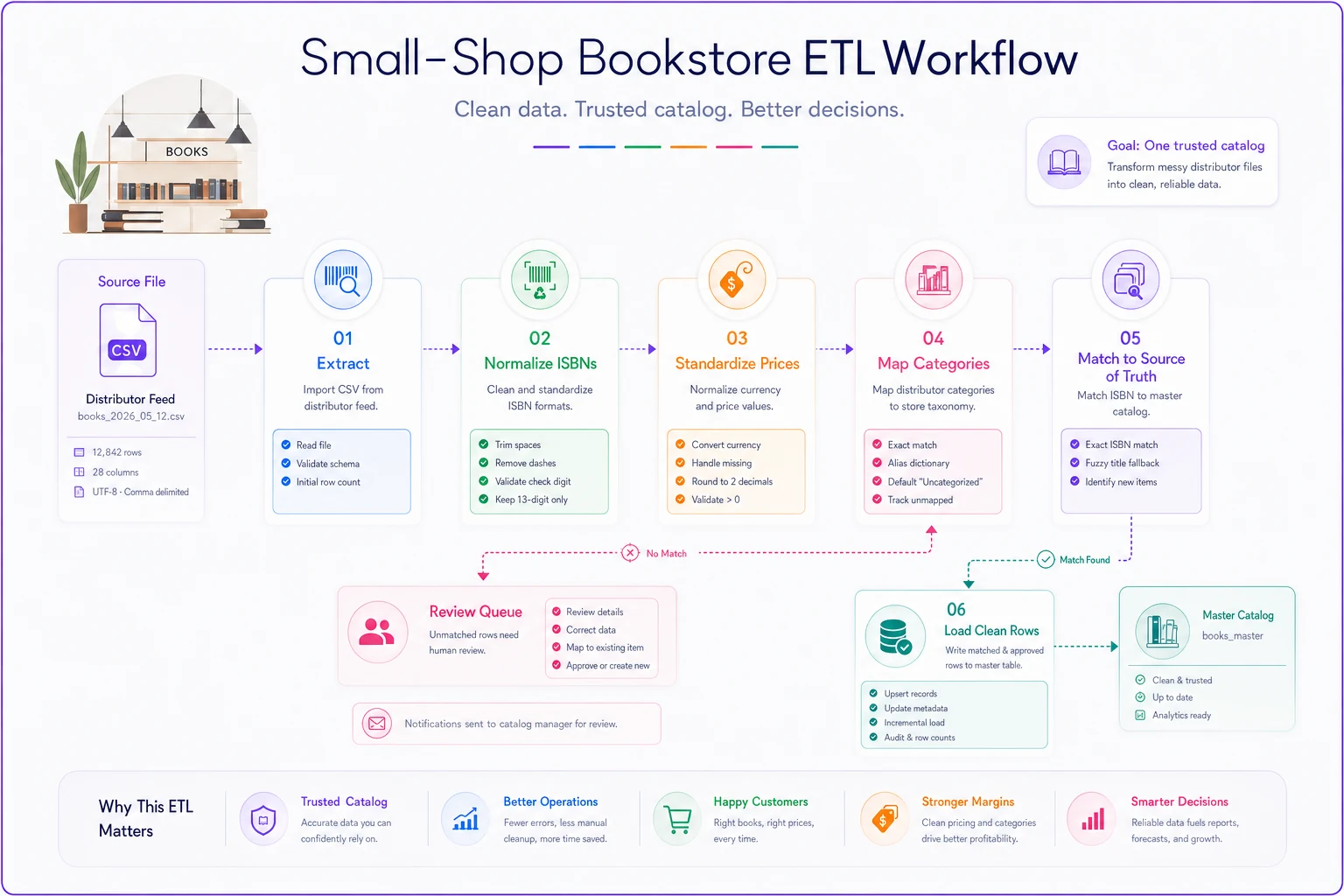
A workable transform pipeline for a small shop, in order:
-
Extract — pull the raw CSV from the distributor or channel export, untouched.
-
Normalize ISBNs — force text format, strip hyphens, validate the check digit, quarantine anything that fails.
-
Standardize prices — strip currency symbols, coerce to two decimals, flag anything zero or negative.
-
Map categories — run every incoming category through a lookup table to your canonical taxonomy.
-
Match to source of truth — join on ISBN/SKU, and route unmatched rows to a review queue instead of the main table.
-
Load — write the clean rows in; write the rejects to a separate file you actually look at.
That review queue in step 5 is the single most valuable thing in this quarter. Most shops load everything and let the errors dissolve into the general population, where they're invisible until a report looks weird. A shop that routes rejects to a queue catches the ISBN typo before it becomes an oversell.
Below is a simple workflow diagram of the ETL steps described above.
A quick reality check on why this matters: a two-person shop running three channels might process a few hundred to a couple thousand line-items a week across feeds and orders. If even 1–2% of those carry a formatting error, that's dozens of silently wrong rows every week, accumulating into thousands of bad data points over a year. That's not a rounding error — that's your reorder decisions running on noise.
Months 7–9: Assign ownership and grab the quick KPI wins
By now the contract is stable and the pipes are cleaner. The danger in month seven is complacency — you fixed it, so it stays fixed, right? No. Data governance decays. New staff, new vendors, and new channels reintroduce the old chaos unless someone owns keeping it clean.
For a one- to three-person team, ownership doesn't mean hiring. It means naming a person and a cadence for each domain, even if it's the same person wearing three hats. When a category mapping breaks, there should be a clear answer to "whose job is it to fix this and when."
A minimal ownership map for a small shop:
-
Catalog owner — approves new products, resolves duplicate flags, maintains the taxonomy. Weekly.
-
Pipeline owner — checks the reject queue, confirms nightly jobs ran, handles unmatched rows. Daily (10 minutes).
-
Numbers owner — owns the KPI definitions, spots reports that don't reconcile, signs off before decisions. Weekly.
Even in a solo shop, writing these down as three roles rather than one undifferentiated blob of "I do everything" changes behavior. It turns "the data is messy" into "the reject queue hasn't been cleared since Tuesday," which is actually a task you can do.
This quarter is also where you cash the quick KPI wins, because now they'll be right. Start with metrics that don't require much history: current sell-through by category, days-of-inventory on hand, oversell incidents per channel, gross margin by product type. These stabilize fast once the underlying data is clean, and they immediately inform buying decisions. If you haven't defined which KPIs actually matter, the KPI dashboard framework for avoiding overstock and blind discounting is the right reference for figuring out what to track before you build anything.
Even in a one-person shop, set a daily calendar reminder for the pipeline owner to clear the reject queue so issues don't silently accumulate.
One mistake to avoid: measuring everything. A three-person team drowning in twenty KPIs will ignore all of them. Pick four or five that actually change decisions. If a number won't change what you order, discount, or promote, it's a vanity metric — leave it out.
Months 10–12: CSV → dashboard, without a developer
The final quarter is where the visible payoff lives, and it's genuinely doable without code. The hard work is already behind you — the data is clean and consistent, so the dashboard is just a view on top, not a rescue operation.
The core transform every small shop needs: take a clean CSV export (sales, inventory, or both), pivot it into the shape your KPIs need, and refresh it on a schedule. Modern spreadsheets do this natively. A pivot table over a clean sales export gives you sell-through by category in about ten minutes. A second one over inventory gives you days-of-cover. Connect them and you have a reorder signal.
A concrete workflow for a nightly-refresh dashboard with zero custom code:
Your POS or channel exports a sales CSV each night into a shared folder. A scheduled routine — a built-in spreadsheet refresh, a no-code automation, or the same nightly job that already runs your reconciliation — appends that CSV to a clean master table that has already passed through the normalization steps from months 4–6. Your dashboard sheet points at that master table through pivot tables and a few formulas. When the file lands, the pivots refresh and your numbers update. No one touches a cell by hand.
The reason this works now and wouldn't have worked in month one: the CSV going in is trustworthy. Same ISBN format, same category names, no phantom duplicates. Garbage-in-garbage-out is the entire story of failed bookstore dashboards. You spent nine months making the "in" not-garbage, so the "out" is finally usable.
If your data flows across retail, marketplace, and events, this is also the moment to make sure your dashboard reflects the routing reality — the omnichannel order-routing map with channel KPIs pairs naturally with this quarter, because a dashboard that ignores which channel a sale came from will mislead you about where your margin actually is.
A real scenario: what this looks like in practice
Consider a two-person used-and-new shop running a POS, a website, and one marketplace. Before any governance work, their "top sellers" report was quietly wrong: a popular title existed as three ISBN entries — a duplicate typo, plus a used variant that had been merged into the new record. Sales split across all three, so it never surfaced in the top ten, and they under-ordered it repeatedly. They were also averaging a handful of marketplace oversells a month because inventory was fragmented across those duplicate records.
They ran roughly this sequence over about nine months — contract first, then CSV normalization, then a daily ten-minute reject-queue check assigned to one owner. The duplicate scan in the first quarter surfaced somewhere around 200–300 problem ISBNs, most of them minor, a couple dozen genuinely costing sales.
The changes weren't dramatic-sounding, but they added up. Oversell incidents dropped to nearly zero once inventory stopped fragmenting. Reorder decisions got noticeably better because sell-through numbers finally reflected reality — that invisible bestseller got reordered on time. And the monthly numbers started reconciling to the bank without the usual two-hour hunt for why they didn't. Nothing here required a developer or a big software spend. It required doing the layers in order.
When this roadmap makes sense — and when it doesn't
This full twelve-month sequence is worth it if you run more than one sales channel, carry a mix of new and used, or have ever made a buying decision off a number you later found out was wrong. Those are the conditions where data ambiguity actively costs money, and the governance work pays for itself.
It's overkill if you're a single-channel shop with a small, all-new catalog and a POS that's already your only source of truth. In that case you don't have a reconciliation problem — you have one system, and it agrees with itself. Fix your category taxonomy, skip the rest, and move on.
And it's genuinely a bad idea to start this mid-migration to a new POS or in the middle of a holiday surge. Governance requires a stable substrate to govern. Trying to standardize contracts while the whole system is in flux just means re-doing the contract work against the new system in three months. Wait for calm, then start with Month 1.
The one thing to take away
The reason bookstore data stays messy isn't a lack of tools — it's that shops fix problems in the order they notice them rather than the order they originate.
This roadmap is really just an argument for fixing bottom-up: settle what a book is, then how it moves, then who keeps it clean, and only then what it tells you. Do that, and the dashboards more or less build themselves — because there's finally something solid underneath them.
This roadmap is really just an argument for fixing bottom-up: settle what a book is, then how it moves, then who keeps it clean, and only then what it tells you. Do that, and the dashboards more or less build themselves — because there's finally something solid underneath them.