



Walk into the back office of any indie bookstore that's been around more than five years, and you'll find the same problem buried in their inventory system. Multiple entries for the same book, different ISBNs pointing to identical titles, hardcover and paperback editions mixed together, special editions floating around without proper categorization.
The damage compounds quietly. Staff spend extra time searching for books that should take seconds to find. Customers get frustrated when the "in stock" book they saw online isn't actually the edition they wanted. Reordering becomes guesswork when your system shows three different entries for what's essentially the same title. And financial reporting? Good luck figuring out which edition of that bestseller actually drove revenue last quarter.
Most bookstores try fixing this with band-aid solutions — dedupe obvious duplicates when they spot them, clean up a category here and there. But without a proper taxonomy system, the mess just rebuilds itself. New staff add books their own way, distributors send data in different formats, and before long you're back where you started.
Why traditional cleanup approaches fail
The typical approach: export everything to Excel, sort by title, manually spot duplicates, merge them one by one, reimport. Sounds logical enough. Except this treats symptoms while ignoring the disease.
First, the manual process takes forever — days of work for even a modest catalog of 10,000 titles. Second, without rules governing future additions, new duplicates start appearing immediately. Third, different staff members make different judgment calls about what counts as a "duplicate" versus a legitimate separate edition.
The real killer though is format inconsistency. Your point-of-sale system might list a book as "Paperback," your distributor feed calls it "Trade Paper," and your website shows "Soft Cover." All the same thing, but your inventory system treats them as three different products. Multiply this across thousands of titles and dozens of formats, and you've got operational chaos.
Consider what happens during a busy Saturday. A customer asks for a specific cookbook. Your system shows it in hardcover. Staff checks the shelf — nothing. Turns out it was the spiral-bound edition, listed separately under a different record. Customer leaves empty-handed. This kind of thing happens more than most owners realize, and it's entirely preventable.
Building a sustainable bookstore inventory taxonomy
A working taxonomy needs three core components: classification rules, transformation processes, and governance protocols. Miss any one of these, and you're just rearranging deck chairs.
Start with your classification hierarchy. At the top level, you've got your unique title identifier — not the ISBN, but a master record that groups all editions together. Think of it as the parent that all specific editions belong to. Under this, you organize by format (hardcover, paperback, audio, digital), then by edition type (first edition, anniversary, illustrated, abridged), then by condition for used books.
Your taxonomy structure might look like this:
| Level | Classification | Example | Purpose |
|---|---|---|---|
| 1 | Master Title | "The Great Gatsby" | Groups all editions |
| 2 | Format | Hardcover | Physical format differentiation |
| 3 | Edition | Scribner 2004 | Publisher/year specifics |
| 4 | Condition | New/Used/Collectible | Pricing and placement |
The value is in the connections between levels. When someone searches for "The Great Gatsby," they see all available formats at once. When you run sales reports, you can aggregate by master title or drill into specific editions. When placing orders, you know exactly which ISBN corresponds to which format your customers actually want.
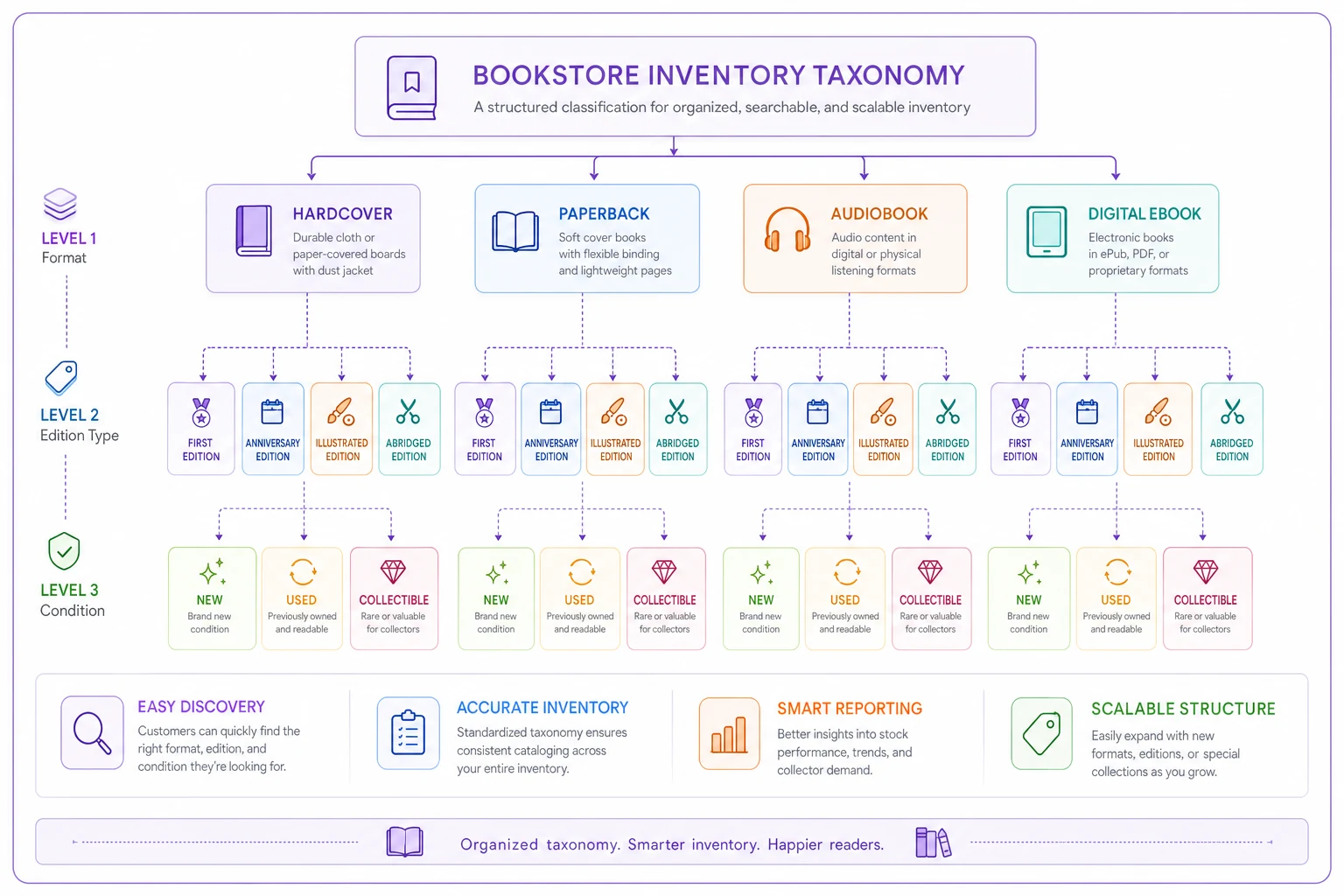
Here's a simple diagram of the taxonomy workflow.
CSV transformation recipes that actually work
Most book data arrives via CSV from distributors, and each one uses different formatting. Without transformation rules, you're cleaning data manually forever. Here's a practical approach that handles the most common scenarios.
Create a format standardization table:
| Original | Standard |
|---|---|
| Trade Paperback | Paperback |
| Trade Paper | Paperback |
| Soft Cover | Paperback |
| Mass Market | Mass Market |
| HRD | Hardcover |
| Hardback | Hardcover |
| HC | Hardcover |
Then build publisher code mappings:
| Code | Publisher |
|---|---|
| RH | Random House |
| S&S | Simon & Schuster |
| PRH | Penguin Random House |
| HC | HarperCollins |
Your transformation recipe runs these rules automatically on import. A book listed as "Trade Paper" from "PRH" becomes "Paperback" from "Penguin Random House" in your system. Consistency without manual intervention.
For ISBN handling, establish a clear hierarchy. ISBN-13 takes priority, followed by ISBN-10, then other identifiers like ASIN for Amazon listings. When multiple ISBNs exist for the same edition — and this happens more than you'd expect — your primary ISBN becomes the canonical reference while others map to it as alternates.
Date standardization matters too. Some feeds give you "01/23/2024," others use "2024-01-23," occasionally you'll see "January 23, 2024." Pick one format (ISO 8601 works well: YYYY-MM-DD) and transform everything to match.
Governance rules that prevent future chaos
Rules without enforcement are just suggestions. Your governance system needs teeth, but it also needs to be simple enough that part-time staff can follow it without constant supervision.
Establish clear ownership. One person — the manager, the inventory lead, whoever — owns taxonomy decisions. When edge cases come up (and they will), this person makes the call and documents it. No committee decisions, no democracy. One owner, consistent decisions.
Create an addition protocol. Every new book added to the system follows the same path:
-
Check for existing master title
-
If exists, add as new edition under the correct format
-
If new, create the master title first, then add the edition
-
Assign primary category and up to two secondary categories
-
Verify against governance rules
-
Flag for review if uncertain
Set up quarterly audits. Every three months, run duplicate detection reports. Look for titles with similar names but different master records. Check for format inconsistencies. Review anything sitting in a "miscellaneous" category. This takes maybe four hours per quarter but keeps small problems from becoming inventory disasters.
Document your edge cases too. What do you do with box sets? How do you handle bilingual editions? Where do graphic novel adaptations of classic literature go? Write these decisions down. New staff shouldn't have to guess.
Implementation checklist for small teams
Week 1: Assessment and Planning
-
Export current catalog to CSV
-
Identify top 100 bestselling titles for pilot
-
Count duplicate entries and format variations
-
Document current pain points with specific examples
-
Set target completion date (usually 6-8 weeks out)
Week 2: Build Core Structure
-
Create format standardization table
-
Define edition hierarchy rules
-
Build publisher code mappings
-
Design master title structure
-
Test with 10 sample books
Week 3: Pilot Implementation
-
Apply taxonomy to top 100 titles
-
Document edge cases encountered
-
Refine transformation rules
-
Train primary implementer
-
Measure time per title (target
under 2 minutes)
Week 4-5: Full Catalog Transformation
-
Process 500-1,000 titles daily
-
Start with current inventory
-
Then recent sales (last 12 months)
-
Then slow movers
-
Finally, out-of-stock items
Week 6: System Integration
-
Update POS system with new structure
-
Sync with website catalog
-
Update marketplace listings
-
Configure import rules for new additions
-
Test ordering process end-to-end
Throughout implementation, keep a decision log. Every time you make a judgment call about categorization or deduplication, write it down. This becomes your governance reference for future additions.
Real-world results from taxonomy implementation
A bookstore in Portland with around 8,000 active titles did this last spring. Before the project, they had roughly 11,000 catalog entries due to duplicates and inconsistent editions. Staff regularly spent 10-15 minutes helping customers find books that should've taken seconds to locate.
After implementation, catalog entries dropped to about 8,200 — the extra 200 were legitimate editions they'd actually missed before. Average customer search time fell under 30 seconds. More importantly, reorder accuracy improved significantly. They stopped accidentally ordering hardcovers when they needed paperbacks, which had been costing them $300-400 monthly in return shipping.
The cleanup also revealed some surprises. They'd been stocking four different editions of certain classics without realizing it, tying up real money in duplicate inventory. They found gaps too — popular titles where they only carried hardcover but customers clearly wanted paperback based on search patterns.
Online integration got much cleaner. Their website finally showed accurate stock levels because the online catalog matched the physical inventory taxonomy. Fast used-book intake became smoother too, since staff had clear rules for adding pre-owned titles to the system.
Maintaining taxonomy health long-term
The biggest risk after implementation isn't technical — it's behavioral. Staff revert to old habits, especially during busy periods. New employees don't get properly trained. Governance rules get ignored "just this once" until exceptions become the norm.
Combat this with system-level enforcement. Most modern inventory platforms let you create required fields and validation rules. Make format selection mandatory. Require ISBN verification for new additions. Set up alerts for potential duplicates. The system should make it harder to do things wrong than right.
Use your POS validation features to force required fields like format and primary ISBN.
Monthly maintenance windows matter too. Two hours a month for taxonomy health checks — run your duplicate detection queries, review recent additions for compliance, check that transformation rules still work with latest distributor formats. Small, consistent effort beats massive cleanup projects later.
Pay attention to seasonal patterns. Academic bookstores see textbook edition chaos every semester. Children's bookstores deal with format proliferation during holiday gift seasons. Build specific protocols for these periods — maybe temporary staff need restricted addition rights, or certain categories require manager approval during peak times.
Clean taxonomy connects to other operations as well. Your buying rhythm works better when you can accurately track edition performance. Financial reporting becomes useful when you can aggregate sales by master title. Customer service improves when staff can instantly see all available formats.
Technology and automation opportunities
Manual taxonomy management works fine for smaller catalogs, but starts breaking down somewhere around 5,000 titles. That's where automation becomes valuable — not to replace human judgment, but to handle repetitive transformation and validation tasks.
Modern inventory platforms can automatically apply your transformation rules to incoming distributor feeds. Instead of manually standardizing formats, the system handles it on import. Instead of checking for duplicates one by one, automated queries flag potential matches for review. It's not about fancy technology — it's about encoding your business rules into repeatable processes.
Automated enrichment is worth considering too. Many distributors provide partial data — maybe just ISBN and title. Systems can pull additional metadata from industry databases, filling in publisher information, format details, publication dates. Your staff focuses on verification rather than data entry.
The goal isn't to remove humans from the process. It's to free them from mindless tasks so they can focus on what matters: helping customers, curating selections, building community. A well-implemented taxonomy system with smart automation handles the tedious stuff while your team handles the actual business.
Common pitfalls and how to avoid them
The biggest mistake stores make is trying to achieve perfection before going live. Your taxonomy doesn't need to handle every possible edge case on day one. Start with the 80% of standard cases, document the weird stuff, and refine over time.
Another common error is over-categorization. Some stores create dozens of format types, hundreds of edition variations, hierarchies that require a manual to navigate. Keep it simple. You can always add complexity later, but simplifying after people are trained on a complex system is genuinely painful.
Watch for scope creep too. You start fixing book taxonomy and suddenly you're redesigning your entire inventory system. Stay focused. Fix the edition chaos first, then tackle other problems. Trying to solve everything at once usually means solving nothing.
And don't underestimate training. Even the best taxonomy fails if staff don't understand or follow it. Build training into your implementation timeline. Create simple reference guides. Make the right way easier than the wrong way.
The competitive advantage of clean book data
Clean taxonomy directly impacts your ability to compete with Amazon and big chains. When a customer searches for a book, they expect to immediately know what formats you have, what condition they're in, and whether they're actually in stock. Mess this up, and they'll go elsewhere — probably without saying anything.
Clean data enables better decisions. When you can accurately track which editions sell, you stop wasting money on formats nobody wants. When you can quickly identify duplicate inventory, you free up cash for new titles. When staff can instantly find any book, service improves.
It also opens doors to other opportunities. Want to launch a subscription box service? You need accurate genre categorization. Thinking about expanding onto online marketplaces? That requires consistent product data. Planning author events? Better know exactly which editions you stock.
The stores thriving right now aren't just community spaces — they're operationally solid businesses that happen to sell books. Clean taxonomy might not be visible to customers, but they feel its effects every time they find exactly what they're looking for.
Building a bookstore inventory taxonomy isn't a one-time project — it's an operational capability you develop and maintain. Start small if you need to. Pick your bestsellers or a single category and get those right first. Build from small wins rather than trying to overhaul everything at once.
Every day you wait, the problem gets slightly worse. More duplicates creep in, more inconsistencies pile up, more staff time gets wasted on preventable friction. The best time to start was probably a few years ago. The second best time is now.
Your taxonomy becomes the backbone of inventory operations — faster customer service, better ordering accuracy, cleaner reporting, fewer daily frustrations. More importantly, it frees your team to focus on what actually makes indie bookstores worth visiting: curation, community, and connecting readers with their next favorite book.
The path from catalog chaos to operational clarity isn't always smooth, but it's achievable for bookstores of any size. Start with the basics outlined here, adapt to your specific situation, and stay disciplined about governance. Within a few months, you'll wonder how you operated without it.