



The monthly close is where most small bookstores quietly lose control of their numbers. Not because owners are lazy or bad with money — but because the close has no shape. It gets squeezed into whatever hour is left after a shift, dragged across three weekends, and by the time the books are "done," it's the 20th and last month's decisions are already made blind.
For a one-to-three person shop, the close doesn't need to be big. It needs to be bounded. The whole thing can fit inside a single working day — or split across a few short mornings — if you stop treating it as one giant task and break it into a fixed sequence with a stopwatch on each piece.
This is the playbook I'd hand to any indie bookstore owner who wants their books closed by the 5th, every month, without hiring a bookkeeper they can't afford.
Why the close balloons for small shops
The math problem in a bookstore isn't complexity. A three-register café-and-books hybrid still has fewer moving parts than a mid-size restaurant. The problem is fragmentation. Money arrives through five or six doors and each door keeps its own records in its own format.
A typical example: retail POS sales, a Shopify or web store, marketplace payouts (Amazon, Bookshop.org, eBay for used stock), Square or Stripe for events and pop-ups, consignment payouts, and cash. Each settles on a different schedule, reports sales tax differently, and drops deposits into your bank on a delay. So when you sit down to reconcile, you're not doing accounting — you're doing forensics.
What tends to happen across small retailers is that the close doesn't take long because there's too much data. It takes long because the data was never mapped in advance. Every month the owner re-derives the same relationships from scratch: which deposit matches which channel, how much of that Amazon payout was tax they already remitted, whether the consignment check cleared. Do that reconstruction twelve times a year and you've burned a full work-week on nothing but figuring out what you're looking at.
The fix isn't working faster. It's building the map once so the close becomes execution instead of investigation.
The shape of a time-boxed close
Before the day-by-day, here's the core principle: every step gets a time box, and when the box is up, you move on. Perfectionism is what turns a 5-hour close into a 15-hour one. A $4 discrepancy in petty cash is not worth 40 minutes. Flag it, note it, keep moving. You come back to real problems in a single cleanup block at the end.
Set a visible timer for each block and treat the alarm as the authority — it keeps perfectionism from derailing the cadence.
For a shop doing roughly $20k–$60k a month across a few channels, the total realistically lands between 4 and 8 hours. Newer or messier operations sit at the high end the first couple months, then drop fast once the templates and mappings are set.
The cadence below assumes you close for the prior month starting on the 1st or 2nd. Spread it across mornings if you can't take a full day — the sequence still holds.
The day-by-day cadence
Block 1 — Cash & bank capture (45–60 min)
Pull every bank and merchant statement for the month before you touch anything else. You want them all open at once: business checking, savings if you sweep, every merchant processor.
Export the bank transactions to CSV. Then do a rough tie-out — total deposits on the bank side versus total expected payouts from your channels. You're not matching line by line yet. You just want to know the two universes are roughly the same size before you invest hours downstream.
The mistake here is starting with the POS instead of the bank. The bank is the source of truth for what actually happened. Everything else is a claim about what should have happened.
Block 2 — Channel sales pull & tax mapping (60–90 min)
This block eats amateurs alive, so it gets the most structure. Pull a sales summary from each channel for the month. Then map each one into the same four buckets: gross sales, discounts/refunds, sales tax collected, and fees withheld.
The piece nobody sets up until it's already burned them: marketplace facilitator tax. On Amazon, Bookshop.org, eBay, and most Shopify markets, the platform collects and remits sales tax for you on those channel sales. You still have to report those sales on your state return, but you don't remit tax on them again. Your own retail POS and direct web sales are where you owe the state.
| Channel | Who collects sales tax | You remit? | Report as |
|---|---|---|---|
| In-store POS | You | Yes | Taxable retail |
| Direct web store (self-collected) | You | Yes | Taxable retail |
| Amazon | Amazon (facilitator) | No | Marketplace-facilitated |
| Bookshop.org | Bookshop | No | Marketplace-facilitated |
| eBay (used stock) | eBay (facilitator) | No | Marketplace-facilitated |
| Events / pop-ups (Square) | You | Yes | Taxable retail |
| Consignment sales | You (on retail price) | Yes | Taxable retail |
Once this table lives in your close file, tax mapping goes from a 45-minute puzzle to a 5-minute copy-paste. The channel structure here connects directly to how you think about margins per channel — if you haven't already built a unified profitability model to compare retail, marketplace, event and subscription margins, the close is a good moment to see whether each door is actually paying for itself.
Block 3 — Match deposits to channels (60–90 min)
Now the forensics turn into matching. Take each bank deposit and tie it to a channel payout. Merchant processors make this easier than it feels — payouts arrive in identifiable batches. A Stripe deposit of $1,214.83 on the 14th matches a Stripe payout report line for the same amount.
The delay is what trips people up. A sale on the 30th shows in your POS in the closing month but doesn't hit the bank until the 2nd or 3rd of the following month. That's your cash-in-transit — real revenue you earned but haven't been paid for yet. Note it; it becomes a receivable, not a hole in your books.
A quick visual of the day-by-day workflow:
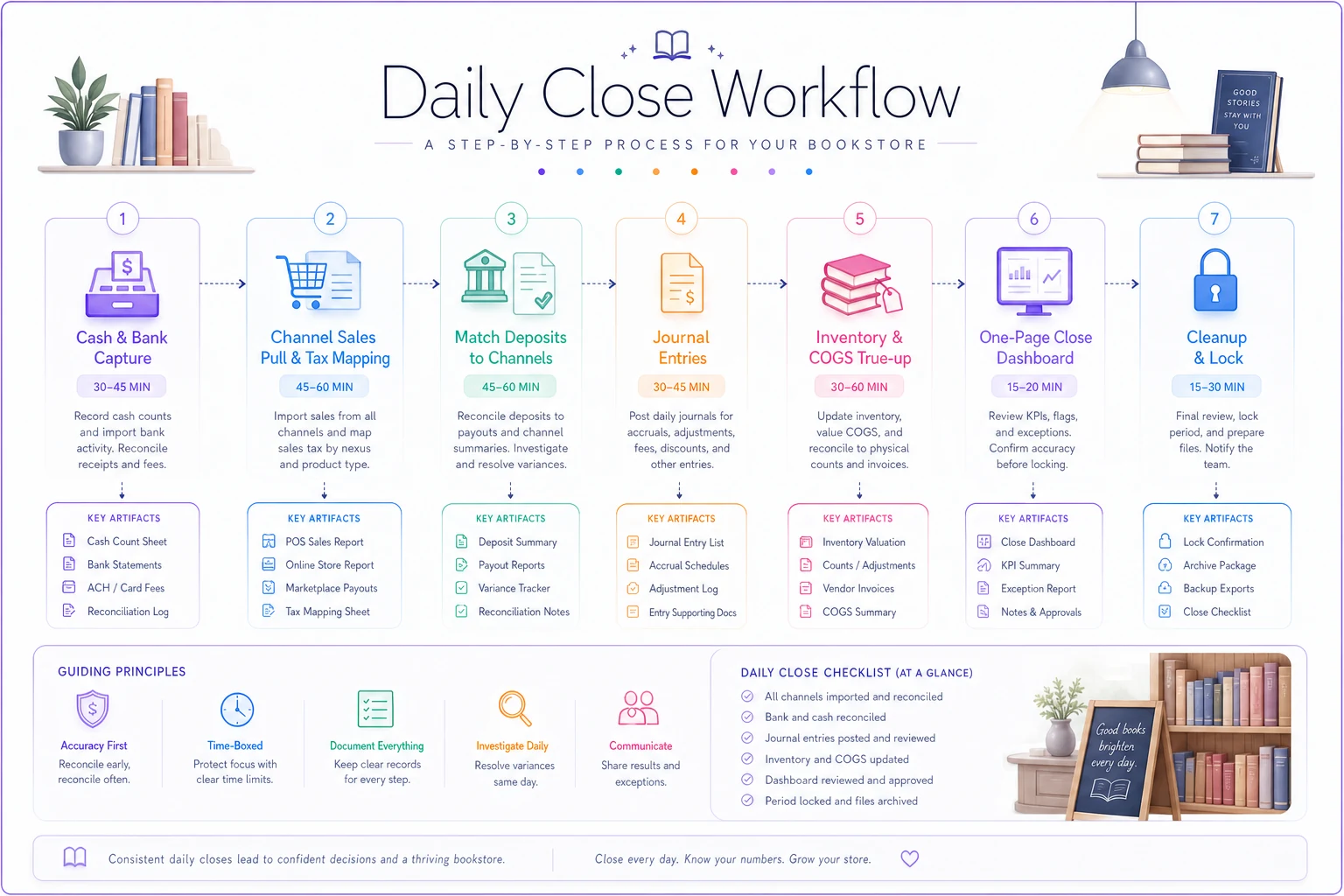
Time-box this hard. Match what matches in the window. Anything that won't reconcile in a few minutes goes on the cleanup list.
Block 4 — Journal entries (45–75 min)
With sales mapped and deposits matched, the entries are mechanical. Here's a sample month for a mixed-channel shop. Numbers are illustrative, but the structure is what you copy every month.
Entry 1 — Record in-store POS sales (you collect tax):
``
Debit   Cash / Undeposited Funds     8,420.00
  Credit   Retail Sales Revenue          7,795.37
  Credit   Sales Tax Payable               624.63
``
Entry 2 — Record Amazon marketplace sales (facilitator collects tax):
``
Debit   Amazon Clearing              2,140.00
Debit   Marketplace Fees Expense       385.00
  Credit   Marketplace Sales Revenue     2,525.00
``
(No sales tax line — Amazon already collected and remitted it. You still report the $2,525 as gross on your state return under marketplace-facilitated.)
Entry 3 — Record consignment payout owed:
``
Debit   Consignment Payable            612.40
  Credit   Cash                            612.40
``
Entry 4 — Record processor fees on direct card sales:
``
Debit   Merchant Fees Expense          268.15
  Credit   Cash                            268.15
``
Entry 5 — Cash in transit at month end:
``
Debit   Undeposited Funds / In-Transit   940.00
  Credit   Retail Sales Revenue             940.00
``
The pattern to internalize: every channel where you collect tax gets a Sales Tax Payable credit; every marketplace-facilitated channel doesn't. Fees always book as an expense, not a reduction of revenue — booking net revenue is how you lose visibility into what channels actually cost you.
Block 5 — Inventory & COGS true-up (45–60 min)
You don't need a full physical count every month — that's what a rolling cycle-count program is for. For the close, you're recording purchases and estimating cost of goods sold. Pull publisher and distributor invoices for the month, book them to inventory, then apply your COGS.
If you run a periodic system, use a standard cost ratio by category (new books at your average discount, used at your intake cost). If your per-order costing is already tight, this ties straight into the logic in the per-order margin waterfall worked spreadsheet — same cost layers, just aggregated to the month.
The common error is treating shipping-in and freight as overhead. Freight to get books onto your shelves is part of inventory cost. Roll it in or your margins will read better than they actually are.
Block 6 — The one-page close dashboard (30 min)
Everything above funnels into a single page you can read in two minutes. This is the deliverable that makes the close worth doing — not the ledger, the dashboard.
-
Total revenue (by channel)
-
Total COGS and blended gross margin %
-
Sales tax collected vs. sales tax owed (self-collected only)
-
Marketplace-facilitated sales (report-only)
-
Merchant + marketplace fees as % of revenue
-
Cash in transit (receivable rolling into next month)
-
Consignment payable outstanding
-
Operating cash balance vs. prior month
-
Top 3 open items on the cleanup list
Trended month over month, this page is where you actually catch drift — fee percentages creeping up, a channel's margin softening, tax payable that doesn't move in line with sales. It pairs naturally with the operational metrics in the KPI dashboard for avoiding overstock and blind discounting; one watches the money, the other watches the merchandise.
Block 7 — Cleanup & lock (30–45 min)
Now, and only now, you work the flagged items. The $4 cash difference, the deposit that won't match, the invoice with no PO. Give it a fixed block. Whatever survives becomes a reconciling item you carry forward with a note — not a reason to keep the month open.
Then lock the period. In most accounting software you can set a closing date that prevents backdated edits. Lock it. A month that stays editable is a month that stays wrong.
A copy-paste close checklist
Keep this taped to the wall or pinned in your close file:
-
[ ] All bank + merchant statements exported (Block 1)
-
[ ] Rough deposit-vs-payout tie-out done
-
[ ] Each channel mapped to gross / discounts / tax / fees
-
[ ] Marketplace-facilitated sales separated from self-collected
-
[ ] Deposits matched to channel payouts
-
[ ] Cash in transit recorded
-
[ ] Journal entries posted (sales, fees, consignment, COGS)
-
[ ] Freight-in rolled into inventory cost
-
[ ] Sales tax payable reconciled to self-collected sales only
-
[ ] One-page dashboard updated and compared to prior month
-
[ ] Cleanup list worked within its time box
-
[ ] Period locked with a closing date
Keep this taped to the wall or pinned in your close file:
A real scenario
A used-and-new bookshop with two staff was running its close across roughly two and a half weeks every month. The owner did it in scraps — an hour after closing, a Sunday afternoon — and it was never really finished. By the time the numbers were readable, buying decisions for the next month had already been made on gut.
The specific pain point: three separate months where they'd over-remitted sales tax because Amazon and Bookshop sales got lumped in with self-collected retail. The amounts weren't huge individually — somewhere around $180–$260 a month — but it added up. Worse, every tax return took hours to reconcile because the sales totals never tied out cleanly.
After building the channel-tax map and the block sequence, the close dropped to a single long morning plus a short cleanup block — about 6 hours the first month, closer to 4 by the third. The over-remittance stopped because facilitated sales were separated at the source. And the owner started making the next month's buying calls off a dashboard that was ready by the 4th instead of guessing.
Nothing about their revenue changed. What changed was that they finally knew their numbers on time, which is the entire point.
Where automation actually earns its keep
The manual version of this playbook works. But the two blocks that stay tedious forever are the exports (Block 1) and the deposit matching (Block 3), because they're pure data-shuffling that has to happen every single month in the same shape.
That's the natural place to lean on tooling. Scheduled exports, CSV transforms that normalize each channel's report into your four buckets automatically, and rules that pre-match deposits to payouts can knock an hour or two off the close without changing your underlying process. If you want the mechanics of setting that up, the retail automation blueprint with copy-paste CSV transforms and nightly jobs covers exactly the transforms that feed a close like this.
The key is automating the shuffling, not the judgment. The channel-tax mapping, the cleanup decisions, the read on your dashboard — those stay human. Automation just gets you to the interesting part faster.
When a same-day close makes sense — and when it doesn't
It makes sense when: you run one to three people, sell across a handful of channels, and mostly need timely, directionally-correct numbers to make buying and pricing decisions. That's the vast majority of indie shops.
It's a bad idea when: you're mid-audit, restructuring your chart of accounts, or you've let the books slide for six months. Don't try to time-box your way out of a backlog — clean up the history first, then adopt the cadence going forward.
Who should skip this entirely: if you already have a bookkeeper closing your books accurately by the 10th and you never look at the numbers to make decisions, your problem isn't close speed — it's that nobody's reading the output. Fix the reading habit before the process.
The whole idea here is small and stubborn: give the close a fixed shape, put a clock on every piece, and refuse to let one stray $4 discrepancy hold twelve months of decisions hostage. Do it three times and it stops being a chore you dread and becomes something closer to a monthly checkpoint you actually trust.