



The problem with holiday hiring at a bookstore isn't finding people — it's that someone hired on Tuesday needs to be useful by Saturday, and you don't have three weeks to shadow them. In a four-person store, one confused seasonal hire ringing up a gift receipt wrong or misdirecting a preorder pickup line does visible damage that day.
This is a compressed system: a pre-hire checklist, a two-hour onboarding you can run during a slow morning, quick-reference role cards, a two-week ramp, and a short QA audit so you catch mistakes before your regulars do. It's built for stores adding two to five seasonal people, not for chains.
Before they show up: the pre-hire checklist that saves you the first bad day
Most of the pain in bookstore seasonal onboarding comes from logistics you should have handled before the person arrives. Do these the day before, not the morning of.
-
POS login created and tested; decide permissions (returns/voids) in advance
-
Gift receipt and gift card button sequences written on one card
-
A named buddy assigned for every scheduled shift
-
Physical kit staged
apron, name tag, key lanyard, working pen, wifi password
-
Emergency basics documented
who to call for reader failures, fire exit, theft/return protocol
-
One printed store map using the customer-facing section names
The two-hour onboarding script
You don't have a full day. Run this script verbatim the first few times. It fits in two hours and focuses on what the hire actually needs to do on shift.
Minutes 0–15: The tour, but only what matters — register, customer-facing sections, bathroom, break area, receiving door, fire exit. Point out the day's buddy and set the rule: "Anything you don't know, ask them."
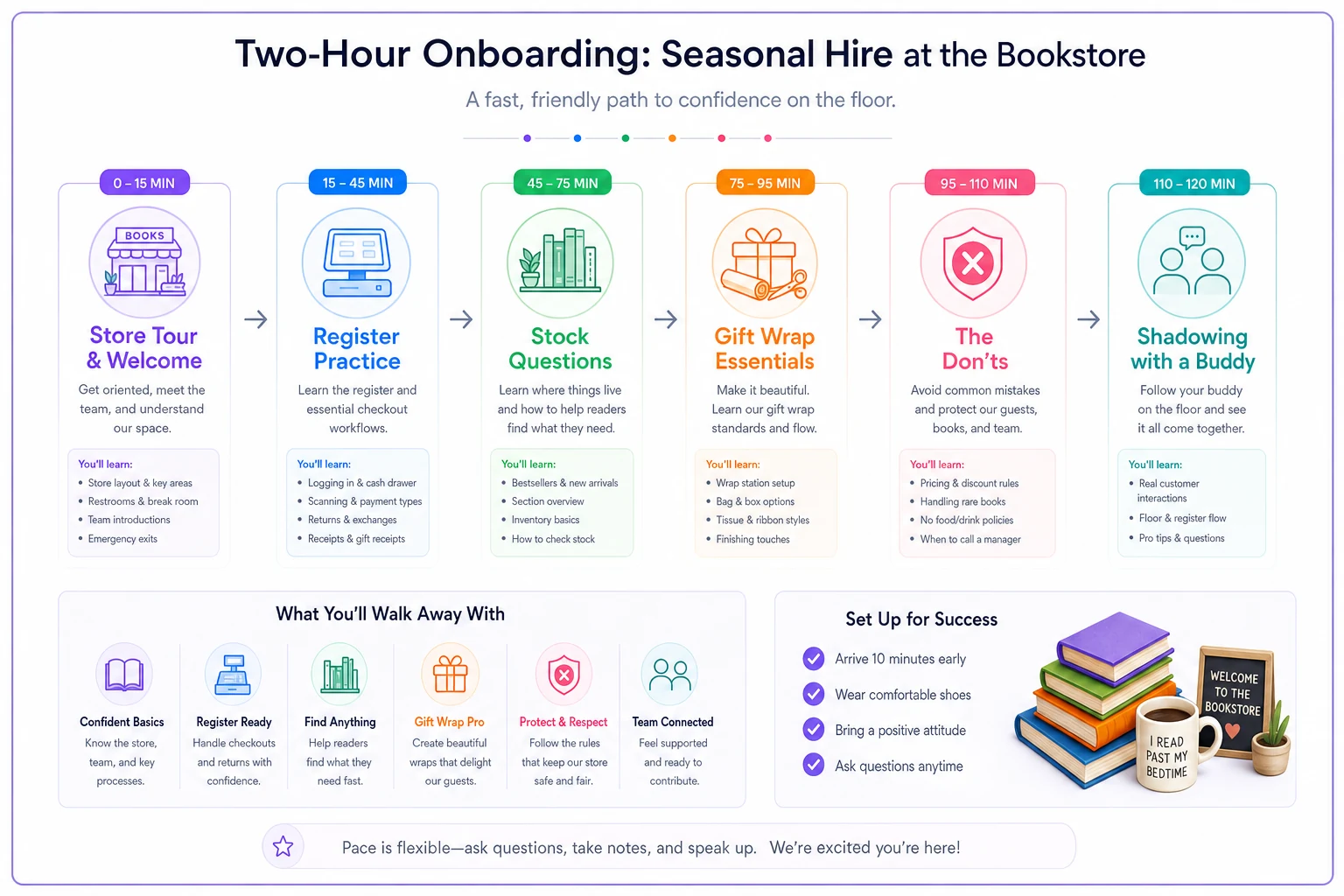
Minutes 15–45: The register, hands-on. Don't lecture the POS — have them ring transactions while you narrate.
-
Normal cash sale
-
Card sale
-
Sale with a gift receipt
-
Gift card purchase
-
Customer changed their mind
remove a line item
Make them do each transaction twice. Muscle memory beats explanation every time.
Minutes 45–75: The three questions they'll get all day — "Do you have this book?" (check stock), "Can you order it?" (special-order flow), and "Where's the [section]?" Walk the floor and quiz them.
Minutes 75–95: Gift wrap and holds — where supplies live, the standard for a gift-ready package, how the hold/pickup shelf is organized, and how to find a customer's held preorder.
Minutes 95–110: What NOT to do. Be explicit: don't process returns yet, don't promise stock you haven't confirmed, don't guess arrival dates, and don't discount on your own. Give them an exact fallback phrase: "Let me grab someone who can help with that."
Minutes 110–120: A live shadowing lap. Follow the buddy through three real customer interactions, then handle one themselves with the buddy watching.
Role-specific quick-reference cards
Print one card per role on card stock and clip near the relevant station. A glanceable card beats interrupting a coworker mid-rush.
Register / Front Card
-
Gift receipt
exact button path on card
-
Gift card sale
exact button path
-
Remove a line item
exact button path
-
Can't find price
scan first; if no barcode, ask buddy
-
Returns
do not process — call the named person
-
If line grows long
call for backup register
Floor / Customer Help Card
-
"Do you have it?" → check stock at terminal/handheld
-
Not in stock → offer to check ordering and get the buddy
-
Section not found → store map on back of card
-
Recommendation requests → refer to the genre expert on shift
-
Never promise a specific arrival date
Receiving / Restock Card
-
Put boxes in the designated receiving area, not on the floor
-
Check packing slip against box before shelving
-
Damaged items → set aside in the damage bin and flag the lead
-
Restock priority
front table > endcaps > main shelves
-
Preorders/holds → do NOT shelve; place in the hold area
The two-week surge plan, day by day
A structured ramp hands each hire slightly more responsibility each day and pairs naturally with your weekly shift templates. The surge plan below is a high-intensity, two-week layer over your normal daypart structure — see weekly shift templates for small bookstore teams for context.
| Day | Focus | Solo-capable by end of day? |
|---|---|---|
| 1 | Onboarding script + shadow register | No — always with buddy |
| 2 | Register with buddy 2 feet away | Simple cash/card sales only |
| 3 | Register solo on quiet dayparts, buddy nearby | Yes, off-peak |
| 4 | Floor help + stock lookups | Basic questions solo |
| 5 | Gift receipts + gift cards under light traffic | Yes, monitored |
| 6 (weekend) | First real rush, paired | No solo during peak |
| 7 (weekend) | Rush again, buddy on second register | Handles their own line |
| 8 | Holds/preorder pickups | Yes |
| 9 | Receiving + restock rotation | Yes |
| 10 | Full front solo, off-peak | Yes |
| 11 | Gift wrap volume + register combo | Yes |
| 12 (weekend) | Peak solo register, backup available | Yes |
| 13 (weekend) | Peak, minimal supervision | Yes |
| 14 | Full shift, QA audit run | Fully ramped |
Two notes: don't push new responsibilities onto someone for the first weekend rushes — use weekends to consolidate. And do a five-minute end-of-shift check-in each day: did they hit the milestone, or do they need another day?
Decision & KPI thresholds for solo readiness
Move hires to solo work using objective standards rather than gut instinct. The frameworks at Deputy, Agendrix, and Enboarder underline focusing on core tasks, milestone check-ins, and a dedicated buddy during early shifts: Downloadable New Employee Forms Template and New Hire Checklist, Retail Onboarding, Retail Employee Onboarding.
| Surge KPI | Example Target | Acceptance Rule | Action if Missed |
|---|---|---|---|
| Checkout Accuracy Rate | 98% clean rings across 25 sample transactions | Zero unassisted voids, gift-receipt price leaks, or unapproved discounts | Return to paired register shadowing for 1 shift; re-audit with buddy |
| Hold & Preorder Precision | 100% compliant pickup filing | Correct label, contact phone logged, and shelf placement matching our compact preorder SOP | Buddy conducts a 10-minute restock drill on the customer hold shelf |
| Escalation Compliance | 100% adherence to escalation boundary | Never process returns independently; always divert to our backroom returns workflow lead | Review role card boundaries during end-of-shift debrief |
To operationalize these benchmarks, download the Holiday Surge Pack — templates and script. The workbook includes printable RoleCards, a TwoHourScript sheet, a DayByDayChecklist with buddy sign-offs, a QA_Rubric with pass/fail thresholds, and Instructions for printing and customization.
The post-hire QA audit
Around days 10–14, spend twenty minutes running a quiet QA audit to catch gaps while there's still time to fix them. This is not a performance review; it's a systems check.
-
Pull five of their gift-receipt transactions and confirm formatting hides prices
-
Check the hold shelf
are items findable by the next person?
-
Spot-check three special orders for working contact info and no promised dates
-
Watch one live customer interaction to see if they escalate appropriately
-
Ask the buddy
"What do they still ask you about?" and "What would you not trust them with yet?"
If multiple hires trip on the same step, fix the materials first — three people making the same mistake usually means the card or script is unclear.
A real scenario
A two-register indie hired three seasonal people the six weeks before Christmas. The prior year they onboarded loosely and spent December fixing mistakes: gift receipts printed prices, preorders shelved into general stock, and a promised special order missed Christmas.
The following year they ran the two-hour script, the two-week ramp, and printed cards. Seasonal hires were solo on off-peak registers by day three instead of day eight, gift-receipt errors dropped to near zero, and the owner reclaimed six to eight hours a week previously spent re-doing new-hire work.
When this level of structure makes sense — and when it doesn't
This playbook fits a real surge: three or more seasonal bodies, six-plus weeks of elevated volume, and weekend rushes that stress register capacity. If that's you, the two hours upfront pays back on the first bad Saturday you don't have.
If you're hiring one experienced person for a light bump, run the register portion of the script and hand over the front card — skip the full ladder. Returning seasonal hires usually only need a fifteen-minute "what changed" briefing.
Keeping the whole thing repeatable
Write this down once — checklist, script, cards, ramp — so you don't rebuild onboarding from memory every year. A shared doc or lightweight ops tool ensures whoever's running the floor can give a new person the exact same setup.
Seasonal hiring isn't about finding great people for six weeks. It's about making an average, willing person genuinely useful by their third shift — without burning the hours you can't spare during the busiest stretch of the year.
If you're facing a holiday surge, invest two hours up front and a structured two-week ramp. It reduces owner rescue time, cuts common seasonal errors, and gets hires useful fast.