



The gap between “we sent it back” and “we got credited” is where indie bookstores quietly bleed money. A single uncredited $14 title is easy to miss, but repeated small losses across consignment and publisher returns add up to real dollars.
A bookstore consignment returns workflow isn't hard — it just requires that four systems (backroom labeling, RA tracking, POS, and accounting) actually agree. In most shops they don't, because each step is handled by a different person on a different day with no shared record. This guide is about fixing those handoffs.
Where the money actually disappears
Before the checklist, it helps to know exactly where credits go missing. The failure points are surprisingly consistent and mostly small, repeated mismatches rather than single dramatic errors.
1. The book physically leaves before it's logged. Someone boxes and ships returns and then plans to log them later — which often never happens. Inventory shows in-stock, but the books are gone and no pending credit is recorded.
2. Consignment and publisher returns get mixed in the same box. Publisher returns and consignment returns follow different money flows. When packed together, reconciliation can't tell which credit belongs where and consignment credits often vanish.
3. The RA number never gets matched to the credit memo. You requested an RA, shipped, then later see a credit memo. If no one links the credit to the RA, you can't prove or dispute shortages.
4. POS says one thing, the credit says another. The pull count and the vendor credit can differ by a few copies. Without a signed count tied to the shipment, you can't tell whether the vendor miscounted or the shop did.
The problem is almost never one big error. It's a drip of unmatched small quantities that nobody audits because auditing them individually feels like more work than they're worth.
The core idea: one record that travels with the box
The fix is a single return record created before anything physically moves, then followed through every system until a credit lands and matches. Think of it as a return passport that every checkpoint stamps.
Flow in plain terms: Backroom labeling → RA request → shipment → POS deduction → credit memo match → accounting entry.
Each arrow is a handoff and a potential failure point. The checklist below assigns timing windows and low-effort controls to each step, because timing — not vague instruction to “be careful” — is what keeps small teams honest.
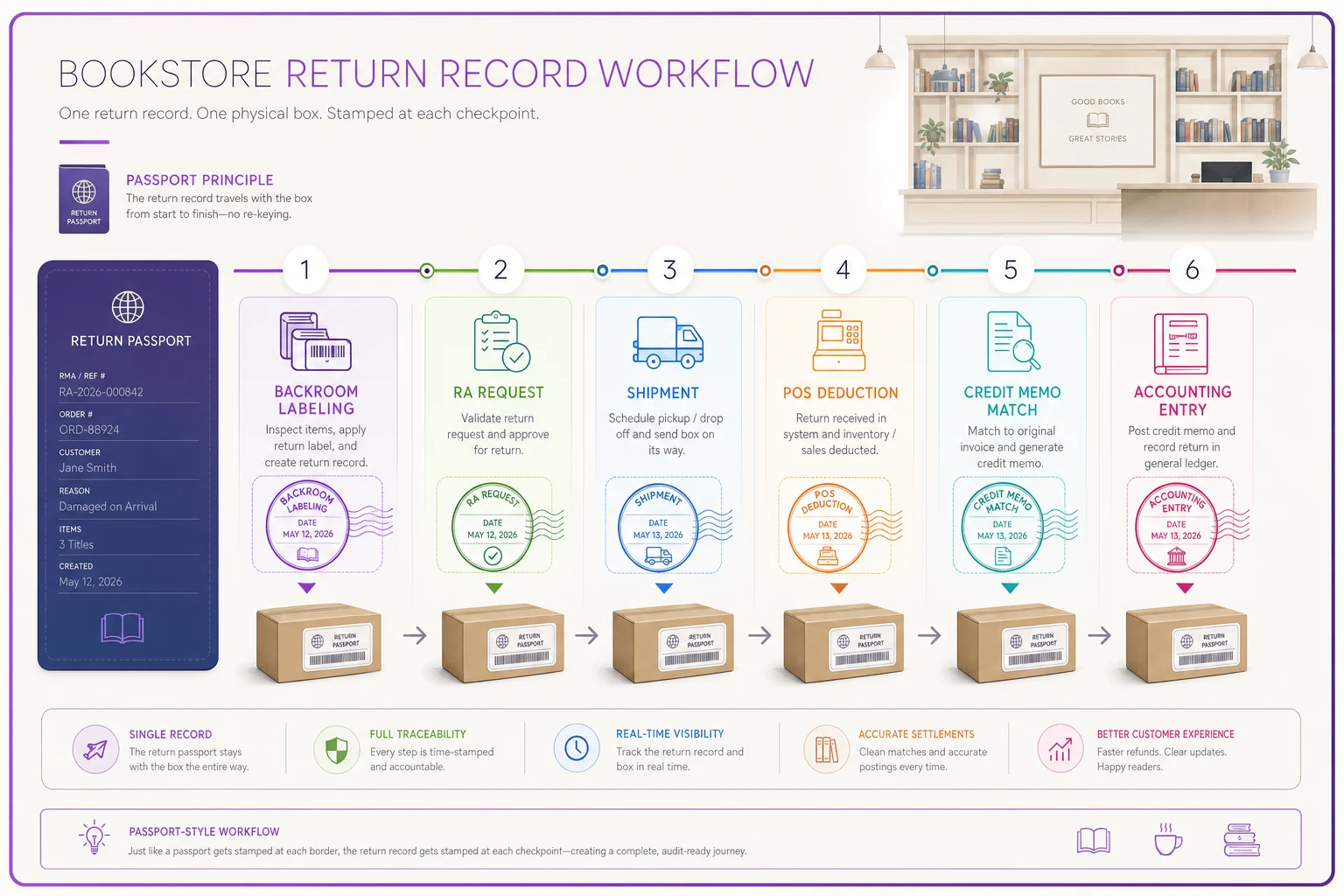
The end-to-end checklist
Step 1 — Create the return record before pulling anything (Day 0). Open one return log entry per shipment first. This is the passport. Minimum fields: Return ID, Vendor/consignor name, Return type (Publisher or Consignment), Date created, Expected RA number.
Low-effort control: No box gets taped until it has a Return ID written on the outside in marker. If there's no ID, the box doesn't ship.
Step 2 — Log every title as you pull it (Day 0). As books come off the shelf, scan or write them into the return record: ISBN, title, quantity, condition, and unit value (cost or agreed consignment cost). Do not mix publisher and consignment titles in one box.
Low-effort control: A quick count sheet taped to the box with two columns: title and quantity. Whoever packs signs the bottom; this becomes evidence when a credit is short.
| Return ID | ISBN | Title | Qty pulled | Unit cost | Line value | Condition |
|---|---|---|---|---|---|---|
| R-2025-014 | 978...203 | Local History of the Valley | 4 | $9.20 | $36.80 | Good |
| R-2025-014 | 978...517 | Poems for a Wet Season | 6 | $6.75 | $40.50 | Good |
| R-2025-014 | 978...889 | The Quiet Shelf | 3 | $8.10 | $24.30 | Shelf-worn |
Total expected credit: $101.60. Write that number down — it's what you'll compare against the vendor credit later.
Step 3 — Request and record the RA (Day 0–2). Get the RA before shipping wherever the vendor requires it. Enter the RA number into the return record next to the Return ID.
Timing window: RA requested within 2 business days of pulling stock. Low-effort control: Weekly 10-minute check of return records with titles logged but no RA number.
Step 4 — Ship and deduct from POS the same day (Day 2–3). Deduct inventory the moment the box leaves. Delays create phantom stock and oversells.
Low-effort control: Ship day = deduct day. Whoever hands the box to the carrier marks it shipped and updates the POS immediately.
Step 5 — Match the credit memo to the RA (Day 30–60). When a credit memo or settlement arrives, pull up the Return ID by RA number and compare line by line.
-
Did they credit every title?
-
Do the quantities match your signed pull sheet?
-
Do the unit values match the agreed cost?
Example: expected $101.60, credited $77.30 — $24.30 short, exactly the three shelf-worn copies. With a signed count sheet and condition notes, you can dispute precisely what is missing.
Timing window: Reconcile credits within 15 days of receiving the memo. Most vendors have a dispute window; miss it and shortages become permanent.
Step 6 — Post the accounting entry only after the match (Day 30–60). Post credits to books only after confirmation. Posting earlier bakes phantom credits into your P&L.
Low-effort control: The accounting entry references the Return ID. If the bookkeeper can't tie a credit to a Return ID, move it to a "needs research" list rather than posting it.
Exception escalation SOP for short or missing credits
When a vendor short-credits a shipment or a consignment settlement fails to arrive, resolve exceptions through defined ownership, clear escalation thresholds, and strict evidence before closing the record.
Follow structured returns authorization SOP standards and escalate according to role-based SLAs.
-
Store Associate / Receiver
log variances against the count sheet within 1 business day.
-
Inventory Lead / Buyer
gather evidence and submit a vendor dispute within 5 business days of memo receipt.
-
Store Manager / Bookkeeper
escalate stalled disputes after 14 calendar days or review variances over $250; coordinate ledger adjustments.
Required evidence checklist:
-
Return ID and vendor-issued RA number.
-
Signed backroom pull sheet showing pack date, title list, and unit counts.
-
Carrier proof of delivery (tracking confirmation or signed bill of lading).
-
Timestamped photo of packed contents and sealed exterior carton label.
Template 1: Vendor dispute email Subject: Credit Memo Discrepancy – RA #[Number] / Return ID [ID] – [Store Name] Hello [Vendor Claims Team], Credit memo [Memo #] reflects $[Amount Credited] for RA #[RA #], but our outbound shipment totaled $[Expected Amount]. We have an unresolved shortage of $[Discrepancy Amount] across [Title/ISBN, Qty missing]. Attached are our signed pull sheet, packing photos, and carrier delivery confirmation ([Tracking #]). Please issue an adjusted credit memo or provide receiving audit detail within 10 business days. Thank you, [Name] – [Store Name]
Template 2: Internal escalation note To: [Store Manager / Bookkeeper] Issue: Stalled Credit Dispute – [Vendor/Consignor Name] Return ID: [ID] | RA #: [RA #] | Disputed Balance: $[Amount] Age: [Days] days post-delivery (disputed on [Date]). Summary: Vendor credited [Qty/Amount] vs. expected [Qty/Amount].
The two failure timing windows to watch
Most gaps happen in two specific windows. Scan these weekly to catch most losses quickly.
-
The pull-to-ship window (Day 0 to Day 3)
logged but not shipped items.
-
The credit-to-reconcile window (Day 30 to Day 60)
credits received but not matched to a Return ID.
A weekly scan of "logged not shipped" and "credited not reconciled" takes about ten minutes and prevents more losses than end-of-quarter cleanup.
A real scenario
A mid-size college-town shop ran 8–12 return shipments a month across two distributors and local consignors. Their informal process — pack when there's time, jot titles on a sticky note, deduct from POS later — hid recurring losses.
When they audited a quarter, they found roughly $600–$700 in consignment credits never settled with local authors and about $400 in short publisher credits that were never disputed. That added up to roughly $4k a year in losses and strained relationships with authors.
After switching to the passport-style return record — one log per shipment, count sheet on every box, weekly scan of the two danger windows — missing consignment credits largely disappeared within two months. Short publisher credits still happened, but two-thirds of disputes were recovered because the shop had the count sheet.
The improvement came from creating the return record before the box moved, not from working harder.
When a formal workflow is overkill
If you process one or two returns a quarter and don't take consignment stock, this level of structure is unnecessary. A notebook line and a POS deduction will do.
It becomes worth the discipline when any of these are true:
-
You carry consignment stock from local authors or small presses.
-
You run more than a handful of returns per month.
-
Returns are handled by more than one person.
-
Credits routinely come back and you're not confident they're correct.
Consignment is the real trigger: publisher returns eventually appear on statements, but consignment credits often exist only in your records. If you don't track them, nobody does.
Where software quietly helps
You can run this workflow in a shared spreadsheet. Operational platforms earn their place by automatically flagging return records that are "logged but not shipped" past a threshold and surfacing credits that arrived but weren't matched to an RA.
AI-assisted tools help by pulling stalled items to the top of your list so nothing sits unreconciled for 60 days. The point isn't the tooling — it's the passport.
Create one return record before anything moves, make every checkpoint stamp it, and reconcile credits against the original count. Do that consistently and the gap between “we sent it back” and “we got paid for it” mostly closes on its own.