



Three months ago, a bookstore owner in Portland called me in tears. She'd just discovered that 47 customers who preordered Sally Rooney's new release never got their books — because her staff accidentally sold the reserved inventory to walk-ins on release day. The preorder deposits sat in their system, the customers kept calling, and she had to wait another two weeks for publisher restock while dealing with furious emails and social media complaints.
This wasn't a staffing problem or a training issue. It was a broken bookstore preorder workflow that made fulfillment mistakes inevitable.
After building operational systems for over a hundred independent bookstores, I've noticed that preorder fulfillment breaks down in predictable ways. The same mistakes happen whether you're handling 20 preorders a month or 200. Staff forget to check reservation lists before selling hot titles. Deposit amounts vary randomly depending on who takes the order. Publishers delay shipments but nobody tells the customers. Special editions get mixed into general inventory.
These mistakes multiply during your busiest seasons — exactly when you can't afford them.
Why bookstore preorders turn into operational chaos
Preorders seem straightforward until you watch them fail in real operations. A customer places an order, you take a deposit, the book arrives, you call them. Simple, right?
That's not how it actually works.
Your morning shift takes a $5 deposit for a $28 hardcover. Your evening shift requires 50% down for the same book because they follow different rules. One staff member writes preorders in a notebook behind the counter. Another enters them in your POS. A third uses sticky notes on the special orders clipboard. When the shipment arrives three weeks later, nobody can reconcile who ordered what.
Meanwhile, your publisher sends 18 copies instead of the 22 you ordered. Four customers prepaid in full, six left partial deposits, eight are on the "call when arrives" list with no money down. Your staff starts calling customers randomly, selling books to whoever answers first, while the fully-paid orders sit unclaimed because nobody flagged them as priority.
The cascade continues. A customer who paid in full watches you sell "their" book to someone else. Another customer insists they left a deposit but you have no record. A third never receives their limited edition because staff didn't know it needed special handling. Each mistake costs you twice — once in the immediate refund or discount you offer to apologize, and again in the customer trust you lose.
Small bookstores handle anywhere from 30 to 150 preorders monthly, depending on release schedules and local reading trends. During major releases — think Colleen Hoover or a new Britney memoir — that number can triple. Without clear reservation rules, each preorder becomes a potential fulfillment disaster.
The hidden costs of preorder mistakes
Every preorder error creates ripple effects through your operation. Let me walk through what happens when these systems fail.
Start with direct financial impact. When you mess up a preorder, you typically offer a 20% discount or store credit to apologize. On a $27 book, that's $5.40 gone. Multiply that by even 10 mistakes monthly and you're losing $650 annually just in apology discounts — not counting the original sale you missed.
But the real damage happens in customer behavior changes. Customers who experience preorder problems stop preordering. They wait for books to hit shelves, browse online instead, or worse — switch to Amazon's predictable fulfillment. One Portland store I worked with tracked this: customers who had preorder problems reduced their annual spending by roughly 40% the following year.
Staff morale takes a hit too. Nobody enjoys calling angry customers to explain why their book isn't ready. Your team starts avoiding preorder duties, leading to further delays. Good employees leave because they're tired of managing preventable problems. You spend more time mediating customer complaints than developing your business.
Then there's the inventory distortion. Those 47 mis-sold books from my Portland example? The owner panic-ordered replacements at rush shipping rates, eating her entire margin. But half the original customers had already bought elsewhere, leaving her with expensive overstock of a title that had already peaked.
The vendor relationships suffer next. Publishers notice when you repeatedly request emergency restock or expedited shipping. Your rep starts treating you as a problem account. Special edition allocations go to stores with cleaner fulfillment records. You lose early access to hot titles because publishers don't trust your execution.
Building a preorder SOP that actually works
After watching dozens of stores struggle with this exact problem, I've developed a compact system that eliminates 90% of preorder mistakes. It's not complicated — just specific rules that everyone follows.
Reservation Rules (Non-Negotiable)
-
Standard titles
30% deposit minimum
-
Special/limited editions
50% deposit minimum
-
Orders over $50
40% deposit minimum
-
Author-signed copies
Full payment required
Print these rules. Laminate them. Tape them to every register. No exceptions, no judgment calls. When customers push back, staff can point to the posted policy instead of making uncomfortable decisions.
The Three-List System
Forget notebooks and sticky notes. You need three distinct lists that never overlap:
-
List 1
Paid-in-full preorders (these ship/hold first)
-
List 2
Partial deposit preorders (these ship/hold second)
-
List 3
No-deposit notifications (these get called third)
Each list lives in a different color folder. Red for paid-in-full. Yellow for deposits. Green for notifications. When shipments arrive, you process red folders completely before touching yellow. This visual system works even during rushes when nobody has time to check computer systems.
Inventory Reservation Mechanics
Most stores miss this — you need physical reservation before digital tracking. When preorder inventory arrives:
-
Count total units received
-
Pull exact quantities for red folder (paid-in-full)
-
Physically separate these units into labeled boxes
-
Pull quantities for yellow folder (deposits)
-
Separate these into different labeled boxes
-
Remaining units go to shelf stock
Those reserved boxes stay in your back room with large signs: "PREORDER HOLD — DO NOT SELL." Only after physical separation do you update your POS to show reduced available inventory.
Vendor Follow-Up Cadence
Publisher delays kill customer trust, but most stores wait passively for updates. Instead, build a proactive check-in rhythm:
-
14 days before release
Confirm shipment schedule
-
7 days before
Verify quantities and tracking
-
3 days before
Final confirmation or delay notice
-
Release day minus 1
Arrival confirmation
Set calendar reminders for each checkpoint. When delays happen, you know immediately and can notify customers before they ask.
Laminate and tape the deposit rules to every register so staff can point to them when customers push back.
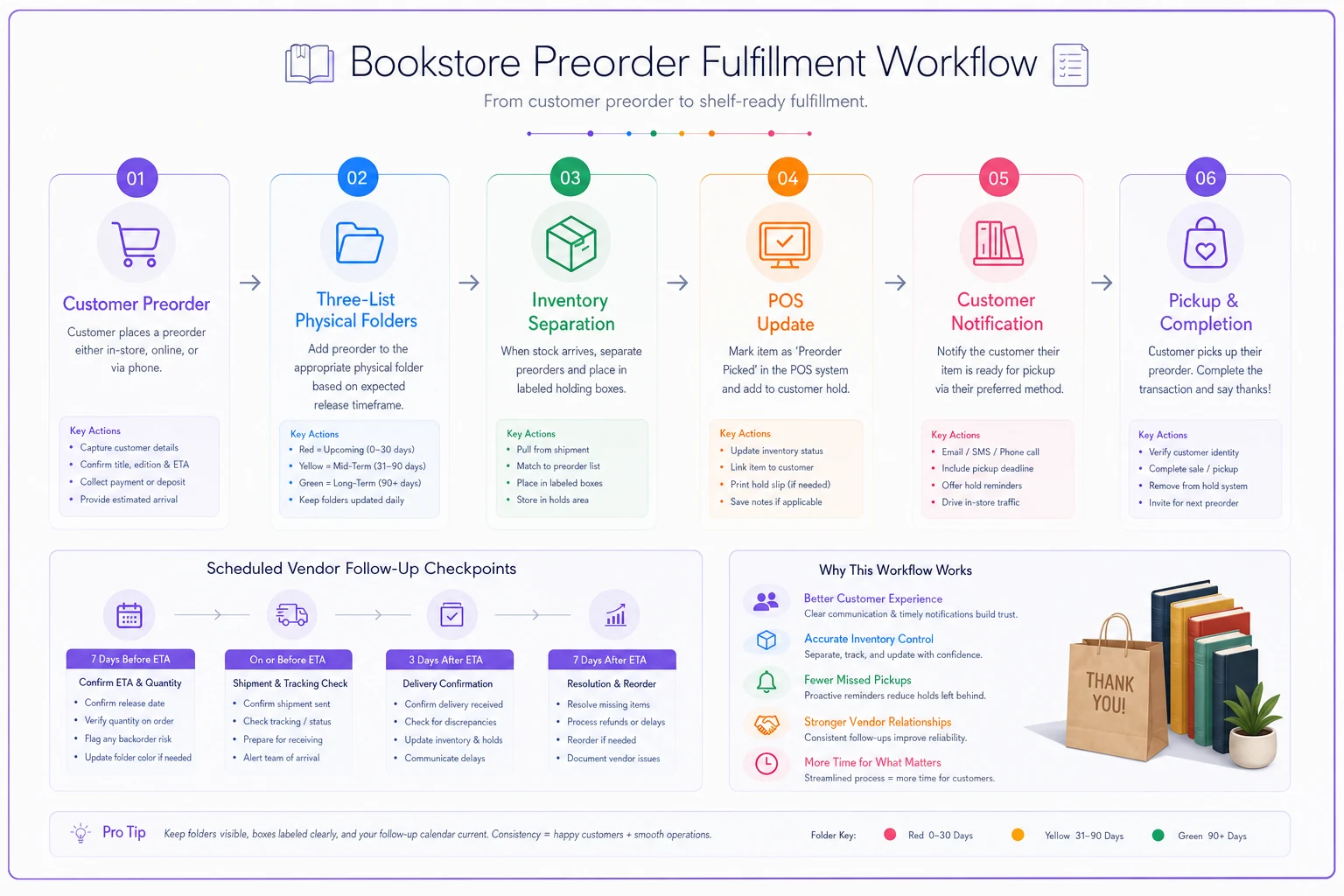
A quick visual of the workflow above to share with staff.
Customer notification templates that prevent anger
The difference between an understanding customer and an angry one often comes down to communication timing and tone. I've tested dozens of notification approaches across different bookstores.
The 48-Hour Rule
Never wait more than 48 hours after discovering a problem to notify affected customers. The longer you wait, the angrier they get. Even if you don't have a solution yet, send an update acknowledging the issue.
Delay Notification Template: "Hi [Name], Quick update on your preorder for [Title]. The publisher has pushed the shipping date to [New Date]. Your book is still reserved and will arrive approximately [Timeframe]. We'll text you the moment it's ready for pickup. Your deposit remains secure and we've added a 10% courtesy discount for the inconvenience."
Arrival Notification Sequence:
-
"Your preorder of [Title] has arrived! Please pickup within 7 days to maintain your reservation. We're open [Hours]."
-
"Friendly reminder
Your copy of [Title] is waiting! After day 7, we'll need to release it to our waitlist."
-
"Last day to collect your reserved copy of [Title]. After today, we'll process a refund and release to waitlist."
This escalation respects the customer while protecting your inventory turnover. Most customers appreciate the reminders rather than resenting them.
Problem Resolution Template: "We made an error with your preorder and take full responsibility. Here's how we're fixing it: [Specific solution]. As an apology, we're providing [Specific compensation]. This isn't our usual standard and we've updated our process to prevent this happening again."
Own the mistake, provide concrete resolution, offer fair compensation, indicate process improvement. Customers respect honesty over perfect execution.
When to codify vs when to stay flexible
Not every bookstore needs the same level of preorder structure. The system above works for stores handling 30+ preorders monthly with 2-4 staff members. But context matters.
You need strict codification when:
-
Multiple staff members take preorders
-
You handle more than 30 preorders monthly
-
You've had more than 3 fulfillment mistakes in the past quarter
-
Your preorders include high-value special editions
-
You're scaling up for a major release season
You can stay flexible when:
-
One person handles all preorders
-
You average under 15 preorders monthly
-
Your customers are primarily regulars who are forgiving
-
You only handle standard editions
-
Your community values personal service over strict process
I worked with a tiny bookstore in Vermont that handles maybe 8 preorders monthly. The owner knows every customer personally. She doesn't need color-coded folders — she needs a simple notebook and good relationships. But when Harry Potter illustrated editions launched and she suddenly had 80 preorders? She immediately implemented the full system above.
Stores try to "wing it" until problems force change. By then, you've already damaged customer relationships. Better to have structure you don't always need than scramble for solutions during crisis.
Real results from a structured preorder system
Riverfront Books implemented this exact workflow system.
Before implementation, they averaged 11 preorder mistakes monthly across roughly 85 total preorders. These ranged from wrong deposits collected to books sold from reserved inventory. Each mistake cost them $25-40 in discounts and refunds. Customer complaints consumed about 6 hours weekly of manager time.
| Riverfront Books implemented this exact workflow system. |
|---|
| Before implementation, they averaged 11 preorder mistakes monthly across roughly 85 total preorders. |
| Preorder mistakes dropped to 2 monthly (both from new staff still learning) |
| Customer complaints about preorders: zero in month three |
| Time spent on preorder management: down to 2 hours weekly |
| Unexpected benefit: preorder volume increased 30% as word spread about their reliability |
-
Preorder mistakes dropped to 2 monthly (both from new staff still learning)
-
Customer complaints about preorders
zero in month three
-
Time spent on preorder management
down to 2 hours weekly
-
Unexpected benefit
preorder volume increased 30% as word spread about their reliability
The owner told me the biggest change wasn't the error reduction — it was staff confidence. Her team stopped dreading preorder shifts. They knew exactly what to do, had clear escalation paths, and felt protected by documented policies when customers pushed boundaries.
The financial impact extended beyond error reduction. With reliable fulfillment, they started promoting preorders more aggressively. Their publisher sales rep noticed the improvement and increased their allocation of limited editions. Customers who previously ordered from Amazon came back because they trusted the store's process.
Technology that supports (not replaces) your workflow
A good bookstore preorder workflow relies on clear process first, technology second. But the right operational software can eliminate huge chunks of manual work while preventing human error.
Modern bookstore management platforms can automatically track deposits, send notification sequences, and flag inventory for reservation. Instead of checking three different lists and folders, your staff sees everything in one dashboard. When books arrive, the system already knows who paid what and in what order to fulfill.
Choose software that enhances your existing workflow rather than forcing you into rigid templates. AI-powered systems can now handle the routine communication — sending delay notices, pickup reminders, and availability alerts — while your staff focuses on customer relationships and special requests.
What matters most is that technology serves your process, not the other way around. Bookstores try to implement complex inventory systems before establishing basic reservation rules. It always fails. Get the human workflow right first, then layer in automation to reduce repetitive tasks and prevent mistakes.
Start with these three changes
If you're drowning in preorder problems, don't try implementing everything at once. Start with these three highest-impact changes:
Change 1: Standardize your deposit policy
Pick one deposit structure and enforce it starting tomorrow. Print it, post it, and don't allow exceptions. This alone eliminates half your reconciliation problems.
Change 2: Implement physical reservation
Before anything digital, physically separate preorder inventory from shelf stock. Use boxes, shelves, or even garbage bags — just keep them completely apart. Mark them clearly. This stops 80% of accidental sales.
Change 3: Create your three lists
Even if you use paper, separate paid-in-full from deposits from notifications. Process them in that order, always. This simple prioritization prevents your worst customer service disasters.
Give these changes two weeks to settle before adding more complexity. Your staff needs time to build new habits, and you need to see which problems persist versus which disappear immediately.
Preorder fulfillment doesn't have to be a recurring nightmare. The stores that implement even basic reservation structures see immediate improvement in customer satisfaction and operational efficiency. You don't need perfect systems — you need clear, consistent rules that everyone follows.
The bookstore preorder workflow outlined here isn't revolutionary. It's just organized common sense that prevents predictable problems. When you stop treating each preorder as a unique situation and start following repeatable process, the chaos disappears.
Your customers want to support independent bookstores. They choose you over Amazon because they value community and personal service. Don't lose them to preventable fulfillment mistakes. Build a simple system, stick to it, and watch your preorder program transform from operational burden to competitive advantage.
The compact SOP detailed above takes maybe two hours to implement and saves dozens of hours monthly in problem resolution. More importantly, it preserves the customer relationships that keep independent bookstores alive. Start with deposit standardization tomorrow. Add physical reservation next week. Within a month, you'll wonder how you ever operated without clear preorder structure.