


Most bookstore staff schedule templates treat your store like it runs the same way at 10am Tuesday as it does at 6pm Friday. They don't. Pretending they do is why you're constantly scrambling to cover the register while someone's trying to set up for tonight's author event.
After watching small bookstores struggle with scheduling across hundreds of different configurations, the pattern becomes obvious: stores under five people need completely different scheduling logic than bigger shops. When you've got 1-4 people total, every task needs an owner, every daypart needs coverage, and every event needs pre-planned support. Generic retail templates just create chaos.
The real problem isn't finding coverage—it's matching tasks to the actual rhythm of your bookstore's day. Morning shipment processing, afternoon customer rushes, evening events, weekend browsing crowds. Each needs different skills, different focus, different task priorities. When someone calls in sick, you need to know exactly which tasks can wait and which will tank your entire day.
Why standard retail schedules fail bookstores under 5 people
Traditional scheduling assumes you have enough people to separate roles. One person on register, one on floor, one processing, maybe someone on events. But in a 1-4 person bookstore, everyone does everything. Your morning person isn't just opening—they're processing returns, checking special orders, prepping the children's section for story time, and somehow trying to get through yesterday's receiving.
The breakdown usually starts around Wednesday. Monday and Tuesday, you're catching up from the weekend. By Wednesday, you're behind on receiving, the event calendar is getting tight, and no one's had time to update the staff picks display that's been showing the same books for three weeks. Thursday hits and you realize tomorrow's author event still needs chairs arranged, books pulled, and someone hasn't confirmed the refreshments order.
Standard templates don't account for bookstore realities. They don't understand that Tuesday morning receiving takes three times longer than Thursday receiving because publishers dump their shipments early week. They don't realize Saturday morning needs different coverage than Saturday afternoon because browsers arrive in waves tied to farmers market schedules or youth sports. They definitely don't factor in that your Wednesday evening book club prep overlaps with your Thursday morning school visit materials.
Breaking your day into actual bookstore dayparts
Bookstores don't run in simple "morning" and "evening" shifts. They run in dayparts tied to customer patterns and operational necessities. How most small bookstores actually flow:
Early morning (open to 11am): Low customer traffic, high operational focus. This is when receiving happens, special orders get processed, displays get refreshed. Customer interruptions are minimal, making it prime time for tasks requiring concentration.
Late morning (11am to 1pm): The lunch browser wave. People on break, parents after school drop-off, retirees doing their rounds. Register coverage becomes critical, but you can usually predict the rush within 15-minute windows.
Early afternoon (1pm to 3pm): The quiet zone. Perfect for event prep, online order processing, or that inventory count you've been putting off. Customer flow is sporadic enough that one person can handle floor and register while another focuses on back-office tasks.
Late afternoon (3pm to 6pm): After-school and after-work rush. Every person needs to be customer-facing. Tasks should be limited to quick hits—restocking, quick special order calls, five-minute display adjustments.
Evening (6pm to close): Event time or deep cleaning time. If you're running an event, everything else stops. If not, this is when you catch up on the physical maintenance that's impossible when customers are browsing.
Reserve early morning blocks for concentration-heavy tasks like receiving and processing when customer interruptions are lowest.
Each daypart needs different task priorities and different staffing intensities. Your bookstore staff schedule template should reflect these natural rhythms, not fight against them.
The task matrix that changed everything
One store owner in Vermont showed me something that transformed how I think about bookstore scheduling. Instead of scheduling people, she scheduled tasks first, then assigned people to task clusters. Her matrix:
Her matrix:
| Daypart | Must-Do Tasks | Nice-to-Have Tasks | Customer Density | Staff Needed |
|---|---|---|---|---|
| Open-11am | Receiving, returns, special order pulls | Display refresh, inventory counts | Low (5-10/hour) | 1-2 |
| 11am-1pm | Register, floor coverage, quick restock | Social media, email responses | Medium (15-20/hour) | 2 |
| 1pm-3pm | Online orders, event prep, deep cleaning | Section reorganization, staff picks | Low (8-12/hour) | 1-2 |
| 3pm-6pm | Full floor coverage, register, rapid restock | Nothing—all hands on customers | High (25-35/hour) | 2-3 |
| 6pm-close | Event support OR maintenance tasks | Inventory, display builds | Varies by event | 1-3 |
What makes this work is the "Customer Density" column. Once you track your actual customer flow for two weeks, you discover your store's real pattern. Maybe your lunch rush hits at 12:30, not noon. Maybe Saturday mornings are dead until 10:30, then explode. These patterns determine everything else.
The "Must-Do" versus "Nice-to-Have" split solves the sick day problem instantly. When someone calls out, you know exactly what to drop. Nice-to-haves can wait. Must-dos can't.
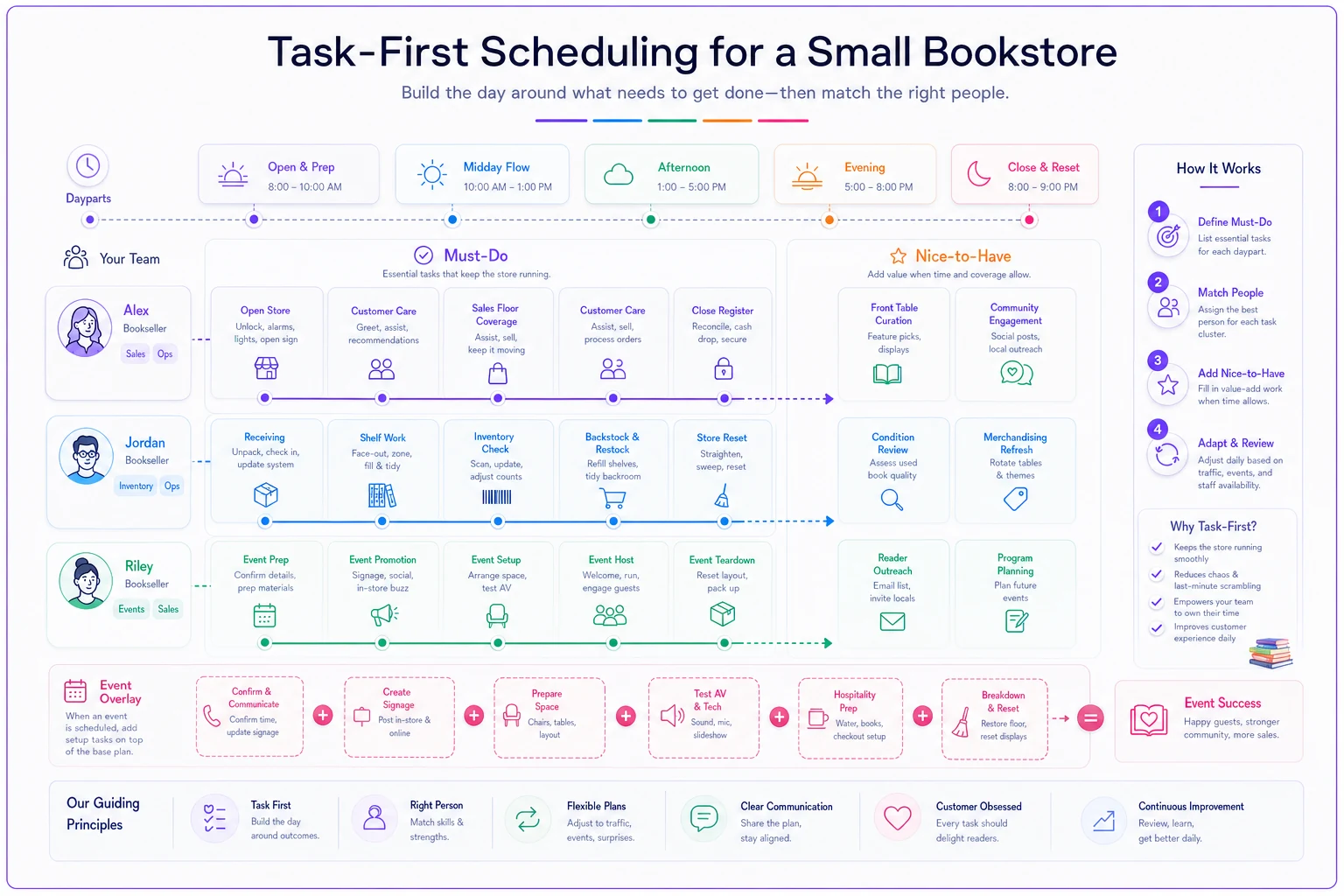
This visual shows how task clusters map to dayparts and where event overlays fit on top.
Event scheduling: the overlay that breaks most templates
Events complicate everything. A Thursday evening author reading doesn't just need coverage from 6-8pm. It needs:
-
Morning
Pull books for display, confirm author arrival time
-
Afternoon
Set up chairs, test microphone, arrange signing table
-
Pre-event
Final setup, brief staff on book talking points
-
During
Register coverage, crowd management, book running
-
Post-event
Breakdown, restock, process special orders
Most templates treat events like they happen in isolation. They don't. They ripple through your entire day's operations. Smart approach: create event overlays—additional task assignments that stack on top of your regular daypart schedule.
A 2-person store running a Thursday evening event might overlay like this:
-
Person A works 10am-6pm
handles normal morning tasks plus event book pulls and setup
-
Person B works 2pm-close
covers afternoon rush then transitions to event support
-
Both overlap 2pm-6pm
one preps while one covers floor
-
Person A leaves at 6pm unless event needs extra hands
-
Person B handles event and cleanup
This only works if your base schedule already accounts for task ownership. Person A knows they own morning receiving but can punt display refreshes when event prep takes priority.
Building your weekly template around predictable patterns
Every bookstore has a weekly rhythm. Monday receiving is heavy. Tuesday is special order day. Wednesday is newsletter day. Thursday is event prep. Friday is weekend display setup. Saturday is all-hands browsing chaos. Sunday is recovery and planning.
Your template should hardcode these patterns. What actually works for a 3-person bookstore:
-
Monday - Person A: 9am-5pm (receiving focus, register backup) - Person B: 12pm-8pm (afternoon coverage, display refresh)
-
Tuesday - Person A: 10am-6pm (special orders, customer service) - Person C: 11am-7pm (floor coverage, online orders)
-
Wednesday - Person B: 9am-5pm (newsletter, social media, receiving) - Person C: 1pm-9pm (afternoon rush, evening event if scheduled)
-
Thursday - Person A: 10am-6pm (event prep, register) - Person B: 2pm-10pm (event support, cleanup)
-
Friday - Person A: 11am-7pm (weekend display prep, customer service) - Person C: 12pm-8pm (rush coverage, restock)
-
Saturday - Person B: 9am-5pm (morning rush, children's section) - Person C: 10am-6pm (peak coverage) - Person A: 12pm-8pm (afternoon/evening coverage)
-
Sunday - Person B: 11am-5pm (light coverage, planning) - Person A: 12pm-6pm (recovery tasks, special orders)
Notice how each person gets roughly 32-36 hours but never works more than 5 days straight. The overlaps hit during predictable rush periods. Event nights are pre-planned into the structure.
The 1-person reality: task batching by day
Running solo changes everything. You can't overlap shifts because there's only you. Instead, you batch entire categories of tasks by day:
-
Monday
Store closed, full receiving and processing
-
Tuesday
Shortened hours (12-6pm), morning for online orders
-
Wednesday
Full hours, but "project day"—customers yes, but also displays
-
Thursday
Event prep day if evening event, otherwise inventory
-
Friday-Saturday
Pure customer service, minimal tasks
-
Sunday
Shortened hours, weekly planning and ordering
One owner in New Hampshire runs this exact schedule. She's closed Mondays, which locals now expect. Tuesday-Thursday she opens late (noon) to get operational tasks done in the morning. Weekends are full hours but task-light. The predictability means customers know when to find her and when she's focused on other work.
The 2-person sweet spot: overlapping ownership
Two people can create magic if they divide ownership clearly. Instead of both doing everything poorly, each owns specific zones:
-
Person A owns
receiving, special orders, publisher relations, morning operations
-
Person B owns
events, marketing, displays, evening operations
Their schedule overlaps during transition periods:
-
Both work Tuesday and Thursday afternoons (order handoffs)
-
Both work Saturday (peak coverage)
-
They alternate Sunday (recovery day)
This gives you 60-70 operational hours from 72 scheduled hours because the overlap periods are highly productive. Both people present means complex tasks get done fast.
Software that actually understands bookstore scheduling
Most scheduling software thinks all retail is the same. It's not. Bookstores need task assignment, not just shift coverage. They need event overlay capabilities. They need to track customer density patterns and adjust automatically.
The operational platforms that work best for bookstores let you define dayparts, assign task clusters, and create event templates that layer onto base schedules. They track who's certified for what (not everyone can process returns or run events). They show you coverage gaps in task terms, not just time terms.
More importantly, good scheduling software learns your patterns. It notices that Tuesday receiving takes 3 hours while Thursday takes 90 minutes. It recognizes that your Saturday 2pm rush needs two on register, not just two in store. It automatically adjusts when someone calls in sick, showing you which tasks to punt and which to prioritize.
The best systems integrate with your POS to pull actual customer traffic data. Instead of guessing that lunch rush hits at noon, you know it peaks at 12:45. Instead of assuming Saturday mornings need full coverage, you see that customers don't really arrive until 10:30.
Making the template actually work week to week
A template is only useful if you can adapt it to reality. The weekly adjustment process that works:
-
Thursday afternoon Review next week's events and deliveries. Identify any unusual patterns (holiday, local festival, author cancellation).
-
Friday morning Adjust the base template for identified variations. Add overlay tasks for events. Shift coverage if someone requested time off.
-
Sunday evening Final confirmation with staff. Everyone knows their Monday start time and primary tasks.
-
Daily Five-minute morning huddle to confirm day's priorities. Any task swaps needed based on yesterday's leftover work.
The stores that nail this spend maybe 20 minutes weekly on scheduling after the initial template is built. The ones that struggle spend hours every week recreating the wheel, usually in panic mode Sunday night.
Your downloadable templates and how to customize them
The templates need to match your specific reality. A bookstore next to a coffee shop has different morning patterns than one next to a school. An event-heavy store needs different overlay structures than a browsing-focused shop.
Start with the base template that matches your team size. Track your actual customer flow for two weeks—just tick marks on paper showing when customers arrive. Note which tasks actually take how long. Pay attention to which overlaps create productivity and which create confusion.
-
Adjust daypart boundaries to match your customer flow
-
Reassign tasks based on actual staff strengths
-
Build event overlays for your common event types
-
Create contingency plans for sick days
Most stores find their ideal template after about three weeks of adjustments. The first week reveals the major mismatches. The second week fine-tunes the overlaps. The third week usually nails it.
When task-based scheduling makes sense (and when it doesn't)
This approach works brilliantly for stores with 1-4 people because everyone must multitask anyway. Task ownership just makes the multitasking intentional instead of chaotic. It works especially well for stores with regular event schedules, clear customer patterns, and staff who want predictability.
It struggles in stores with highly variable traffic, constantly changing staff, or owners who prefer pure flexibility over structure. If your customer patterns are genuinely random, if your staff turns over monthly, or if you thrive on daily variety, stick with traditional coverage-based scheduling.
For most small bookstores though, the task-based approach solves the fundamental problem: too much to do, too few people, and no clear prioritization. When everyone knows what they own and when they own it, the daily scramble transforms into smooth operations.
From schedule chaos to operational rhythm
The stores that thrive with tiny teams don't work harder—they work with better systems. A good bookstore staff schedule template isn't about coverage, it's about ownership. It's about matching tasks to dayparts, building in event overlays, and creating predictable patterns your customers and staff can rely on.
Stop fighting your bookstore's natural rhythm. Stop pretending Tuesday morning is the same as Saturday afternoon. Stop scrambling when someone calls in sick because you don't know which tasks can wait.
Build a template that reflects reality: customer flow patterns, task clusters, event requirements, and the actual capabilities of your 1-4 person team. Adjust it based on real data, not wishes. Let software handle the complexity while you focus on what matters—creating a bookstore experience that keeps customers coming back.
The difference between barely surviving and smoothly operating isn't more hours or more people. It's better templates, clearer ownership, and systems that match how your bookstore actually runs. Start with the template, track the patterns, adjust based on reality. Within a month, you'll wonder how you ever managed without it.