



Most indie buyers don't think of their vendors as a portfolio. They think of them as a pile of accounts — three majors, a couple of regional wholesalers, a dozen small-press direct relationships, one or two sidelines suppliers, maybe a Christian or academic distributor if that's your niche. Each one gets managed in isolation, usually reactively, usually when something goes wrong.
That's the real problem. Not any single vendor. The lack of a system for looking at all of them together, on a schedule, with the same yardstick.
When a shipment arrives three weeks late during the holiday rush, you deal with it. When a wholesaler quietly drops your discount tier because your volume slipped, you find out months later on a margin report. When a small press you love goes dark on returns, you eat the dead stock. Each incident feels like a one-off. Across a year, they're a pattern — and that pattern is costing you real money and real shelf position. Bookstore vendor portfolio management is the discipline of treating those relationships as a managed set instead of a stack of invoices.
This article walks through how the whole thing connects: a scoring system that actually drives decisions, a quarterly review that takes an hour instead of a day, a decision tree for when to renegotiate versus substitute, and a credit-risk tracker so a distributor's financial trouble doesn't become your problem.
Why vendor risk hides until it's expensive
Vendor problems almost never show up as a single catastrophic event. They accumulate as drip costs that don't trip any alarm.
A vendor with a 92% fill rate instead of 98% doesn't send you a warning. You just quietly lose a handful of sales every month because the title the customer wanted never came in. A vendor whose average ship time crept from 3 days to 8 days doesn't announce it. You just notice your preorders feel tighter and your special orders generate more "where's my book" emails. A distributor stretching their own payables — a sign they're in cash trouble — looks totally normal from your side until the day they can't fulfill or they get acquired and your terms reset.
-
Margin reports, when your realized discount doesn't match your contracted discount
-
Customer complaints, when fill and speed problems become visible to the person at the counter
-
Cash flow, when terms quietly shorten or a credit you were owed never lands
The reason this hides so well is that no single vendor owns the whole P&L. You feel the blended result and can't easily trace it back to the account causing it. A scoring system fixes exactly that — it forces each vendor to carry a number you can compare and track over time.
The three-axis scoring system
Forget a 25-point rubric. Nobody maintains those. What holds up quarter after quarter is three axes, each scored 1–5, each weighted. The three that matter for a bookstore:
Never miss a sale or stock shortage again.
Bookstorely helps you manage inventory, orders, and customer relationships seamlessly.
- Integrated inventory tracking
- Customer purchase history
- Sales reporting & analytics
No credit card required
1. Terms — your economics with this vendor. Discount tier, payment terms (net 30 vs net 90), returns policy (full returnability, restocking fees, return windows), freight treatment, and co-op or marketing support.
2. Reliability — can they actually deliver. Fill rate, ship speed, order accuracy, backorder behavior, and how they communicate when something slips.
3. Margin impact — what this vendor does to your realized margin after everything. This is not the same as terms. A vendor with great nominal terms but high freight, frequent short-ships, and clunky returns can have worse real margin impact than a vendor with a lower headline discount.
| Axis | What it measures | Weight | Why that weight |
|---|---|---|---|
| Terms | Discount, payment, returns, co-op | 35% | Sets your ceiling margin, but a ceiling you don't always reach |
| Reliability | Fill rate, ship speed, accuracy | 40% | A great deal you can't depend on isn't a great deal |
| Margin impact | Realized margin after freight/returns/shorts | 25% | The reality check that catches "good on paper" vendors |
Reliability gets the heaviest weight on purpose. The most common scoring mistake is over-rewarding discount tier. A 46% discount that fills 88% of the time and ships in 9 days will underperform a 42% discount that fills 98% in 2 days — because the stockouts cost you sales you never see, and the slow ship ties up customer patience and your special-order labor.
How the composite works: score each axis 1–5, multiply by weight, sum, and you get a number between 1 and 5 per vendor. Anything under ~3.0 is a flag. Under 2.5 is a renegotiate-or-replace candidate. That single number is what makes the quarterly review fast — you're not re-litigating every detail, you're looking at which scores moved and why.
One note on scoring reliability honestly: pull the numbers, don't guess them. Fill rate is fillable lines received ÷ lines ordered over the quarter. Ship speed is order date to in-the-door, not the vendor's "shipped" notification. If you're already running per-order margin tracking, your realized margin number is sitting right there in the data.
Quarterly vendor review: a one-hour agenda
The review only works if it's boring and repeatable. Once a quarter, same agenda, scores updated beforehand so the meeting is about decisions, not data entry. Even a one-person shop benefits from blocking the hour and treating it like a standing appointment.
-
Score refresh (done before the meeting). Update the three axes for every vendor from the quarter's actuals. 15 minutes of data pulling, not in the meeting.
-
Movers. Which vendors moved up or down more than 0.3 points? These are the only ones that get real discussion time. A vendor steady at 4.2 doesn't need airtime.
-
Flags. Anyone under 3.0. For each, the question is narrow
renegotiate, substitute, or watch one more quarter?
-
Concentration check. What percent of your total buying went to your top vendor and top three? If one vendor is over ~40% of purchases, that's a risk line item regardless of how great they are.
-
Credit-risk scan. Any vendor showing financial-distress signals (covered below). Even one flag here gets a contingency note.
-
Decisions and owners. Every flag leaves the meeting with a decision and a date. No "let's keep an eye on it" without a specific metric and a review date.
The concentration check in step 4 is the one people skip, and it's the one that bites hardest. Over-reliance on a single wholesaler feels efficient — one invoice, one return process, predictable terms. Then that wholesaler changes ownership, resets your discount tier, or has a warehouse problem, and suddenly 45% of your buying is in chaos at once. Portfolio thinking means you're always a little diversified on purpose, even when it costs a point of discount to keep a backup relationship warm.
Block the hour on your calendar and treat the quarterly review as non-negotiable—it's the cheapest insurance against a surprise vendor crisis.
Here's the workflow in one picture.
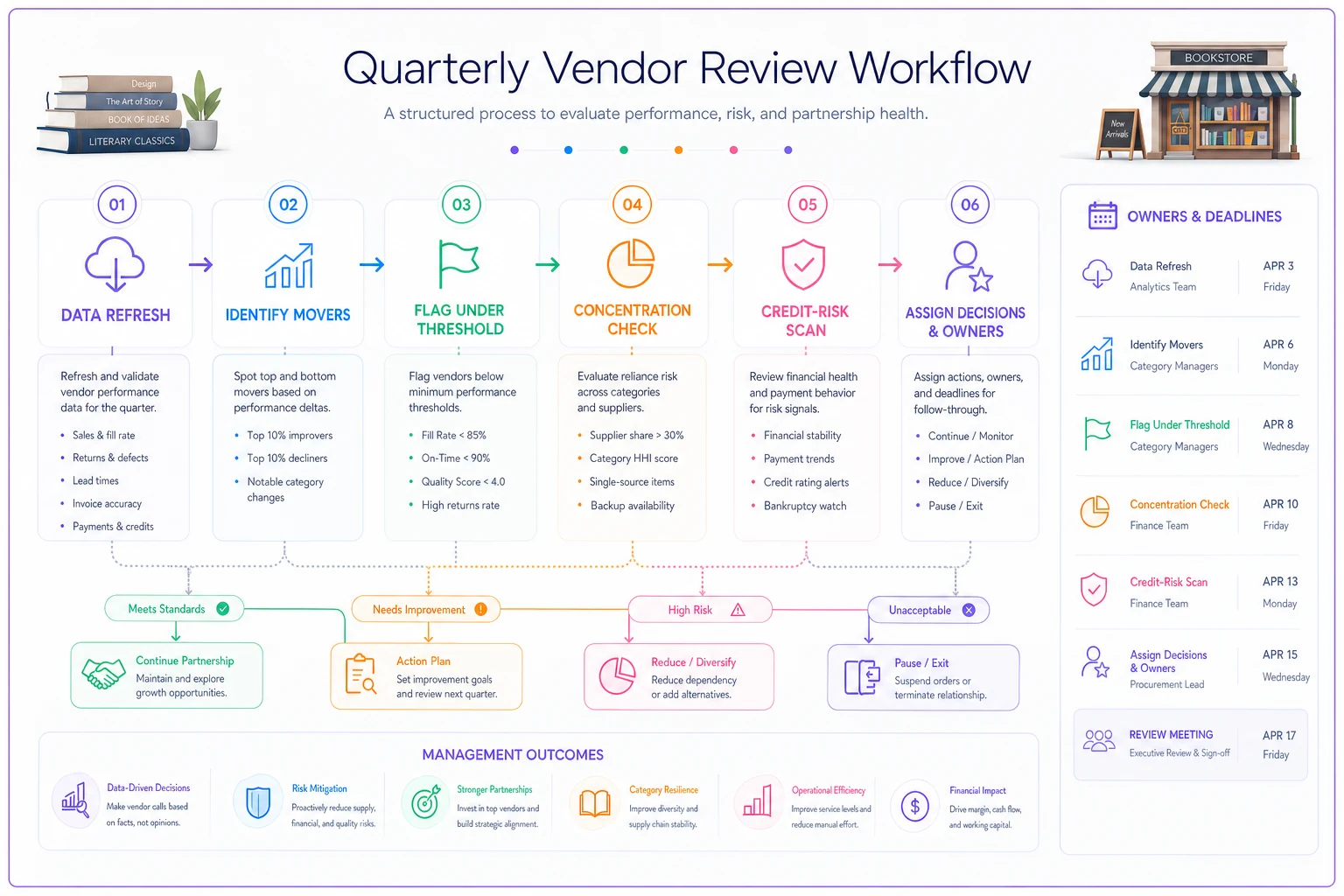
Keep the visuals simple: one lane per step, arrows for flow, and clear callouts for owners and timelines.
The renegotiate-vs-substitute decision tree
A low score tells you something's wrong. It doesn't tell you what to do about it. This is where most buyers freeze — they know a vendor is underperforming but switching feels disruptive, so they do nothing for another year.
Step 1 — Is the problem terms or reliability?
-
If it's terms (discount, payment, returns) → go to Step 2.
-
If it's reliability (fill, speed, accuracy) → go to Step 3.
Step 2 — Is this vendor's catalog substitutable?
-
Yes, substitutable (same titles available elsewhere at comparable or better terms) → you have leverage. Renegotiate from a position of strength, with a real walk-away. If they won't move, substitute.
-
No, unique catalog (small press, exclusive distribution, your niche depends on them) → renegotiate softly, because you can't credibly walk. Focus on the terms you can win — returnability, freight, or payment timing rather than headline discount. Our publisher terms negotiation scripts and partial-ship options are built for exactly this situation where walking isn't a real option.
Step 3 — Is the reliability problem fixable on their end?
-
Fixable and they're responsive (recent warehouse move, a staffing gap they acknowledge) → give one quarter with a specific target: "fill back above 95% by next review." Document it.
-
Chronic or they're unresponsive → substitute. Reliability problems don't respond to loyalty, and the drip cost of stockouts compounds.
The key discipline: you don't renegotiate without a walk-away, and you don't substitute without a replacement already identified. A renegotiation where the vendor knows you can't leave isn't a renegotiation, it's a request. And a substitution you haven't sourced is just a gap on your shelves.
When substitution is actually a bad idea
Switching vendors has real costs people forget to price in: re-onboarding a new account, rebuilding your ordering templates, re-learning their returns process, the risk of worse reliability from an unknown, and the relationship capital you lose with a vendor who might've been a backup later. If the score gap is under about half a point and the catalog overlap with alternatives is thin, the renegotiate-and-monitor path usually beats the disruption of switching. Substitution earns its cost when the score is genuinely low and a clearly better, sourced alternative exists.
Worked cash-impact example
Numbers make the decision concrete. Here's a realistic mid-size indie situation.
Say Vendor A is a regional wholesaler you run about $9,000/month through — roughly $108k a year. Headline discount is 44%. But this quarter their fill rate slipped to 90% and ship time stretched to 7–8 days.
-
Stockout cost The missing 10% of fill isn't just lost margin on those lines — it's lost sales. If even half those requested titles represent real demand you can't recover elsewhere, and your average sale carries ~$9 of margin, missing roughly 40–50 titles a month works out to somewhere around $1,800–$2,300 in margin a year walking out the door unseen.
-
Special-order labor Slow ship means more customer follow-up and more "is it here yet" handling. Call it an extra 3–4 hours a month of your or a staffer's time.
-
Realized vs headline margin Between short-ships you still paid freight on and slower inventory turns, your realized margin on this vendor is running closer to 40% than the 44% on paper.
Now compare the two decision paths:
| Path | Year-one cash effect | Notes |
|---|---|---|
| Do nothing | ~ -$2,000 to -$2,500 | Stockout + labor drip continues, margin stays depressed |
| Renegotiate (push for freight-paid + fill commitment) | ~ +$1,200 to +$1,800 swing | If they move freight and tighten fill, drip shrinks; onboarding cost = $0 |
| Substitute with a wholesaler at 43% but 97% fill, 3-day ship | ~ +$900 net after switch costs | Slightly lower headline discount, but stockout cost mostly recovered; ~$600–$800 one-time onboarding/learning cost |
The counterintuitive result: substituting to a vendor with a lower headline discount can still come out ahead, because reliability is worth more than the two points of discount you "lose." This is the exact blind spot the margin-impact axis is designed to catch. If you want to pressure-test numbers like these across your whole operation, our unified channel profitability model lets you see how a vendor change ripples through retail versus special-order versus event sales.
The credit-risk tracker
Vendor financial distress is the risk nobody scores until it's too late. If a distributor goes under or gets acquired, you can lose owed credits, see terms reset overnight, or lose supply mid-season. You can't audit their books, but you can track the signals that show up on your side of the relationship.
-
Terms creep. Are they quietly shortening your payment window or asking for prepayment on orders that used to be net 30? Cash-strapped vendors pull in receivables.
-
Returns friction. Credits taking longer to process, disputes on legitimate returns, "we'll look into it" that drags for weeks. Slow credits often mean they're short on cash.
-
Fill deterioration tied to backorders. Not a one-off, but a trend of "temporarily out" that stretches. Can signal they're not paying their own suppliers.
-
Communication changes. Rep turnover, slower email response, vague answers about restock timing.
-
Ownership or financing news. Acquisitions, leadership changes, anything you catch in trade press or from other booksellers.
Score each vendor green / yellow / red on these. A yellow doesn't mean drop them — it means reduce exposure and build a contingency. Trim how much you pre-pay, keep a backup source warm for their key titles, and don't let owed credits pile up unreconciled. If a vendor goes red: get your outstanding credits collected fast and cap how much they owe you going forward.
The pattern worth internalizing: the vendor most likely to leave you holding dead credits is rarely the one you're actively worried about on reliability. It's the pleasant, long-standing relationship where the credits just started taking a little longer and nobody connected the dots.
Where the system tends to break at scale
A two-vendor shop can manage this in their head. The stress shows up as you grow — more vendors, more channels, more volume — and the failure points are predictable.
Failure point one: the scoring data gets stale. When you had five vendors, updating scores was trivial. At twenty-five vendors across retail, online, special orders, and events, nobody's pulling fill rates by hand every quarter. The review degrades into gut-feel, which defeats the whole point. This is where keeping the underlying data clean — order records, receiving logs, realized margin by vendor — stops being optional. If your order and inventory records already track received-vs-ordered and landed cost, your scores basically compute themselves, and the quarterly review stays an hour instead of becoming a dreaded all-day data hunt.
Failure point two: concentration sneaks up. Growth often means leaning harder on your best, most reliable vendor because onboarding new ones is work. Then you wake up with half your buying in one account and no warm backups. The concentration check has to be a hard line in every review, not a someday-item.
Failure point three: the decisions don't get executed. The review flags three vendors; a quarter later all three are still flagged because nobody owned the follow-through. A review that doesn't end in dated decisions with owners isn't a review, it's a venting session.
A short real scenario
A mid-size indie — roughly 1,500 SKUs, around $420k in annual revenue — ran four wholesalers and about a dozen direct small-press accounts with no formal review. Vendor problems got handled as one-offs.
When they finally scored everything on the three axes, two things jumped out. Their largest wholesaler, at ~45% of total buying, scored a solid 4.1 — great vendor, dangerous concentration. And a mid-tier wholesaler they'd used for years scored 2.6, dragged down by a fill rate that had quietly slid to around 89% and credits that were taking six-plus weeks to process.
They ran the low-scorer through the decision tree: catalog was fully substitutable, problem was reliability, vendor was unresponsive about the fill slide. Substitute. They moved that volume — roughly $3,500/month — to a cleaner wholesaler at a slightly lower headline discount but 96%+ fill. On concentration, they deliberately shifted a sliver of the big wholesaler's volume to keep a second major relationship warm.
The payoff wasn't dramatic in any single line. Stockouts on special orders dropped noticeably, the six-week credit drag disappeared, and their realized margin ticked up maybe a point and a half across the affected volume. Call it somewhere in the $2,500–$3,500 range of annual benefit, plus a concentration risk they'd been carrying blind that was now managed. The bigger win was that the quarterly review became routine — vendor problems started getting caught at the "score moved 0.4" stage instead of the "we've got dead credits and a stockout crisis" stage.
Pulling it together
Vendor risk for an indie bookstore isn't really a vendor problem — it's a visibility and cadence problem. The individual issues are usually survivable. What compounds into real damage is never looking at the whole set of relationships together, on a schedule, with a number attached to each one.
The system has four moving parts and they reinforce each other: a three-axis score that makes vendors comparable, a quarterly review that turns scores into decisions, a decision tree that resolves the renegotiate-versus-substitute paralysis, and a credit-risk tracker that catches financial trouble you can't see directly.
Start with the scoring — even a rough first pass on terms, reliability, and margin impact will surface at least one vendor you've been carrying out of habit. The quarterly review only becomes fast and useful once your underlying data is clean enough that updating scores doesn't take half a day. That's the part most buyers underestimate. The system isn't the hard part; the discipline of keeping the data current is. Everything else builds from there.
Ready to elevate your bookstore’s operations?
Join 500+ bookstores using Bookstorely to boost sales, optimize stock, and delight book lovers.