

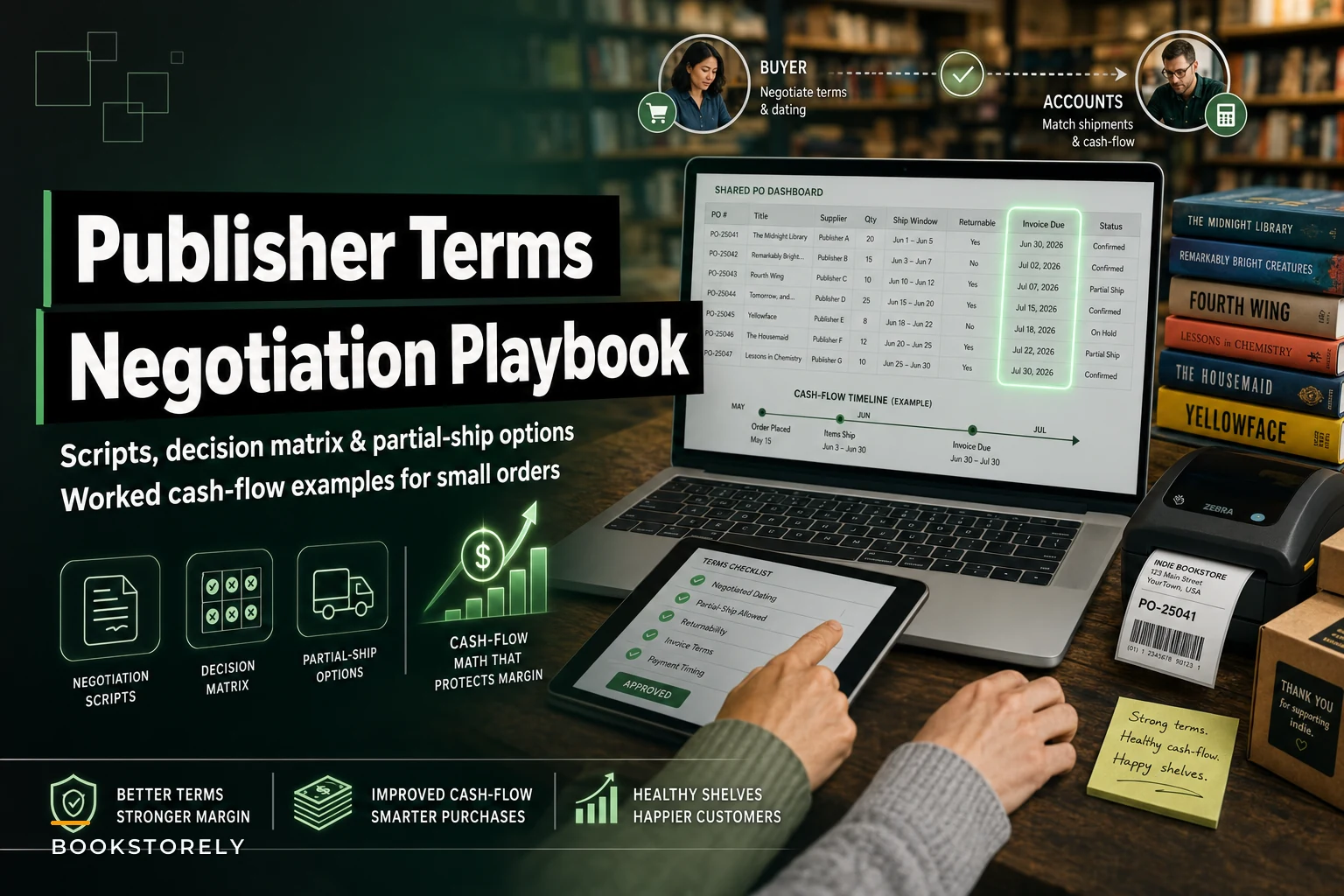

Most indie buyers negotiate discount percentage and then stop. They'll fight for 46% instead of 44% on a mid-list title, feel good about it, and completely ignore the three terms that actually move cash: dating, ship structure, and return handling. Those are the levers that decide whether a $2,400 opening order quietly strangles your March or sits comfortably until the books actually sell.
This is a playbook for the small-volume conversations — the 8-copy, 24-copy, 60-copy orders where reps have less incentive to bend but where a single bad term hurts you proportionally more than it hurts a chain buying pallets. You already know the discount ladder. What follows is how to talk about terms, what to trade for what, and the actual cash-flow math so you can decide in the moment instead of guessing.
The three terms that matter more than the discount
When a rep quotes you, there are usually four things on the table at once, and most buyers only hear the first one:
-
Discount — the percentage off list.
-
Dating / net terms — when the invoice is actually due (net 30, net 60, extended dating for seasonal).
-
Ship structure — all at once, or split shipments over time.
-
Returnability — fully returnable, non-returnable at a deeper discount, or consignment.
On small orders, an extra 2 points of discount on 24 copies is almost meaningless to your cash position, while 30 extra days of dating can be the difference between paying an invoice from cash you already have versus cash you're hoping to earn. Reps know discount is what buyers fixate on, so they defend it hard and give up dating easily — because dating costs their company almost nothing on a small line.
Flip your priority order. Concede a point of discount to get better dating or a split ship, and you usually come out ahead on cash even though it feels like you "lost" the discount fight.
Consignment vs. net terms vs. partial shipments — what each actually does to your cash
These three arrangements solve different problems, and buyers constantly reach for the wrong one. Consignment isn't "better terms" — it's a completely different risk transfer. Partial shipments aren't a discount, they're a timing tool. Here's the honest breakdown:
| Arrangement | What it protects | Real cost to you | Best for | Watch out for |
|---|---|---|---|---|
| Consignment | Cash + shelf risk (you pay only on sell-through) | Usually a worse effective margin; heavy reconciliation burden | Unproven local authors, event-driven stock, risky quantities | Credit tracking chaos — missing consignment credits eat the whole benefit |
| Net terms (extended dating) | Cash timing only | Nothing, if you actually sell within the window | Titles you're confident will move, seasonal front-loading | Paying full invoice on unsold stock when the window closes |
| Partial / split shipments | Overstock + cash timing | Slightly higher freight per shipment sometimes | Series, deep front-list buys, uncertain velocity | Reps "forgetting" the second ship; tracking split POs |
The one that quietly destroys value is consignment done sloppily. The margin hit only pays off if you have airtight tracking of what sold and what credit you're owed. If your backroom process for reconciling consignment is loose, you get the worse margin and lose credits — worst of both worlds. The workflow side of that gap is worth tightening before you ever expand consignment volume.
The workflow side of that gap is worth tightening before you ever expand consignment volume.
Scripts you can actually say out loud
Reps respond to specific, reasonable asks far better than vague "can you do better?" pressure. Here are the exact framings that work on small-volume orders.
When you want extended dating instead of more discount: > "The discount's fine. What I really need on this one is net 60 instead of net 30 — this is a spring title and I won't see real sell-through until April. Can we date the invoice to match when the book actually earns?" This works because you've given the rep an easy internal justification: seasonal timing. Reps can approve dating far more easily than an off-ladder discount.
When you're nervous about quantity but the rep wants a bigger commitment: > "I can commit to the full 60 if we split it — 24 now, 36 in six weeks. That way I'm not sitting on stock before the reviews land, and you still book the whole order." You're letting them count the full order while you protect your shelf. Most reps will take this because their number stays intact.
When you want to test an unproven or local title: > "For a first-time author with no track record here, I'd rather do this on consignment for the first batch. If it moves, I'll switch to firm terms on the reorder and go deeper." Framing consignment as a pathway to firm orders makes it a growth story for the rep, not a concession.
When freight is quietly killing a small order: > "This order's small enough that freight eats the margin. Can you either hit free-freight minimum by combining it with my next PO, or move me to net 45 to offset the shipping?" Notice the pattern in all four: you name the specific term, give the rep a reason that helps them justify it internally, and keep the ask narrow. Broad pressure gets "let me check." Specific, justified asks get "yes."
The cash-flow math, worked out
This is where the abstract becomes real. Three versions of the same order, so you can see what the term change actually does.
The order: 60 copies of a spring hardcover, list $28, at 46% off = $15.12 net cost per copy, total invoice $907.20. Assume you sell through over roughly 12 weeks.
Version A — Standard: full ship, net 30
-
Full $907.20 due in 30 days.
-
At 30 days you've realistically sold maybe 15–20 copies. Revenue in hand
around $420–$560 (at $28, minus nothing yet).
-
You're paying $907 out of pocket while roughly two-thirds of the stock is still unsold. That's the classic cash squeeze.
Version B — Split ship: 24 now / 36 in six weeks, net 30 each
-
First invoice
24 copies = $362.88, due in 30 days.
-
By day 30 on the first batch, you've likely sold most of those 24. The invoice is covered by actual sales.
-
Second $544.32 arrives only after early sell-through confirms the title works — and if it flops, you can cut or cancel the back half.
Your maximum cash exposure drops from $907 to about $363, and you get a real-world velocity read before committing the rest.
Version C — Full ship, net 60 (traded one discount point)
-
Say you gave back a point to get the dating
45% off = $15.40/copy, invoice $924.00.
-
But now it's due in 60 days. By day 60 you've sold roughly 35–45 copies = $980–$1,260 in revenue.
-
The invoice is fully funded by sales before it comes due. You paid $17 more in total cost to eliminate the entire cash-timing problem.
Look at what that $17 bought. In Version A you float $907 for a month out of your own working capital. In Version C you float nothing — the books pay for themselves before the bill lands. On a store doing dozens of these orders a season, choosing dating over that last discount point across the board is the difference between constantly scrambling for cash and having actual buffer.
When each move actually makes sense
Extended dating (net 60) makes sense when:
-
You're confident in sell-through and the delay in cash is your only real risk.
-
The title is seasonal and revenue is genuinely back-loaded.
-
You'd otherwise fund the order from a tight cash position.
Split shipments make sense when:
-
Velocity is uncertain and you want a read before going deep.
-
The rep is pushing a quantity larger than you'd choose on your own.
-
Shelf and backroom space is tight and you can't absorb 60 copies at once.
Consignment makes sense when:
-
The title has real downside risk — debut local author, niche topic, event tie-in.
-
You have the reconciliation discipline to track credits precisely.
-
You're using it as a stepping stone to firm reorders, not as a permanent crutch.
Who should NOT reach for these
Skip consignment entirely if your backroom credit tracking is shaky — you'll lose more in missing credits than you save in risk. Don't push for net 60 on fast-turning frontlist you'll sell in three weeks anyway; you're spending negotiating capital on nothing. And avoid split shipments on tiny orders where the second-ship freight wipes out the timing benefit. A 12-copy order split in half often isn't worth the extra shipping and the tracking overhead.
A short decision process for the moment you're on the phone
Before you dial, it's worth spending two minutes getting clear on what you actually need from this negotiation — because walking in without that usually means you default to fighting over discount and miss the terms that matter.
-
Ask
is my risk on this order about cash timing, or about whether it sells at all?
Timing → dating. Sell-through uncertainty → split ship or consignment. -
Check the order size. Under roughly 20 copies, favor dating (simple) over splits — the freight and tracking overhead usually isn't worth it.
-
Rank your asks before you speak. Decide what you'll trade — usually a discount point — and what you need to keep.
-
Name the specific term and give the rep an internal justification (seasonal, first-time author, freight minimum).
-
Confirm the second ship or the credit terms in writing on the PO. Verbal split-ship promises evaporate.
Confirm the second ship or the credit terms in writing on the PO to avoid verbal promises evaporating.
Work through this before every significant order, not during it, and the conversations get noticeably easier.
The tracking problem nobody warns you about
Every one of these arrangements adds a moving part. Net 60 means an invoice due on a different day than your other bills. A split ship means one PO with two delivery dates and two invoices. Consignment means tracking what sold, what's still on the floor, and what credit the publisher owes you.
Miss any of those and the benefit reverses. Pay a net-60 invoice at net 30 by accident and you gave yourself the squeeze you negotiated away. Forget the second half of a split ship and your reorder is late. Lose track of consignment sell-through and you're eating margin for nothing.
Here's a simple workflow to keep terms from slipping through the cracks.
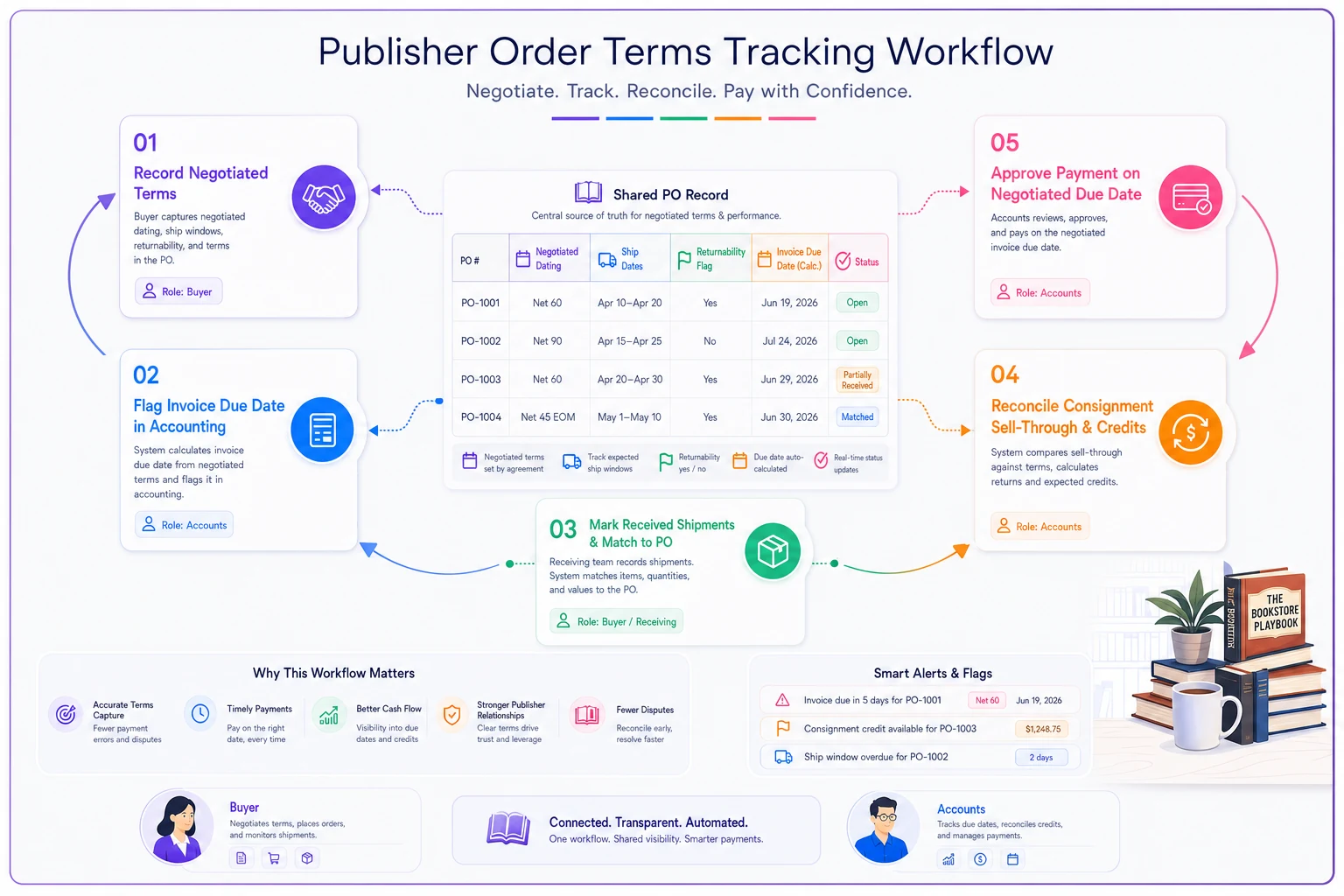
The fix is boring and it works: one place where every PO carries its own dating, ship dates, and returnability flags, with the due date calculated from those terms — not a default net 30.
Whether that's a shared sheet with disciplined columns or operational software that flags each invoice by its actual negotiated date, the point is that the terms you fought for only pay off if the system knows about them. This is the same discipline that keeps split preorders from collapsing into fulfillment nightmares — the negotiation is only half the job; the tracking is the other half.
Real scenario
A single-owner shop in a college town was doing roughly 30–40 publisher orders a season, all on standard net 30, full ship. Every February and September the owner hit the same wall — a stack of invoices due right when the new season's stock landed but before it sold. She was regularly floating $4k–$6k of unsold inventory out of a personal line of credit to bridge it.
The change wasn't dramatic. On the dozen largest seasonal orders, she started trading her last discount point for net 60, and split the three biggest speculative buys into 40/60 shipments. Nothing else changed — same titles, same reps, roughly the same total discount give-up of maybe $150–$200 across the whole season.
The cash picture shifted noticeably. Peak out-of-pocket exposure during the season openings dropped by more than half, and she stopped touching the credit line entirely for two seasons running. The books were funding themselves before the invoices came due. That $150-ish in "lost" discount bought her out of the annual cash scramble — which is the trade almost every small buyer should be making and almost none are.
Bringing it together
Discount is the term reps defend hardest and buyers obsess over most, and it's usually the least important lever on a small order. The money is in matching when you pay to when the books actually sell — through dating, split ships, or consignment — and then tracking those terms tightly enough that the benefit survives contact with your backroom.
Rank your asks before the call. Trade a discount point for timing without flinching. Name the specific term and hand the rep an easy reason to say yes. Write the real due dates and ship dates somewhere they can't get lost. Pair that with a steadier quarterly buying rhythm and the seasonal cash squeeze stops being an emergency and starts being something you planned around.