



Most indie stores don't have a used book problem. They have a used book system problem. The books come in fine. The grading kind of happens. Pricing gets guessed. Then the whole thing stalls somewhere between the receiving table and the shelf, and three weeks later there's a rolling cart nobody wants to touch.
The reason this keeps happening is that used inventory gets treated as a series of disconnected tasks — buy it, grade it, price it, shelve it — when it's actually a single lifecycle where every stage feeds the next. A book graded loosely gets priced wrong. A book priced wrong gets routed to the wrong channel. A book on the wrong channel sits, ages, and quietly turns your "circular economy" into a landfill with a spine-out display.
This piece is about the whole loop. Not tips. The actual system: how a used book should move from the front counter to cash, and where the money leaks at every handoff.
How intake, grading, refurbishment, resale routing, and lifecycle accounting connect into one profitable loop — instead of a pile of unpriced books in the back
Why the used book lifecycle breaks (and why it's worse than new-book operations)
New books are easy in one specific way: they're identical. Same ISBN, same condition, same cost, same margin math. Used books break every one of those assumptions. Two copies of the same title can have a $9 spread in value based on a bent corner and a name written inside the front cover.
That variability is the core challenge, and it compounds at three points:
-
Intake, where nobody has time to grade carefully during a busy trade-in
-
Pricing, where condition and demand have to be reconciled fast
-
Channel routing, where the same book is worth wildly different amounts depending on where you sell it
The failure usually looks the same: a store gets good at acquiring used stock — trade-ins, estate lots, library discards — and never builds the downstream system to move it. Acquisition scales linearly. Processing does not. So the backroom fills up, cash gets tied in inventory that isn't moving, and the owner starts thinking used books are "a hassle" when really the pipeline just has no plumbing.
Acquisition scales linearly. Processing does not. So the backroom fills up, cash gets tied in inventory that isn't moving, and the owner starts thinking used books are "a hassle" when really the pipeline just has no plumbing.
The five stages, and what each one owes the next
Think of the lifecycle as five stages that hand off to each other. If one stage does its job badly, the next stage inherits the mess — and usually can't fix it.
Never miss a sale or stock shortage again.
Bookstorely helps you manage inventory, orders, and customer relationships seamlessly.
- Integrated inventory tracking
- Customer purchase history
- Sales reporting & analytics
No credit card required
-
Intake standards — decide what you accept and what you reject at the door
-
Grading rubric — assign a consistent condition grade
-
Grading-to-price matrix — convert grade + demand into a shelf price
-
Refurbishment SOP — decide what's worth fixing and fix it consistently
-
Resale-channel decision — route each book to where it earns the most, net of fees
-
Lifecycle accounting — track whether the whole thing is actually profitable
The mistake most stores make is starting at pricing. Pricing is stage three. If your intake and grading are sloppy, no pricing model saves you, because you're pricing garbage data. Fix the front of the line first.
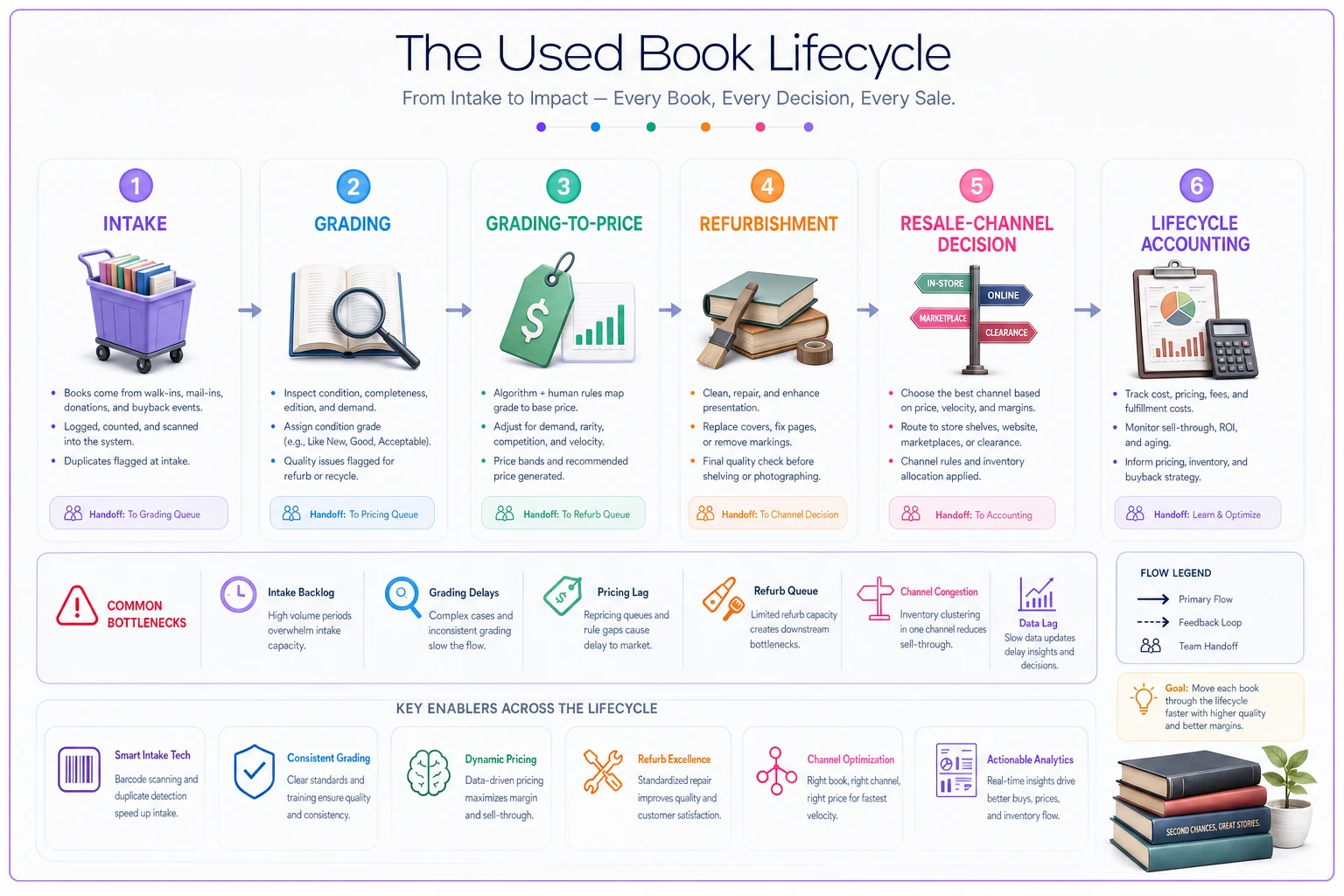
A simple visual of the five-stage handoff helps teams see where bottlenecks form.
Stage 1: Intake standards (the cheapest place to say no)
The single most profitable decision in the whole used-book operation is what you refuse. Every book you accept costs you handling time, shelf space, and eventual markdown risk — even if you paid $0 for it in a donation.
A workable intake standard has three gates:
-
Hard rejects (never take)
water damage, mold/mildew smell, missing pages, ex-library with heavy stamping in low-demand categories, mass-market paperbacks in bulk with no local demand.
-
Conditional accepts (take only if the title is a proven mover)
highlighting, cracked spines, cover creasing — fine for a $30 in-demand textbook, not worth it for a $2 novel.
-
Clean accepts
gradeable, resaleable, and in a category you actually turn.
The part most stores miss: your intake standard should be tied to your sell-through data, not to sentiment. A category that takes 400 days to sell doesn't deserve loose intake rules. If fiction paperbacks sit forever, your intake person should be rejecting all but the cleanest, most-wanted titles — while your local-history section might warrant accepting rougher copies because they're scarce and they turn.
Most stores run the opposite standard by accident: strict on the stuff that sells, generous on the stuff that doesn't, because saying "no thanks" to a regular's donation feels rude. That politeness has a real cost, and it's sitting on your bottom shelf.
Stage 2: The grading rubric (consistency beats accuracy)
You don't need the world's most precise grading scale. You need one that any staff member grades the same way on a Tuesday afternoon. Consistency is worth more than nuance, because inconsistent grading destroys your pricing model and torches your online reputation when a "Very Good" book shows up looking Fair.
A practical five-tier rubric that maps cleanly to how buyers actually think:
| Grade | Definition | Typical price factor* | Online-safe? |
|---|---|---|---|
| Like New | No visible wear, unread appearance, tight spine | 0.55–0.70 of new | Yes |
| Very Good | Minor shelf wear, clean pages, no markings | 0.40–0.55 of new | Yes |
| Good | Reading wear, small blemishes, maybe a name inside | 0.25–0.40 of new | Yes, with honest photos |
| Acceptable | Heavy wear, tanning, some markings, still complete/readable | 0.10–0.25 of new | In-store or bargain only |
| Reject/Recycle | Damage, incomplete, odor | — | No |
\*Price factor is a starting anchor, not a rule. Demand overrides it — more on that next.
The discipline that makes this work: grade to the worst visible flaw, not the average. A book that's Like New except for a cracked spine is a Good, not a Very Good. Staff naturally want to grade optimistically — and that optimism is exactly what generates return complaints on marketplaces. Train to the flaw.
Worth building in: a five-point physical checklist at the grading station.
-
Spine
tight or cracked?
-
Corners
sharp or bumped?
-
Pages
clean or marked/highlighted?
-
Cover
crisp or creased/scuffed?
-
Smell/moisture
neutral or off?
Any single "bad" answer drops the grade a tier. It sounds rigid. That's the point — rigid is repeatable.
If you want the station-level version of fast grading and cataloging so intake doesn't clog, we broke that down in detail in the fast used-book intake grading and cataloging checklist.
Stage 3: Grading-to-price matrix (where grade meets demand)
Grade alone doesn't set price. Grade × demand does. A Good copy of a title people are actively searching for is worth more than a Like New copy of a book nobody wants. This is where a lot of stores leave money on the table in both directions — overpricing dead titles and underpricing hot ones.
The workable model is a two-axis matrix:
Axis 1 — Grade (Like New → Acceptable)
Axis 2 — Demand tier (Hot / Steady / Slow / Dead)
You figure out demand tier from three signals you probably already have: how fast the category turns in your own store, comparable listing counts and prices online (lots of cheap copies = weak demand), and local or seasonal pull like regional authors, course adoptions, or event tie-ins.
| Grade / Demand | Hot | Steady | Slow | Dead |
|---|---|---|---|---|
| Like New | Max anchor, hold firm | Full anchor | Anchor −15% | Don't accept |
| Very Good | Full anchor | Anchor −10% | Anchor −25% | Bargain bin |
| Good | Anchor −10% | Anchor −20% | Bargain bin | Recycle |
| Acceptable | Bargain bin | Bargain bin | Recycle | Recycle |
The pattern worth noticing: as you move toward the bottom-right, the matrix stops trying to extract value and starts trying to clear the book. That's deliberate. The worst financial outcome isn't selling a book cheap — it's a $4 book occupying a shelf slot for 500 days while blocking a $15 book that would've turned in a month. Space is your scarcest asset. Price the dead corner aggressively and mean it.
Stage 4: Refurbishment SOPs (when a little work pays, and when it's a trap)
Refurbishment is seductive because it feels productive. But most refurb work is a net loss once you count labor. The rule is simple: only refurbish if the grade uplift × price factor exceeds the labor cost of the work, with some margin to spare.
Things that reliably pay:
-
Removing loose price stickers and residue (two minutes, can move Good → Very Good on a clean book)
-
Light dusting/wiping covers
-
Erasing pencil marks in an otherwise clean, in-demand title
-
Replacing a torn dust jacket with a protective cover on a collectible
Things that almost never pay on general stock:
-
Repairing cracked spines
-
Trying to flatten water-warped pages
-
Deep cleaning cheap paperbacks
-
Any repair on a Dead-demand title, ever
When refurbishment actually makes sense
On scarce, high-value, or collectible titles — first editions, out-of-print regional books, signed copies. Ten minutes of careful work (mylar jacket, gentle cleaning) can add real dollars because the ceiling price is high enough to justify it.
When it's a bad idea
On common stock in slow or dead categories. If there are 200 cheap copies online, no amount of refurb changes the economics. Recycle it, donate it, or bargain-bin it and move on. Refurbishing a book you'll price at $3 is a hobby, not an operation.
The SOP itself should be a single laminated card at the refurb station: a quick-decision flow of "Is this title Hot or collectible? If no → clean-only or recycle. If yes → follow refurb steps." That one gate stops staff from lovingly restoring $2 novels for 20 minutes each.
Stage 5: The resale-channel decision tree
Same book, different channel, different profit. This is the most under-managed part of the used lifecycle in indie stores, because "put it on the shelf" is the path of least resistance — even when the book would earn twice as much online, or half as much and should just be cleared out entirely.
The channels most stores actually work with:
-
In-store shelf — low fees, but consumes floor space and depends on foot traffic
-
Online marketplace — wider audience, but fees, shipping labor, and grading-complaint risk
-
Bargain bin / sidewalk cart — near-zero handling, clears volume, tiny margin
-
Donate / recycle — negative or zero value, but frees space immediately
A working decision tree runs top to bottom and stops at the first "yes":
-
Is it collectible or scarce (high ceiling)? → List online with full photos and an honest grade. These carry the online channel's fee and labor cost easily.
-
Is it a Hot/Steady local-demand title in Very Good+? → Shelve it in-store. Foot traffic sells these without much effort.
-
Is demand Steady but you already have shelf copies? → List online to avoid dead stock.
-
Is it Good/Acceptable in a Slow category? → Bargain bin. Don't waste online labor on it.
-
Dead + Acceptable, or failed intake later? → Donate/recycle. Reclaim the slot.
Something buried here that actually matters: online is not automatically the "best" channel. Marketplace fees plus pick-pack-ship labor can eat $3–$5 of effective cost per order. On a $6 book, that's the whole margin. Online should be reserved for books where the price justifies the handling — which is exactly why grading and demand tiering upstream matter so much. If the earlier stages are sloppy, you can't route intelligently here.
Lifecycle accounting: is any of this actually making money?
Most stores never actually know if used books are profitable, because they only track the sale — not the cost of processing. And processing is where used-book profit quietly dies.
A real per-unit lifecycle cost includes:
-
Acquisition cost (cash or trade credit given)
-
Grading + cataloging labor
-
Refurb labor (if any)
-
Shelf/storage carrying time
-
Channel cost (fees, shipping, packing)
-
Eventual markdown or write-off on unsold copies
Track this at the batch level, not per book, or you'll go insane. Grade a lot of 80 estate-sale books, log the total acquisition and processing time, then track what that batch nets over 90 days. The batch view tells you the truth: which sources, categories, and channels actually pay.
For the mechanics of pulling apart what a single sale really earns after every deduction, the per-order margin waterfall spreadsheet walks through the exact line items so nothing hides.
A useful rule of thumb from stores that actually run this well: if a used-book batch isn't cash-positive within roughly 90–120 days, your intake standard for that source or category is too loose. The accounting isn't just a report — it's the feedback signal that retunes stage one.
A short real scenario
A two-person store in a college town was drowning in trade-ins. Somewhere between 60 and 90 books came in weekly, and the backroom held well over 1,200 ungraded books at any given time — a wall of "we'll get to it."
The problem wasn't acquisition. Everything got treated the same: everything shelved, nothing routed, nothing accounted for. Their used section turned maybe twice a year.
They changed three things. A hard intake standard that rejected roughly a third of incoming donations at the counter. The grade-to-price matrix, which meant dead-corner titles got priced to clear instead of to dream. And the channel tree, which pulled their scarce and course-adopted titles onto a marketplace where those specific books actually sold for real money.
Within a couple of months, the backroom shrank to something manageable — under 300 books in process — and the used section's turn roughly doubled. The revenue lift was real but not dramatic; the bigger win was cash. They stopped paying (in trade credit and space) for inventory that was never going to sell. That freed shelf slots for books that actually moved, and that compounded.
Nothing about that turnaround was clever. It was just connecting stages that were already happening in isolation.
Where software fits (and where it doesn't)
You can run this entire lifecycle on a whiteboard and a spreadsheet, and plenty of stores do — at low volume. It starts breaking when your used intake grows past what one person can hold in their head, usually somewhere around a few hundred titles in process, or when a second staff member starts grading and their standards quietly drift from the first person's.
That's where an operational platform starts earning its keep: keeping the grading rubric consistent across whoever's at the station, holding the grade-to-price matrix so pricing isn't re-argued every shift, flagging books that have aged past their markdown trigger, and tracking batch-level lifecycle costs so the accounting feedback loop actually closes. AI-assisted pricing suggestions and demand tiering help most when your catalog is too large to eyeball comps by hand — fewer manual decisions, fewer inconsistencies, but still human judgment on the collectible stuff where judgment is the whole value.
The tool matters less than the system. A great platform running a broken lifecycle just produces broken data faster.
The takeaway
A used-book circular economy only works when every stage respects the next one. Loose intake ruins grading. Loose grading ruins pricing. Bad pricing sends books to the wrong channel. And no channel decision matters if you're never measuring whether the whole loop is cash-positive.
Build the five stages so they hand off cleanly, tie your intake standard back to your own sell-through data, and let the accounting tell you where to tighten. Do that, and used books stop being the cart nobody wants to deal with — and start being one of the highest-margin, most local, most defensible parts of the store.
Ready to elevate your bookstore’s operations?
Join 500+ bookstores using Bookstorely to boost sales, optimize stock, and delight book lovers.