

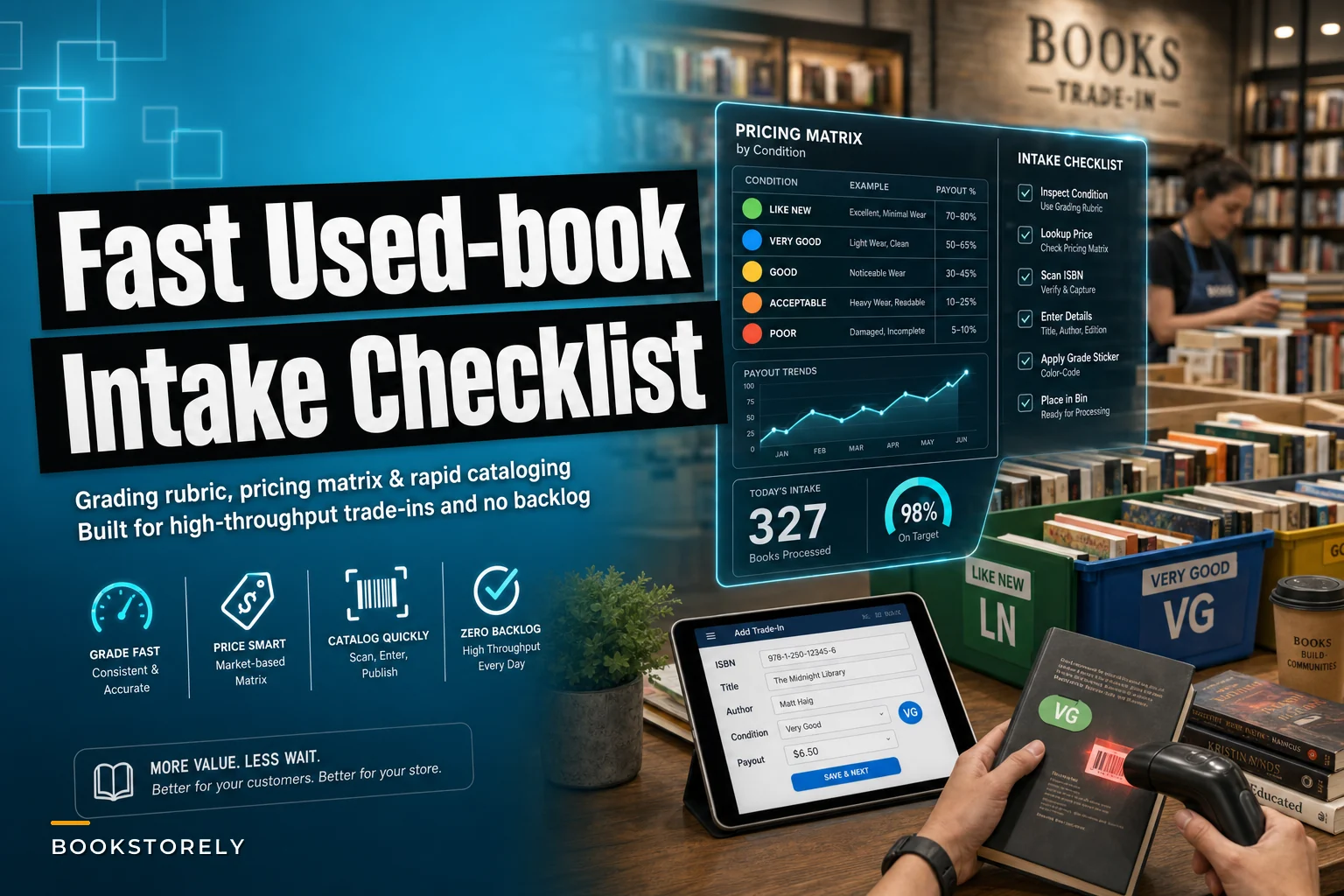

Your backroom looks like a crime scene. Stacks of unprocessed trade-ins lean against walls, spill from boxes, and gather dust on every flat surface. Customers keep bringing more books through the door, your staff feels overwhelmed, and thousands of dollars in potential inventory sits there doing absolutely nothing.
The real damage happens quietly. Those books aging in your backroom represent dead capital — money you could have turned three times over if they'd been priced and shelved within 48 hours of arrival. Most independent bookstores process trade-ins the same broken way: accept everything during store hours, let it pile up, then have someone spend entire shifts sorting through backlogs that never quite disappear.
Trade-in bottlenecks kill bookstore cash flow faster than slow sales ever will
A bookstore in Portland nearly went under, not from poor sales, but from operational constipation. They had $18,000 worth of tradeable inventory rotting in their backroom while their shelves sat half-empty and customers complained about poor selection. Their trade-in process took 20 minutes per customer and still resulted in pricing mistakes that cost them hundreds weekly. Nobody wanted to deal with it, so it just kept getting worse.
Processing delays create cascading problems that ripple through every aspect of your operation.
The hidden math behind trade-in disasters
Most bookstore owners underestimate how much unprocessed inventory costs them. Take a typical week: you might accept 400-500 books through trade-ins. If even half are sellable at an average price of $8, that's $1,600 in potential weekly revenue stuck in limbo. Multiply that across a month and you're looking at $6,400 that should be generating cash flow but instead sits collecting dust.
The operational breakdown goes deeper. Your experienced staff members — the ones who actually know book values — spend their shifts buried in the backroom instead of helping customers. You're essentially paying your most knowledgeable employees to do data entry while part-timers struggle on the floor. One bookstore calculated they were losing $340 daily just from this misallocation of labor.
Then there's the customer experience collapse. Regular sellers learn your system is slow and start taking their best stuff to competitors. New customers wait 25 minutes for a trade-in evaluation, get frustrated, and never return. The books that do make it through your system are often mispriced because whoever finally processes them at 9 PM on a Tuesday is exhausted and making mistakes.
Build an intake rubric that actually scales
Forget the complex evaluation systems that require encyclopedic knowledge. You need three simple grading categories that any staff member can apply in under 30 seconds per book:
Grade A (Premium): Current bestsellers, classics in excellent condition, specialty books with clear demand. These get your highest trade credit multiplier and go straight to prime shelf space.
Grade B (Standard): Good condition books with steady but not spectacular demand. Most fiction, older bestsellers, common non-fiction. These form your bread-and-butter inventory.
Grade C (Bulk): Acceptable condition with slow turnover. Old textbooks, dated self-help, worn paperbacks. These still sell but need aggressive pricing to move.
Make these categories visual and tactile. Create a one-page reference sheet with photo examples of condition standards. Bent corners, highlighting, cover wear — show exactly where each defect drops a book one grade level. Staff should be able to glance at a book and instantly categorize it without lengthy deliberation.
Laminate a one-page reference and keep it at the intake station so new hires can match condition examples instantly.
One store in Austin cut their intake time by 70% using this system. They went from processing 12 books per hour to 45 books per hour, simply by removing decision paralysis from the equation. The key was making the criteria so obvious that there wasn't room for debate.
Price matrices that eliminate guesswork
Static pricing kills bookstore profits. You can't charge the same for every paperback and expect to optimize revenue. But you also can't have staff researching every single title online during busy periods. The solution is a dynamic pricing matrix that adjusts automatically based on clear factors.
| Grade | Fiction Paperback | Fiction Hardcover | Non-Fiction | Specialty/Local |
|---|---|---|---|---|
| A | $12-15 | $18-25 | $15-20 | $20-30 |
| B | $7-9 | $12-15 | $10-14 | $14-18 |
| C | $3-5 | $6-8 | $5-7 | $8-10 |
These ranges give staff flexibility while maintaining consistency. A Grade A thriller from this year might price at $15, while a Grade A literary fiction might go for $12. The matrix provides guardrails, not rigid rules. It prevents the $2 paperback that should have been $12 and the $25 mass market romance that sits forever.
For trade credit, use simple multipliers: Grade A gets 40% of retail price in credit, Grade B gets 25%, Grade C gets 15%. This encourages customers to bring quality inventory while still accepting volume trades that keep foot traffic flowing. Update these matrices quarterly based on what's actually moving. If mystery paperbacks are flying off shelves, bump their pricing tier up. If business books are stagnating, drop them down. The matrix evolves with your market reality, not some theoretical ideal.
Rapid cataloging that prevents pile-ups
The cataloging stage is where most bookstore trade-in systems completely fall apart. Staff either spend forever entering detailed information about every book, or they rush through and create inventory chaos later. You need a middle path that captures essential data without becoming a time sink.
-
Title (abbreviated is fine)
-
Grade (A, B, or C)
-
Price (from your matrix)
-
Section (fiction, mystery, biography, etc.)
-
Source (which customer/date)
That's it. No ISBN lookups, no author first names, no publication dates unless it's relevant to pricing. This information takes under 20 seconds to capture per book, either on paper or in a basic spreadsheet.
The source tracking is crucial but often overlooked. When certain customers consistently bring Grade A inventory, you can offer them premium trade rates or early access to sales. When someone dumps 200 Grade C books on you monthly, you can politely adjust their expectations or limit quantities. A bookstore in Denver implemented this five-field system and eliminated their backlog entirely within three weeks. They now process every trade-in within 24 hours of receipt, maintaining zero backroom accumulation while actually increasing the volume of books they accept. The difference was having a system that anybody could follow.
The 90-second decision workflow
Speed is everything in trade-in processing, but speed without structure creates chaos. Here's the exact workflow that prevents bottlenecks while maintaining quality control:
-
Step 1
Quick scan (10 seconds)
- Check spine for damage - Fan pages for writing/highlighting - Assess general condition -
Step 2
Grade assignment (5 seconds)
- Compare to reference sheet - Assign A, B, or C grade - Mark with colored dot sticker -
Step 3
Price lookup (15 seconds)
- Check matrix for category - Write price on inside cover - Add section code -
Step 4
Credit calculation (20 seconds)
- Total all accepted books - Apply grade multipliers - Write credit slip -
Step 5
Sort to processing (5 seconds)
- Grade A to immediate shelving box - Grade B to standard processing - Grade C to bulk pricing area -
Step 6
Data capture (35 seconds)
- Enter five fields per book - Note customer name - File credit slip
The entire process takes 90 seconds per book when followed correctly. That means a single employee can process 40 books per hour, or roughly 320 books per eight-hour shift. Most importantly, books never sit waiting for "someone to get to them later."
Here's a simple visual to help staff internalize the steps.
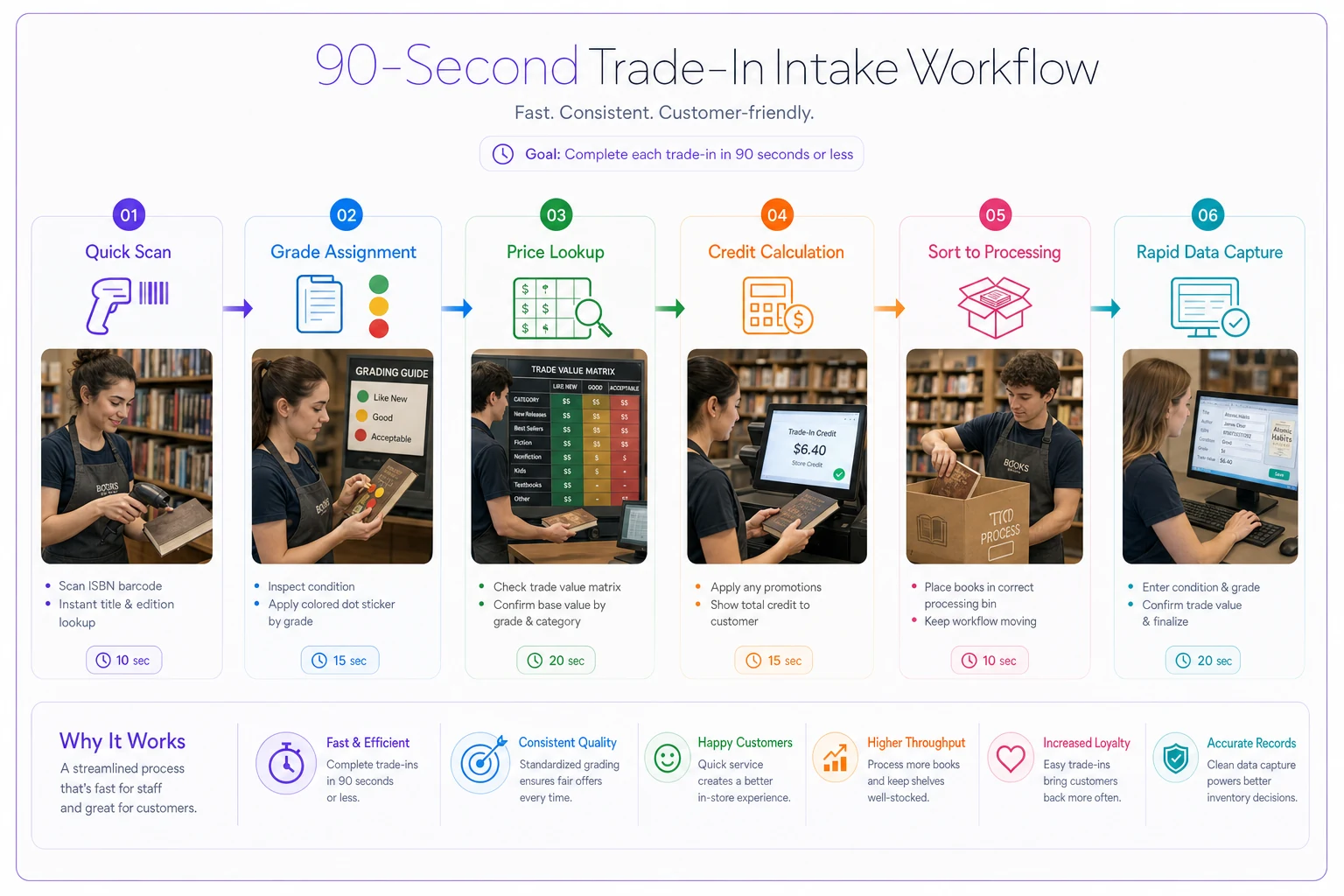
The workflow only works if everyone actually follows it. Post the steps somewhere visible and train staff until it becomes automatic.
Who shouldn't use this system
This rapid intake method fails spectacularly for certain bookstore types. Rare book dealers need extensive evaluation processes — you can't grade a first edition in 30 seconds. Academic bookstores dealing with textbooks need ISBN verification and edition checking. Specialty stores focusing on collectibles require condition documentation that goes far beyond three simple grades.
The system also breaks down if you don't have consistent foot traffic. Stores seeing fewer than 10 trade-ins weekly don't need this level of systematization — the overhead isn't worth it. Similarly, if your customers primarily bring high-value, low-volume trades, the rapid processing approach might miss opportunities to identify valuable titles worth premium pricing.
When automation starts making sense
The manual system works beautifully for most independent bookstores processing 500-2000 books weekly. But somewhere around 2000 books per week, even the best manual workflow starts breaking down. That's when simple automation tools become game-changers, not because they're fancy, but because they eliminate the repetitive tasks that cause human error.
A basic barcode scanning system connected to a simple database cuts data entry time by 80%. Instead of writing five fields per book, staff scan a barcode and verify pre-populated information. The same Grade A/B/C logic applies, but capture happens instantly. One Seattle store processes 4000 books weekly with just two part-time employees using this approach.
The automation doesn't need to be complex. A smartphone app that captures ISBN via camera, checks against your pricing matrix, and exports to a spreadsheet is enough for most stores. Some operations benefit from AI-powered operational software that tracks which categories sell fastest, automatically adjusts pricing matrices based on sales velocity, and flags when certain sections need restocking.
The compound effect of speed
Every bookstore owner understands that inventory turns equal profit. What they miss is how trade-in processing speed directly impacts those turns. Books that hit shelves within 24 hours of acquisition sell 3x faster than books that age for a week in the backroom. It's not just about freshness — it's about momentum.
When customers see new inventory constantly appearing, they visit more frequently. When sellers get their credit quickly, they return sooner with more books. When staff isn't overwhelmed by backlogs, they have energy to merchandise creatively and help customers discover titles. The entire ecosystem speeds up. A bookstore in Nashville tracked this precisely. After implementing rapid intake processing, their average inventory turn increased from 3.8 to 5.2 annually. That seemingly small change meant they generated $47,000 more revenue from the same shelf space, simply because books moved through their system faster. The numbers don't lie.
The psychological impact on staff is equally important. Nobody wants to face a mountain of unprocessed books every shift. When the backroom stays clear and systems work smoothly, employees actually enjoy the trade-in process instead of dreading it. They become better at grading, faster at pricing, and more confident in their decisions.
Your bookstore trade-in checklist doesn't need to be perfect. It needs to be fast, consistent, and clear enough that any employee can execute it without hesitation. The grading scales, pricing matrices, and cataloging systems outlined here aren't revolutionary — they're just organized common sense applied consistently. The difference between bookstores that thrive and those that struggle often comes down to these operational fundamentals. You can have the best curation, the most knowledgeable staff, and the perfect location, but if your operations create bottlenecks instead of flow, none of that matters. Clear the backlog, implement the systems, and watch your bookstore transform from a storage facility into a profitable retail operation.