


Bookstore owners have good reason to be skeptical about recurring revenue. Plenty of stores have launched subscription boxes that quietly died after a few months, or memberships that turned into an administrative headache with underwhelming returns. The math rarely worked out the way people promised.
But stores that actually crack recurring revenue aren't just adding a couple thousand dollars monthly — they're fundamentally changing their cash flow predictability. The difference between stores that make it work and those that don't usually comes down to this: they test small, track religiously, and know exactly when to kill an idea before it bleeds them dry.
The testing sprint that prevents six-month disasters
Most bookstores approach recurring revenue backwards. They dream up a big idea, spend two months planning, launch to their entire customer base, then wonder why only a dozen people signed up. Meanwhile, they've already ordered custom packaging, committed to quarterly themes, and hired someone to manage it.
A better approach that actually works: start with a two-week micro test. Pick your simplest possible recurring idea — maybe a monthly staff pick with a handwritten note, or early access to used book arrivals for a $5 monthly fee. Cap it at 20 customers max. No fancy packaging, no long-term commitments, just the core value proposition.
Cap it at 20 customers max.
Track three things during those two weeks: actual signup rate when you mention it at checkout, the time it takes your team to fulfill, and whether customers actually engage with what you're offering. One store tested a "first look" program where members got a Monday morning email of new used arrivals before they hit the floor. Took their buyer 15 minutes to write, brought in $180 monthly from 36 members, and had a 94% retention rate after eight months.
Compare that to their previous attempt at a YA subscription box that lost money every month despite 50 subscribers — they'd badly underestimated pick-and-pack time and shipping costs.
Sample P&Ls that show what actually works (and what doesn't)
Here are the numbers from three different recurring models pulled from actual store operations:
Model 1: Book-of-the-Month Club
| Item | Value |
|---|---|
| Monthly revenue | $25 × 45 members = $1,125 |
| Book cost (40% discount) | $15 × 45 = $675 |
| Packaging/materials | $2 × 45 = $90 |
| Labor (2 hours pick/pack) | $60 |
| Payment processing | $35 |
| Monthly profit | $265 |
| Margin | 23.5% |
Model 2: Early Access Membership
-
Monthly revenue
$8 × 125 members = $1,000
-
Direct costs
$0 (digital delivery)
-
Labor (4 hours monthly admin)
$120
-
Email platform
$29
-
Payment processing
$31
-
Monthly profit
$820
-
Margin
82%
Model 3: Curated Quarterly Box
-
Quarterly revenue
$65 × 30 members = $1,950
-
Book costs (3 books)
$35 × 30 = $1,050
-
Bookish items wholesale
$8 × 30 = $240
-
Packaging
$4 × 30 = $120
-
Labor (8 hours)
$240
-
Shipping
$9 × 30 = $270
-
Payment processing
$60
-
Quarterly profit
-$30
-
Margin
-1.5%
Notice which one's bleeding? The quarterly box looks great on paper — $65 price point, premium positioning — until you factor in the actual operational costs. Meanwhile, the boring early-access membership prints money because there's no physical fulfillment to manage.
The operational checklist your two-person team can actually handle
When you're running lean, every recurring program needs to fit into your existing workflow without breaking it. Here's what that looks like in practice:
Here's a quick visual of how setup, daily checks, fulfillment, and monthly analysis flow for a two-person team.
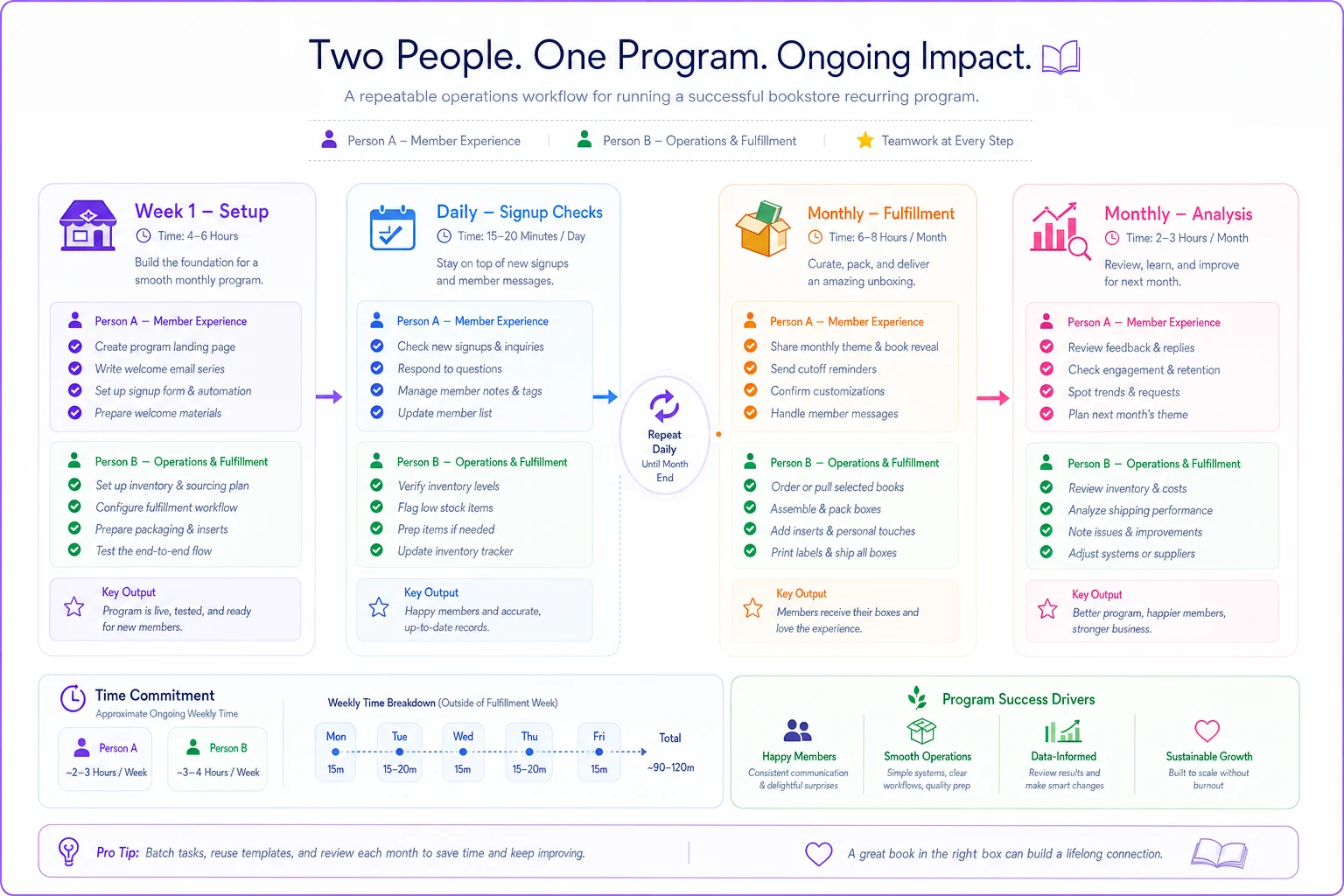
Week 1 Setup Tasks (roughly 4 hours total):
-
Create signup form (online + in-store card)
-
Set up payment processing for recurring billing
-
Write the two-paragraph pitch your team will use
-
Pick your pilot group (aim for 10-20 people who already shop monthly)
Daily Operations (15 minutes):
-
Check for new signups
-
Flag any payment failures
-
Add new members to fulfillment list
Monthly Fulfillment (varies by model):
-
Digital programs
1 hour for email creation/sending
-
Physical pick programs
3-4 hours for 30-40 members
-
Shipped boxes
6-8 hours for 30-40 members
Monthly Analysis (30 minutes):
-
Pull retention rate
-
Calculate actual margin
-
Note time overruns
-
Check customer feedback
Stores that make recurring revenue work protect these time blocks. They don't let special requests creep in, they don't customize beyond their operational capacity, and they track time as closely as they track money.
Kill triggers: when to shut it down before you lose money
Not every recurring revenue stream deserves to live. The successful stores know exactly when to pull the plug, and they do it quickly.
If month-two retention drops below 80%, you have a value problem. People are trying it and bailing, which means the core offer isn't working. One store ran a "surprise book" program where customers paid $20 monthly for a wrapped mystery book. Month one brought 60 signups. By month three, 12 people were still active. They killed it and shifted to a model where members picked from three options — retention jumped to 85%.
If fulfillment consistently takes more than 20% longer than planned over three months, you have an operations problem. That quarterly box that was supposed to take six hours to pack? If it's routinely taking nine, your real margin is probably negative once you factor in the opportunity cost of that time.
If your effective hourly rate drops below roughly $40 per hour spent on the program, it's worth reconsidering. Calculate it by dividing monthly profit by total hours spent. A book club bringing in $265 profit but requiring 12 hours monthly between selection, ordering, packing, and customer service works out to about $22 an hour — you'd generate more value just hand-selling on the floor.
Building the test sequence: coffee shop, personal shoppers, then book clubs
A store in Portland tested six different recurring models over 18 months. They didn't launch everything at once — they ran two-month pilots, analyzed results, then either scaled or scrapped.
Their sequence:
-
Coffee subscription (partner with local roaster)
$15/month for unlimited drip coffee. 47 members, virtually no operational burden, created daily foot traffic.
-
Personal book shopper
$10/month plus book cost for quarterly curated selections based on reading history. 28 members, high retention, good margin.
-
First-look privileges
$5/month for 24-hour early access to online used inventory. 89 members, zero fulfillment cost.
-
Kid's birthday book club
$8/month, birthday book delivered to school. 31 members, died after four months due to logistics complexity.
-
Author event access
$15/month for reserved seating plus meet-and-greet. 22 members, integrated well with existing event operations.
They started with the simplest operational lift — coffee they were already brewing — then gradually tested more complex models once they had recurring revenue rhythms down. That sequencing mattered a lot.
The coordination bottlenecks nobody talks about
What actually breaks these programs is handoffs between team members. Your bookseller takes a signup but forgets to add them to the fulfillment list. Your buyer selects books but doesn't communicate inventory holds. Your event coordinator doesn't know who has membership privileges.
These aren't lazy employee problems — they're system problems. When information lives in three different places (the POS, someone's notebook, a Google Sheet), coordination failures are inevitable.
Stores making recurring revenue work have one source of truth that everyone can access. They track:
-
Member list with join dates
-
Payment status (current/failed/cancelled)
-
Fulfillment history
-
Preferences or restrictions
-
Communication history
Without central tracking, you're running a memory-based business. That works fine at 10 members, starts falling apart at 50, and becomes a real problem at 100.
This is where operational software makes the biggest difference — not by automating everything, but by creating that single source of truth. When your morning person can see what the evening person promised, when billing automatically flags failures, when fulfillment lists generate from active memberships, a two-person team can handle what used to require four.
The margin math most stores get wrong
Everyone calculates product cost and forgets about payment processing, customer service time, and replacement shipments. Your real P&L needs to include:
Revenue side:
-
Membership fees
-
Upsell revenue (members buying above minimum)
-
Reduced acquisition cost for events
Cost side:
-
Product cost
-
Payment processing (2.9% + $0.30 per transaction)
-
Platform fees (Shopify, Square, etc.)
-
Fulfillment materials
-
Shipping (if applicable)
-
Labor at actual hourly cost
-
Member communications time
-
Customer service handling
-
Replacement/error rate (usually 2-3%)
-
Cancellation processing time
When you factor everything in, that $25 book club with a $15 product cost isn't making $10 profit — it's probably closer to $3-4 after all operational costs. That might still be worth it if it drives foot traffic and additional purchases, but you need the real number, not the wishful one.
Converting your event audience to recurring revenue
You already have people showing up monthly for author events. They're literally demonstrating recurring behavior — you just haven't monetized it yet. This is usually the lowest-hanging fruit for bookstores, much easier than starting from scratch with subscription boxes.
Create an "inner circle" membership tied to your existing event ecosystem. $12-15 monthly gets members reserved seating, meet-and-greet access when possible, and a monthly newsletter with your buyer's notes on upcoming releases.
One store in Austin converted about 20% of their regular event attendees to a $15 monthly membership. That's 40 people generating $600 monthly with almost zero additional operational burden — they were already running the events, managing RSVPs, sending event emails. The membership just formalized what was already happening.
Start with people who are already demonstrating the behavior you want to monetize. Event attendees are perfect for this.
The technology stack that won't overwhelm your team
You don't need complex subscription box software to start. Here's the minimum viable stack:
Payment processing: Stripe or Square subscriptions. Both handle recurring billing, payment failures, and cancellations. Takes about an hour to set up.
Member tracking: A simple spreadsheet works fine under 30 members. Include name, email, start date, membership type, and status. When you hit 30+, you'll want actual software.
Communication: Your existing email platform (Mailchimp, Constant Contact) already has segmentation. Create a segment for members, send them their monthly perks.
Fulfillment: A printed pick list works up to around 50 members for physical products. Beyond that, you need dedicated fulfillment software or an operational platform that handles inventory allocation.
Over-engineering before you have proof the model works is the most common mistake. Start manual, systematize once you have consistent revenue.
Real store example: from $0 to $2,400 monthly in six months
Here's what actually happened at a store in North Carolina. They started with zero recurring revenue and owners who'd been burned by a failed subscription box attempt three years earlier.
Month 1: Launched "First Friday" privileges — $8/month for early access to their monthly remainder sale. Signed up 18 people just by mentioning it to regular remainder buyers. Time investment: 2 hours setup, 30 minutes monthly.
Month 2: Added coffee subscription in partnership with a neighboring cafe. $12/month for unlimited standard coffee. 31 signups, mostly morning regulars. Zero operational burden — the cafe handled everything for a 20% revenue share.
Month 3: Tested a book concierge service at $20/month for quarterly curated selections. Capped at 15 people. Higher price point, but also higher touch — took their buyer about 4 hours quarterly.
Month 4: Killed the coffee program despite 31 members. The cafe partnership got complicated, and the margin wasn't worth the coordination hassle.
Month 5: Expanded First Friday to 45 members through targeted email. Added a book concierge waitlist after the first cohort renewed at 93%.
Month 6: Launched event membership at $15/month, converted 34 existing event regulars.
Current steady state: 45 First Friday members ($360), 25 concierge members ($500), 34 event members ($510), plus roughly $530 monthly in above-minimum purchases from members.
Total monthly recurring: $2,400. Operational time: About 12 hours monthly across all programs.
They killed what wasn't working fast, and doubled down on what was. That's the whole playbook.
Why most recurring revenue fails at month four
Month four is when the excitement wears off, the operational burden becomes clear, and the first wave of cancellations hits. Most programs die here — not because they couldn't work, but because stores don't have systems to handle the mundane middle period.
What breaks at month four:
-
Initial enthusiasm from staff fades
-
Edge cases emerge (address changes, payment failures, special requests)
-
Founder stops championing the program internally
-
Fulfillment starts getting delayed or sloppy
-
Communication becomes inconsistent
Stores that push through month four have three things in place: clear ownership (one person ultimately responsible), documented processes that aren't stored in someone's head, and realistic expectations about growth. They know that 5% monthly churn is normal, payment failures will happen, and some months will feel like more trouble than they're worth.
The transition from manual to automated
At some point, if your recurring revenue programs work, manual processes will break. Usually around 75-100 total members across all programs. You'll know you've hit this point when:
-
Payment reconciliation takes more than an hour monthly
-
You're maintaining member lists in multiple places
-
Fulfillment errors creep above 5%
-
Staff spends more time on administration than value delivery
This is where operational software actually matters. Not the fancy subscription box platforms charging $300 monthly, but basic operational tools that centralize member data, automate billing notifications, and generate fulfillment lists. The goal isn't to remove humans from the process — it's to free them up for selection, curation, and member experience rather than data entry and payment chasing.
Make this transition gradually. Don't rip everything out and start over. Move one process at a time, starting with whatever's most painful — usually payment tracking or fulfillment list generation.
Your 30-day launch sprint
If you're going to test recurring revenue, commit to a focused sprint:
Days 1-5: Choose your model Pick based on your operational reality, not what sounds coolest. One-person operation? Start with digital benefits. Have staff bandwidth? Test physical fulfillment.
Days 6-10: Build the basic infrastructure
-
Set up payment processing
-
Create tracking spreadsheet
-
Write member communication templates
-
Design signup flow (online and in-store)
Days 11-15: Recruit your pilot group Target 10-20 existing customers who already shop regularly. Not random people — customers you know by name who've already demonstrated repeat purchase behavior.
Days 16-30: Run the pilot
-
Daily
Check signups, note feedback
-
Weekly
Send member communication
-
End of sprint
Calculate real margins, time investment, retention
Day 31: Decide Kill it, scale it, or modify and retest. No lingering in maybe-land.
The stores that successfully build recurring revenue don't overthink the launch. They test fast, track closely, and adjust based on actual data. That bookstore in North Carolina went from skeptical to $2,400 monthly recurring because they started small, killed what didn't work, and scaled what did.
Subscription boxes aren't your only option. The best recurring model for your store might be something completely different — early access to used books, reserved event seating, personal shopping services, or something you haven't considered yet. The framework stays the same: test small, track everything, scale what works, kill what doesn't.
That First Friday remainder access program generating $360 monthly isn't revolutionary. It's not Instagram-worthy. But it's reliable income that took two hours to set up and 30 minutes a month to maintain. Sometimes boring recurring revenue beats exciting one-time sales.
The stores that successfully build recurring revenue don't overthink the launch. They test fast, track closely, and adjust based on actual data. That bookstore in North Carolina went from skeptical to $2,400 monthly recurring because they started small, killed what didn't work, and scaled what did.
Subscription boxes aren't your only option. The best recurring model for your store might be something completely different — early access to used books, reserved event seating, personal shopping services, or something you haven't considered yet. The framework stays the same: test small, track everything, scale what works, kill what doesn't.