



Three months ago, a bookstore owner in Portland showed me her event spreadsheet. Six years of author readings, meticulously tracked - attendance, book sales, refreshment costs. Color-coded and beautiful.
When we calculated the actual P&L for her last twelve events? She'd lost $8,400.
Why bookstore events hemorrhage cash (and owners don't realize it)
Most independent bookstores run events exactly how they've always run them. Set up folding chairs in fiction. Order wine and cheese. Hope the author's following shows up. Count attendance. Feel good if the room looks full.
Nobody calculates what that fiction section normally generates Thursday 6-9pm. Nobody factors the two staff members staying late at $18 an hour. Nobody tracks that you ordered 40 copies but only sold 11, and now 29 copies eat up stockroom space you need for holiday inventory.
Revenue side:
-
Ticket sales (if you charge, which most don't)
-
Book sales during event
-
Browse-after customer sales
-
Bar/cafe sales if you have them
Cost side:
-
Lost retail revenue from blocked floor space
-
Staff overtime or event-specific labor
-
Inventory carrying cost for event books
-
Refreshments and supplies
-
Marketing and promotion
-
Author fees or travel
-
Equipment rental
Run these numbers on a typical author reading and you'll often find losses of $400-800 per event. A book club meeting weekly in your prime real estate? Annual losses can hit five figures.
Three event P&L models that actually work
After analyzing event data from dozens of bookstores, clear patterns emerge. The key is matching your event model to your space constraints and customer base.
Model 1: The Ticketed Experience (High-margin, low-frequency)
This works when you create genuine scarcity and exclusivity. Bestselling author visits, publishing insider panels, themed literary dinners.
Real numbers from a 50-person ticketed event:
| Line Item | Amount | Notes |
|---|---|---|
| Revenue | ||
| Tickets (45 × $25) | $1,125 | Usually sell 90% capacity |
| Book sales (38 × $28) | $1,064 | 85% attachment rate typical |
| Bar sales | $320 | Average $7 per person attending |
| Total Revenue | $2,509 | |
| Costs | ||
| Author fee | $500 | Local authors often lower |
| Lost floor revenue | $180 | 3 hours × $60/hour baseline |
| Staff (2 × 3hrs × $18) | $108 | |
| Refreshments | $150 | Light apps and wine |
| Marketing | $50 | Mostly digital/email |
| Total Costs | $988 | |
| Net Profit | $1,521 |
The magic happens when you charge admission. It pre-qualifies buyers, creates perceived value, and covers baseline costs before anyone walks through the door.
Model 2: The Workshop Series (Steady-margin, recurring)
Writing workshops, book binding classes, literary craft sessions work because participants pay for expertise and community, not just access to an author.
Monthly writing workshop example (12 participants):
| Line Item | Amount | Notes |
|---|---|---|
| Revenue | ||
| Workshop fees (12 × $40) | $480 | 4-session commitment |
| Book/supply sales | $156 | Craft books, notebooks |
| Total Revenue | $636 | Per session |
| Costs | ||
| Instructor | $150 | Local writer/teacher |
| Space opportunity cost | $60 | Smaller area/off-peak |
| Admin time | $30 | Minimal once established |
| Total Costs | $240 | |
| Net Profit | $396 | Per session × 4 = $1,584/month |
Workshops generate predictable monthly revenue and build community without the feast-or-famine cycle of big author events.
Model 3: The Corporate Partnership (Sponsored/subsidized)
Local businesses will pay to access your culturally engaged customer base. "Wine & Words" with a local vineyard, "Business Book Club" sponsored by the downtown development council.
Sponsored business book club example:
| Line Item | Amount | Notes |
|---|---|---|
| Revenue | ||
| Sponsorship | $500 | Quarterly commitment |
| Book sales (20 × $35) | $700 | Business titles higher margin |
| Corporate bulk orders | $350 | Sponsor buys for team |
| Total Revenue | $1,550 | |
| Costs | ||
| Facilitator | $100 | Often owner/manager |
| Space cost | $0 | Use sponsor's conference room |
| Books wholesale | $420 | 40% margin on $1,050 sales |
| Light coordination | $50 | |
| Total Costs | $570 | |
| Net Profit | $980 |
The sponsor covers your risk, brings guaranteed buyers, and sometimes provides the venue.
Pricing decision rules that protect your margins
Stop defaulting to free events. Use these pricing filters:
Charge $20+ when:
-
Author has 10K+ social following
-
Topic has professional development angle
-
You're limiting capacity under 30 people
-
Event includes food/beverage beyond basics
-
Customer segment skews affluent
Charge $10-15 when:
-
Local author with modest following
-
General interest topics
-
Capacity 30-60 people
-
Building new event series momentum
Keep free only when:
-
Building community partnerships
-
Testing new format/time
-
Children's programming
-
Genuine community service mission
A Denver bookstore switched from free events to $12-15 ticketed events last year. Attendance dropped from an average of 35 to 22 people. But event profit went from negative $300 to positive $400 per event. That's a $700 swing, multiplied by 24 events annually.
The workflow that prevents event losses
Most event losses happen before the event starts. Bad inventory orders, poor scheduling, weak promotion kill your margins before the first guest arrives.
-
Six weeks out
Run the pre-mortem
Calculate your breakeven attendance. If you need 40 paid tickets to break even and the author's last three events averaged 25 people, kill it now. -
Five weeks out
Lock inventory orders
Order books at 70% of optimistic attendance. You can always reorder for future sales, but event overstock kills margins. -
Four weeks out
Open ticket sales
Start marketing only after tickets are live. Track sales velocity weekly - if you haven't sold 40% of capacity by week two, reduce inventory order. -
Two weeks out
Confirm staffing
Schedule only essential staff. One register, one floor, one coordinator maximum for events under 75 people. -
One week out
Final push or pivot
If you're under 60% sold, pivot to smaller space or add value (signed bookplates, exclusive content) rather than discounting. -
Event day
Capture the upsell
Station someone at checkout with related titles. "Since you enjoyed this mystery author, you'll love..." drives 20-30% incremental sales. -
Next day
Calculate actual P&L
Don't wait. Record real numbers while fresh. Include everything - that last-minute Uber for the author counts.
Visual workflow below.
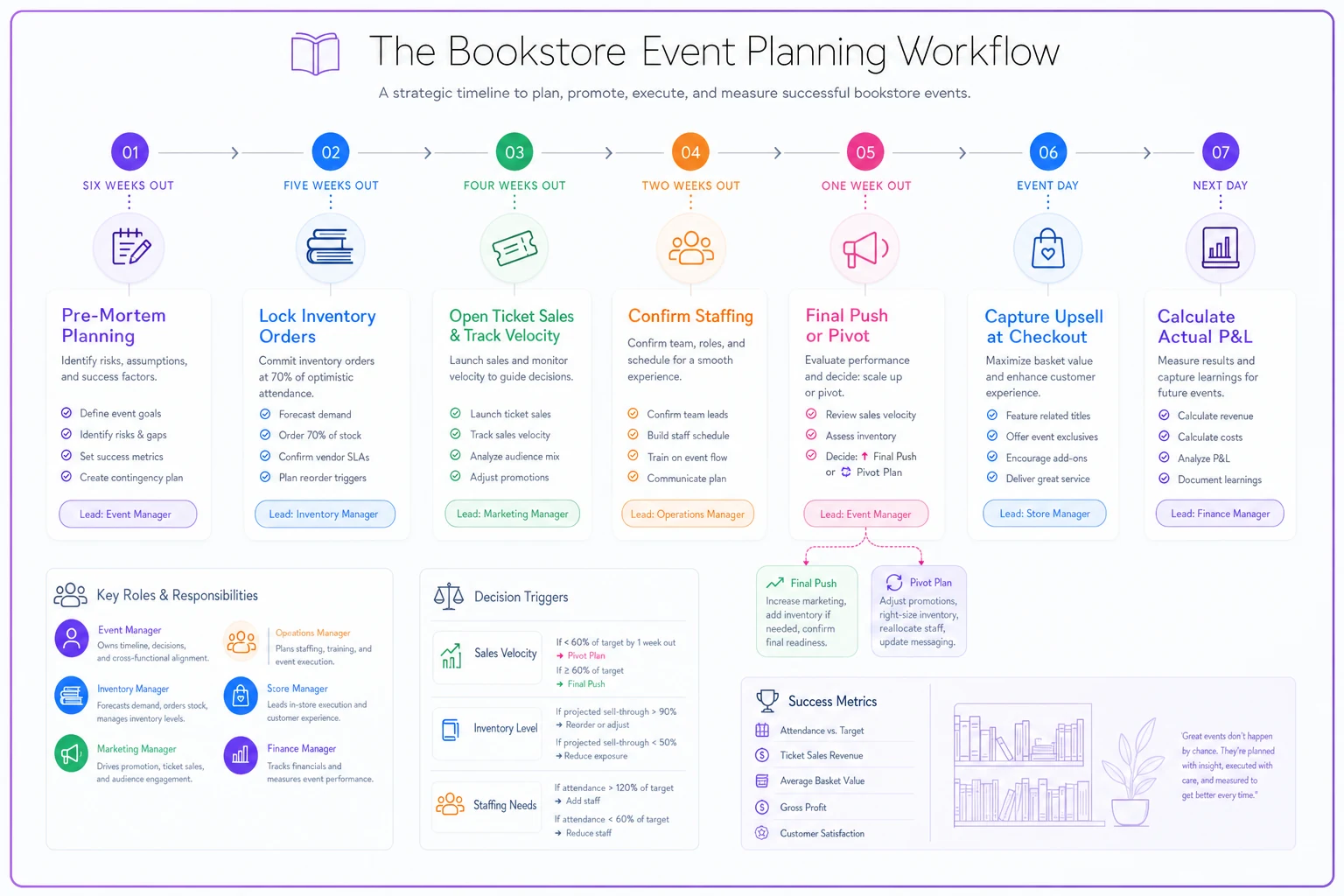
Order books at 70% of optimistic attendance; you can always reorder.
This systematic approach prevents the random cost bleed that destroys event profitability.
Capacity and staffing templates you can steal
The biggest mistake stores make is overstaffing events. You don't need your full weekend crew for a Tuesday night reading.
For readings/signings (up to 50 people):
-
Setup (2 hours before)
1 person arranging chairs/space
-
Setup (2 hours before)
1 person handling book display/checkout prep
-
During event (2 hours)
1 person at register
-
During event (2 hours)
1 person as host/coordinator
-
During event (2 hours)
0 floating staff (yes, zero)
-
Breakdown (1 hour after)
Same 2 people who set up
-
Total labor
10 person-hours maximum
For workshops/classes (up to 20 people):
-
1 instructor
-
1 store representative (can be owner/manager)
-
Register handled before/after only
-
Total labor
4-6 person-hours
For major events (50-100 people):
-
Add only
1 crowd control/line management
-
Add only
1 additional register during peak buying
-
Total labor
16-18 person-hours
A store in Austin cut event labor costs by 40% using this template. They went from averaging 24 person-hours per event to 11, saving roughly $230 per event in labor alone.
When events make sense (and when they're vanity metrics)
Some brutal truth about when to run events versus when to stop kidding yourself:
Run events when you have:
-
Dedicated event space that doesn't cannibalize retail
-
Customer base that actually buys books (not just attends)
-
Clear sponsorship or partnership opportunities
-
Ability to charge admission without backlash
Stop running events if:
-
Your retail per square foot exceeds $400 annually (events can't compete)
-
You're in a tourist area (one-time visitors don't build community)
-
Your average transaction is under $20 (not enough margin to offset costs)
-
You can't dedicate someone to own the P&L
Most bookstores in high-rent districts fall into that first category. Their retail space is too valuable to give away for free entertainment.
The spreadsheet that changed everything
Revenue Section:
Ticket Price × Expected Attendance = Ticket Revenue
Expected Attendance × Book Attachment Rate × Average Book Price = Book Revenue
Expected Attendance × Auxiliary Spend Rate = Auxiliary Revenue
Sponsorship/Partnership = Partnership Revenue
True Cost Section:
Space Square Footage × Hourly Retail Rate × Event Duration = Opportunity Cost
Staff Hours × Loaded Labor Rate = Labor Cost
Inventory Orders × (1 - Sell-through Rate) × Carrying Cost = Overstock Cost
Direct Costs (refreshments, supplies, author fees) = Direct Cost
Marketing/Promotion = Marketing Cost
Decision Metrics:
Breakeven Attendance = Total Costs ÷ Revenue per Attendee
Margin per Square Foot Hour = Net Profit ÷ (Square Feet × Hours)
ROI = Net Profit ÷ Total Costs
Track these for every event. After ten events, patterns emerge. You'll know poetry readings need 35 paying people to break even, but business book clubs only need 12. You'll discover Thursday events outperform Saturdays because opportunity cost is lower.
A real turnaround story
Green Light Books in Brooklyn was running 40 events annually, losing an average of $450 per event. That's $18,000 in annual losses disguised as "marketing" and "community building."
They implemented three changes:
-
Killed all events with projected attendance under 25
-
Started charging $10-15 for author events
-
Moved book clubs to morning hours when retail was slow
Result after six months:
-
Events dropped from 40 to 24 annually
-
Average event profit
positive $380
-
Annual event contribution
positive $9,120
-
Total swing
$27,120 improvement
They reinvested that money into inventory turns, which drove more sustainable revenue than any event program ever could.
Building your event evaluation system
The goal isn't eliminating all events. Run events that actually contribute to your business rather than slowly draining it.
Start by calculating the true P&L for your last five events. Include everything - opportunity costs, carrying costs for unsold inventory, even the coffee you bought the author. The numbers will probably shock you.
Then apply the frameworks above. Test ticketing on one event. Try a sponsored partnership. Run a morning workshop when your store is quiet anyway.
Stop measuring success by how full the room looked. A packed room of non-buyers is worth less than ten people who each buy three books and come back next month.
The Portland bookstore that lost $8,400 on events? After rebuilding their approach using actual P&L analysis, they're now generating about $1,200 monthly from a streamlined event program. That's a $15,600 annual swing from fixing one operational blindspot. Your events should make money. If they don't, you're subsidizing entertainment for people who probably aren't your best customers anyway.