


The bookstore down the street from my apartment runs author events twice a month. They get decent crowds—maybe 40 people on a good night. But those same 40 people never come back for anything else. No book clubs. No workshops. No morning story times. The store basically starts from zero with every single event.
This isn't just one store's problem. Most indies treat events like isolated transactions instead of an interconnected ecosystem. They'll spend 20 hours organizing a single author visit, then watch those attendees disappear until the next big name comes through town.
The real opportunity isn't in running more events—it's in building a bookstore community events strategy that connects each program to the next, creating pathways that turn one-time attendees into regular participants across multiple offerings.
Why Most Event Programming Fails
Most bookstore owners think about events wrong. They see a calendar with slots to fill rather than a system with interconnected parts. The stores actually making money from programming understand something different: every event serves multiple purposes within a larger machine.
Take Prairie Lights in Iowa City. Their poetry readings feed their monthly workshop series, which feeds their annual anthology project, which feeds back into more readings. Each piece supports the others. Compare that to stores running random author visits whenever publishers offer them—there's no connective tissue, no momentum building.
The ecosystem approach changes your entire operational model. Instead of starting fresh with marketing for each event, you're moving people through an established pipeline. Instead of hoping random customers show up, you're systematically converting different audience segments.
This requires mapping four critical components: audience pipelines, partnership structures, revenue models, and scaling sequences. Get these right, and programming becomes a profit center. Get them wrong, and you're burning labor hours on feel-good activities that drain resources.
Most stores measure success by single-event attendance. That's backwards. The real metric is lifetime value across multiple touchpoints.
Mapping Your Audience Pipeline Architecture
Successful programming ecosystems segment audiences by temperature—cold, warm, and hot—then design specific entry points and progression paths for each group.
Cold audiences need zero-commitment touchpoints. These are people who've never been in your store or maybe bought a book once six months ago. For them:
-
Free Saturday morning story times (parents browsing while kids listen)
-
Open mic nights with no cover charge
-
Community bulletin board events hosted in your space
-
School field trips during slow weekday mornings
Warm audiences already know you exist but aren't regulars yet. They need reasons to increase frequency:
-
Monthly themed book clubs with small membership fees
-
Writing workshops with 4-week commitments
-
Early access to author event tickets
-
Members-only shopping hours with discounts
Hot audiences are your superfans who'll pay premium prices for exclusive access:
-
Annual membership programs with extensive benefits
-
Small-group dinners with visiting authors
-
First editions club with quarterly shipments
-
Private workshop series with established writers
The magic happens in the bridges between these segments. A parent coming to free story time gets invited to the parenting book club. Book club members get early access to parenting author events. Event attendees get pitched on the premium membership that includes all of the above plus discounts.
| Segment | Entry Point | Bridge Offer | Expected Conversion |
|---|---|---|---|
| Cold → Warm | Free story time | $5/month book club | 15-20% |
| Warm → Hot | Book club member | $99 annual membership | 25-30% |
| Hot → Advocate | Annual member | $500 patron circle | 5-8% |
Stores that get this right track progression metrics obsessively. They know exactly how many story time attendees convert to book clubs, how many book club members upgrade to annual memberships, and what percentage of members become major donors or volunteer coordinators.
Most bookstores track nothing. They have no idea where attendees come from or where they go next. That's operational blindness.
School and Library Partnership Structures That Actually Work
Everyone talks about partnering with schools and libraries, but most bookstores approach it backwards. They pitch random author visits without understanding the institutional constraints these organizations face.
Schools operate on semester planning cycles with budget allocations made months in advance. Libraries have programming quotas they need to hit with limited staff capacity. Both have specific educational requirements that random author visits rarely address directly.
Bookstores making real money from institutional partnerships create standardized program packages that solve specific problems. Instead of "would you like an author to visit," they offer "a complete unit on local history including three author visits, curriculum guides, and take-home materials for $1,200."
Elementary Package ($4,000/semester):
-
Monthly author visits aligned to reading curriculum
-
Classroom book sets at 20% discount
-
Teacher professional development workshop
-
Book fair with 15% kickback to school
Middle School Package ($3,000/semester):
-
Quarterly young adult author panels
-
Creative writing workshop series
-
Summer reading program coordination
-
Student book club facilitation
High School Package ($2,500/semester):
-
College essay writing workshops
-
AP Literature author discussions
-
Student-run bookstore partnership
-
Literary magazine sponsorship
The operational key: everything runs on templates. Same author visit structure, same ordering process, same invoicing system. Once you've built the machine, adding new schools becomes a copy-paste operation rather than custom work each time.
Libraries work differently. They're not buying programs—they're looking for co-marketing opportunities and shared resources. The smart play here is complementary programming that drives traffic both ways. The library hosts the big-name author event (they have the space and marketing budget), while you run the prep book club and handle book sales.
Revenue Model Architecture Beyond Ticket Sales
Ticketed events represent maybe 30% of potential programming revenue. The real money comes from building multiple income streams around each event that compound over time.
Direct Event Revenue:
-
Ticket sales (if applicable)
-
Book sales at event
-
Merchandise specific to event
-
Food/beverage if you have a café
Indirect Same-Day Revenue:
-
Additional book purchases from browsing
-
Membership sign-ups with event discount
-
Future event pre-orders
-
Gift card sales
Sophisticated operators go deeper:
Pre-Event Revenue Streams:
-
Prep reading groups (paid)
-
Early bird shopping hours
-
Signed book pre-orders
-
Virtual meet-and-greet upgrades
Post-Event Revenue Streams:
-
Recording sales/streaming access
-
Signed book mail orders
-
Follow-up workshop series
-
Book club curriculum packages
A bookstore in Austin runs poetry readings every Thursday. Free events, maybe 25 people attending. Looks like a money-loser until you see the full model:
-
Featured poet's books prominently displayed all week
roughly $250 in sales
-
Poetry workshop series marketed at each reading
$1,200/month
-
Annual poetry anthology featuring readers
around $2,000 in pre-orders
-
Corporate sponsorship from local arts foundation
$500/month
-
Email list growth driving general sales
estimated $400/month value
Total monthly revenue from "free" weekly readings: roughly $4,400
Most bookstores have no idea how much their events actually generate because they only measure direct ticket sales. Building proper attribution into your bookstore community events strategy changes everything about how you evaluate and iterate programs.
From One-Offs to Recurring Revenue Machines
Most bookstores try to scale events by doing more of them. That's backwards. Real growth follows a specific sequence that builds operational capacity while reducing per-event effort.
Start with high-margin, low-complexity events that test your operational systems. Author readings where the publisher handles most logistics. Simple book clubs with minimal prep. The goal isn't volume—it's proving you can execute profitably.
Key metrics during this phase:
-
Profit per event (must be positive)
-
Setup time per event (track religiously)
-
Attendance relative to capacity
-
Conversion to email list
Once you nail the basics, take your successful one-offs and turn them into repeatable templates. That author reading becomes a monthly series with the same setup process, marketing templates, and operational flow. Book clubs get standard structures that work for any genre.
This is where operational software becomes critical. Managing recurring events manually means scattered spreadsheets, missed communications, and constant reinvention. The right platform lets you duplicate successful events, automate reminders, and track performance across iterations.
Next, you combine templates into coherent programs. The monthly author series plus the genre book clubs plus the writing workshops become your "Literary Lovers Membership" at $30/month. Suddenly you're not selling individual events—you're selling ongoing access to a literary community.
Bundle architecture that works:
-
3-5 core offerings included
-
Clear value proposition (save 40% vs individual pricing)
-
Member-only perks that cost you nothing
-
Automatic renewal with easy cancellation
Finally, you connect programs across audience segments. Natural progression paths emerge. Children's story time feeds the middle-grade book club which feeds the teen writing workshop which feeds the adult literary series. Each program markets the others. Each success makes the next one easier.
Critical Failure Points and Prevention Systems
Even well-designed ecosystems break down at predictable points. Understanding these failure modes—and building prevention systems—determines whether your programming becomes sustainable revenue or expensive distraction.
Calendar Conflicts You schedule a major author event the same night as the high school play. Attendance tanks. This happens when event planning exists in isolation from community awareness. Prevention: Maintain community calendar integration. Check school districts, libraries, major venues, and cultural organizations before locking dates. Build relationships with event coordinators at other venues who'll give you heads-up on conflicts.
Partnership Breakdown The school that promised to promote your event doesn't. The library backs out of the co-marketing agreement. The corporate sponsor pulls funding. These failures usually stem from unclear expectations and informal agreements. Prevention: Everything in writing, even with friendly partners. Standard partnership templates that specify deliverables, timelines, and contingencies. Regular check-ins scheduled in advance, not when problems arise.
Volunteer Burnout Your event coordinator volunteers quit after six months of 20-hour weeks. The book club facilitator disappears mid-series. Relying on unpaid labor for critical operations eventually implodes. Prevention: Build real compensation into your model from day one. This might be hourly wages, commission on event revenue, or free membership benefits worth actual money. Track volunteer hours and intervene before burnout hits.
Track volunteer hours and rotate responsibilities so no one is carrying 20-hour weeks for months at a time.
Marketing Channel Decay Facebook changes its algorithm and your event posts reach nobody. The local newspaper stops covering book events. Your email open rates plummet. Single-channel dependency kills event programs. Prevention: Minimum three marketing channels per event, with success metrics for each. Physical flyers still work. Text messaging beats email for day-of reminders. Partner cross-promotion provides algorithm-proof reach.
Financial Opacity You're running 20 events per month but losing money overall. Without clear P&L tracking per program type, you can't identify which events drain resources versus drive profit. Prevention: Implement proper cost allocation from the start. Staff time, marketing spend, space opportunity cost, inventory investment—everything gets attributed. This is where operational software really matters. Manual tracking in spreadsheets falls apart at scale.
Building Your Implementation Roadmap
The distance between understanding this ecosystem model and actually implementing it is where most bookstores fail. They get excited about the possibility, try to do everything at once, and burn out before seeing results.
Month 1: Audit and Document Map your current programming honestly. What events do you run? What do they actually cost (including labor)? Who attends? What happens to those attendees afterward? This baseline determines everything else.
Month 2: Pick Your Beachhead Choose one audience segment and nail it. Usually, this should be your warmest audience—people who already shop with you occasionally. Design simple progression from free event to paid program to membership. Nothing fancy, just something that works.
Month 3-4: Build the Infrastructure Create templates, setup tracking systems, establish partnerships. This is unglamorous work that makes everything else possible. Email sequences, registration forms, feedback surveys, financial tracking—all the boring stuff that multiplies your impact.
Month 5-6: Test and Iterate Run your beachhead program through multiple cycles. Each iteration should get smoother, more profitable, and require less manual intervention. Document what works. Kill what doesn't. Resist the urge to expand until this is humming.
Month 7-12: Systematic Expansion Add one new program element per month, always building on what's working rather than starting fresh. Each addition should serve existing audiences while opening new ones.
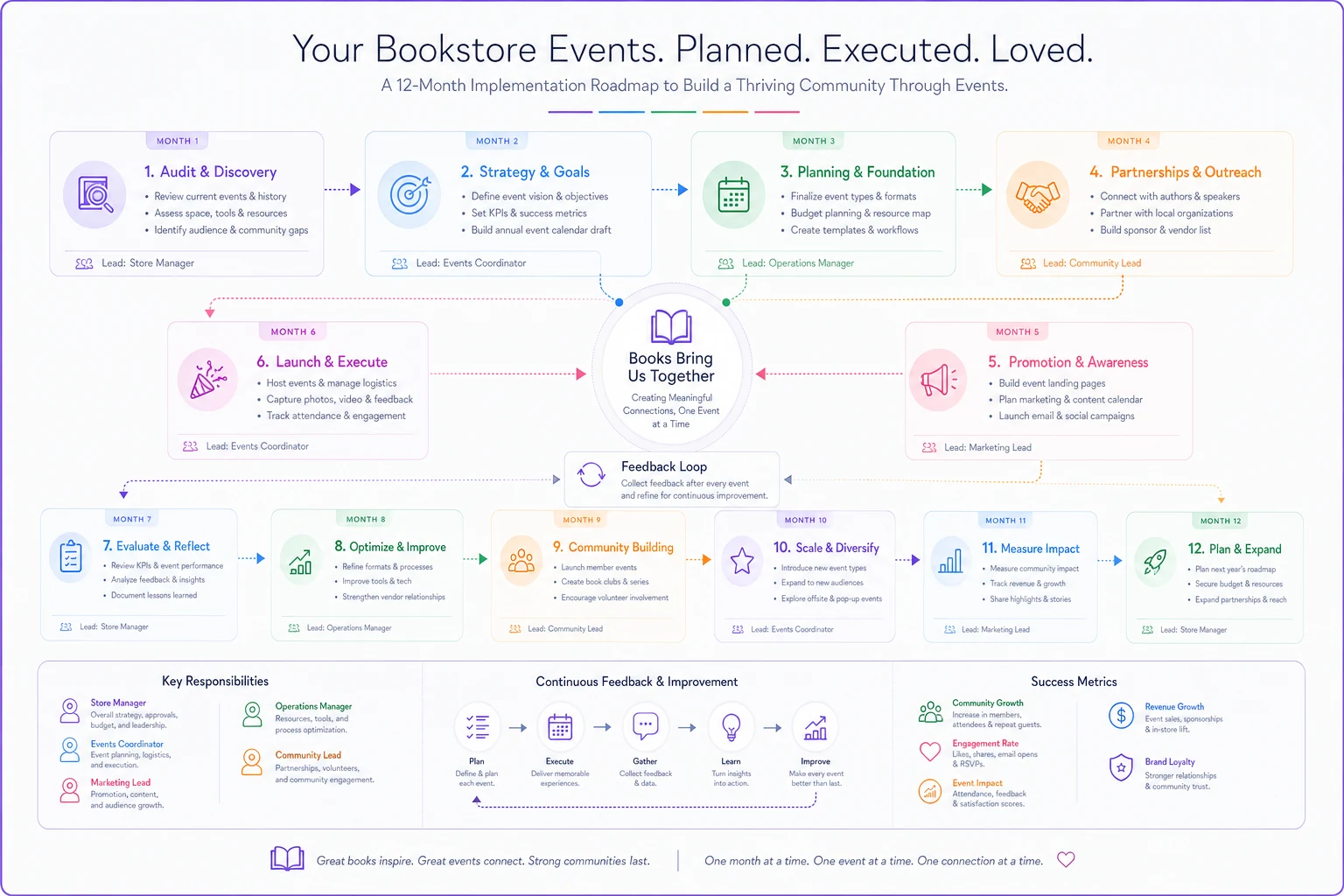
Here's a quick visual of the roadmap.
When This Model Doesn't Make Sense
Not every bookstore should build this kind of ecosystem. The model fails in specific conditions that you need to recognize upfront.
Geographic isolation kills the community density needed for recurring programs. If you're the only bookstore in a 50-mile radius serving a population under 20,000, one-off events might be your ceiling.
Tourist-dependent locations face different challenges. Your audience refreshes weekly, making progression paths irrelevant. A bookstore in a beach town or ski resort needs a different model—high-margin, single-touch experiences rather than community building.
Micro-bookstores (under 1,000 square feet) often lack physical space for meaningful events. A cramped poetry reading with 12 people standing might work occasionally, but it won't support a full ecosystem. Partner venues become mandatory, adding complexity that might not pencil out.
Owner burnout is real and usually irreversible. If you're already working 60-hour weeks just keeping the doors open, adding programming complexity will break you. Fix the core operation first, or hire someone specifically for community programs.
Making the Strategy Operational
The gap between strategy and execution is where bookstore community events usually die. You understand the ecosystem concept, see the revenue potential, but Monday morning arrives and you're still doing things the old way.
First, treat programming as a product line, not a marketing expense. This means real P&Ls, inventory investment (yes, events are inventory), and performance metrics that matter. When author events are just "something we do for the community," they never get the operational rigor needed for profitability.
Second, build the machine before scaling the output. Temptation is always to book more events, reach more people, fill more calendar slots. But scaling broken systems just amplifies problems. One perfectly executed monthly series beats four chaotic weekly events every time.
Third, embrace compound effects over immediate results. The first iteration of your book club might have six people. The writing workshop might barely break even. School partnerships might take three months to finalize. This is normal. Ecosystems take time to develop momentum.
A bookstore in Denver nearly quit their entire events program after six months of losses. The owner was ready to go back to just selling books and hosting occasional publisher-sponsored readings. Instead, they stripped back to one monthly author series, perfected the operational flow, then slowly rebuilt.
Two years later, programming generates $120,000 annually—roughly 15% of total store revenue. The difference wasn't better events. It was better systems around those events. Better tracking, better follow-up, better integration with the store's other offerings.
The Technology Layer That Changes Everything
Manual event management hits a breaking point around 8-10 programs per month. Registration spreadsheets become unwieldy. Communication falls through cracks. Financial tracking turns into guesswork. This is where operational software transforms what's possible.
The right platform handles repetitive tasks that drain your team's energy. Automated registration confirmations, reminder sequences, waiting list management, post-event surveys—all the stuff that takes hours when done manually but seconds when systematized.
More importantly, integrated operations software connects events to your broader business. When someone registers for an author event, they automatically get added to relevant marketing segments. Their purchase history informs future event invitations. Their attendance patterns trigger personalized membership offers. The ecosystem becomes self-reinforcing rather than manually maintained.
Stores struggling with events usually manage them in isolation—Facebook for marketing, Eventbrite for registration, Excel for tracking, email for communication. Nothing talks to anything else. Every event starts from zero.
The stores succeeding have unified systems where each event builds on the last, where data flows automatically, where patterns become visible and actionable.
Your Next 30 Days
Building a sustainable event ecosystem takes months, but the first actions determine trajectory.
Week 1: Document your true event economics. Include everything—staff time at actual wages, marketing costs, space opportunity cost, inventory investment. Most stores discover they're losing $200-500 per event when fully loaded costs get calculated.
Week 2: Choose your highest-potential audience segment and map their ideal journey. Where do they first encounter you? What makes them come back? What triggers payment? What creates advocacy? This becomes your North Star for all decisions.
Week 3: Design one repeatable program that serves that audience. Not five programs, not a complex series—one thing you can execute consistently with current resources. Make it profitable at small scale.
Week 4: Create operational infrastructure for that one program. Templates for marketing, registration system, feedback mechanism, financial tracking. This infrastructure becomes the foundation for everything that follows.
Bookstores that succeed with this model don't try to build Rome in a day. They start with one program, perfect the operations, then systematically expand. The ones that fail try to launch everything at once and burn out before seeing results.