


The math on bookstore subscription boxes looks incredible until you're staring at 47 unfulfilled December boxes at 9pm, wondering how a $35 monthly subscription is somehow costing you $42 to pack and ship. This exact scenario plays out across dozens of indie bookstores, and the pattern is maddeningly consistent.
Subscription boxes promise recurring revenue and deeper customer relationships. What they deliver, at least initially, is operational chaos that bleeds margin faster than a remainders table. But the stores that survive past month eight follow remarkably similar operational patterns. Not marketing strategies or curation philosophies. Pure operational discipline around fulfillment, pricing tiers, and churn monitoring.
The pre-launch math that actually matters
Most bookstores launch subscription boxes backwards. They start with themes and curation, maybe pricing, then figure out operations later. The successful ones flip this completely.
| Monthly Volume | Pick/Pack Labor | Materials | Avg Shipping | Total Cost | Break-even Price |
|---|---|---|---|---|---|
| 1-25 boxes | $8.50/box | $2.75 | $7.85 | $19.10 | $27.29 |
| 26-75 boxes | $6.25/box | $2.40 | $7.85 | $16.50 | $23.57 |
| 76-150 boxes | $4.75/box | $2.10 | $7.30 | $14.15 | $20.21 |
| 150+ boxes | $3.50/box | $1.95 | $6.95 | $12.40 | $17.71 |
Notice how dramatically the economics shift at scale. That Portland bookstore was pricing for 150+ volume while operating at 35 boxes per month. The gap between $30 revenue and $38 actual cost wasn't a mystery — it was predictable math they never ran.
Your product cost target should be 35-40% of subscription price at your current volume tier, not your hoped-for volume. If you're launching at $35/month and expect to start with 40 subscribers, your product budget is around $12-14 per box, not the $20 you'd have at 200 subscribers.
Even if your curation is incredible, terrible unit economics will kill you. No amount of delighted customers fixes math that doesn't work.
Building tiered pricing that prevents margin erosion
Single-tier subscription pricing is usually a mistake for bookstores. The operational reality is that different customer segments have wildly different acquisition costs and lifetime values, but most stores treat them identically.
Framework that's worked across multiple bookstore launches:
Essential Tier ($24-28/month)
-
One new paperback or two used books
-
Bookmark or small paper good
-
Monthly newsletter with staff picks
-
Margins
28-32% after fulfillment
Curator Tier ($38-45/month)
-
One new hardcover or trade paperback combo
-
Small bookish item (pins, stickers, tea)
-
Early access to signed editions
-
Digital author Q&A access
-
Margins
32-38% after fulfillment
Collector Tier ($65-75/month)
-
Premium new release or limited edition
-
Exclusive bookstore-branded item
-
Quarterly print with local artist
-
Priority event registration
-
Handwritten recommendation card
-
Margins
35-42% after fulfillment
The key insight: your margins should increase with tier price, not stay flat. Higher-tier subscribers are less price sensitive and churn less frequently, so you can build in better economics. A Denver bookstore runs this exact structure and found their Collector tier subscribers stay 2.3x longer than Essential tier, despite being only 18% of total subscribers.
This isn't about extracting more money from loyal customers. It's about creating genuine value at each tier while maintaining healthy unit economics.
Packing standards that scale without bleeding labor
The difference between profitable and unprofitable subscription box operations often comes down to packing efficiency. Most bookstores treat each box like a gift to a friend — custom tissue paper, handwritten notes, unique arrangements. Beautiful, yes. Scalable, absolutely not.
What works is standardized packing with controlled customization points. An Austin store cut their pack time from 12 minutes to 4 minutes per box with these standards.
The 4-minute pack protocol:
-
Pre-cut tissue paper in three standard sizes
-
Books spine-up, heaviest item on bottom
-
Small items in pre-assembled kraft pouches
-
Thank you cards pre-printed for the month
-
Shipping labels printed in batches of 25
-
Boxes pre-assembled during slow floor hours
Pre-assemble common small-item pouches to shave seconds off every box without losing perceived value.
The handwritten element? They add it once per quarter for retention impact, not monthly. This quarterly personal touch actually drives better retention than monthly notes because it feels more special when it arrives unexpectedly.
Our detailed packing standards guide covers damage prevention specifics, but for subscription boxes, consistency beats perfection. Your goal is sub-5-minute pack times at any volume above 50 boxes per month.
Resist the urge to make every box unique. You'll burn through profit margins faster than you can acquire new subscribers.
Churn prediction and the 45-day danger zone
Subscription box churn follows predictable patterns that most bookstores miss entirely. They track monthly churn rate (usually 8-12% for bookstore boxes) but miss the behavioral signals that predict it.
The 45-day mark is crucial. Customers who don't engage with any content or open emails between day 30 and day 45 of their subscription have a 68% chance of churning before month three. A simple engagement trigger at day 35 can cut that churn rate nearly in half.
Day 35 Engagement Protocol:
-
Email asking for feedback on last box (23% response rate)
-
SMS with next month's sneak peek (31% open rate)
-
Offer to adjust preferences or tier (8% take rate)
-
Simple survey
"What genre should we explore next?" (19% response rate)
Any engagement at day 35 drops the 45-day churn risk from 68% to around 35%. That's pure retention math that compounds monthly.
Most stores wait until payment failures to address churn. By then, you've already lost them mentally. The 45-day window is where you can actually intervene.
Retention experiments that move the needle
Most subscription box retention tactics are actually acquisition tactics in disguise. Free shipping, discount codes, referral bonuses — these might bring in new subscribers but rarely impact retention meaningfully.
The Alternating Surprise Model
Every third box includes an unexpected upgrade — maybe a $25 hardcover in a $24 tier, or a signed bookplate in a standard box. Subscribers don't know when it's coming, but they know it will come. This anticipation effect reduces churn by roughly 20% in months 4-6 when most subscribers typically evaluate whether to continue.
The Pause Option
Instead of canceling, offer a two-month pause with held preferences. About 40% of would-be churners take this option, and 65% of those reactivate within four months. The operational overhead is minimal — you just need a simple status flag in your fulfillment list.
The Community Hook
Create a private online reading group exclusive to subscribers. This isn't about the content — it's about the switching cost. Once someone's halfway through a book with the group, they're significantly less likely to cancel. One store saw their 90-day retention jump from 72% to 81% after launching a simple Discord community.
These tactics work because they address the real reasons people churn: boredom, life changes, and lack of connection. Price is rarely the primary factor.
Your launch cadence determines survival
The biggest operational mistake in subscription box launches is going from zero to full-scale without iteration steps. Successful launches follow a specific cadence that allows for operational debugging without public failure.
Week 1-4: Friends and Family Alpha:
-
10-15 boxes maximum
-
Manual everything (no automation yet)
-
Document every friction point
-
Time every process
-
Calculate actual costs
Week 5-12: Soft Launch Beta:
-
25-40 boxes
-
Test basic automation (labels, packing slips)
-
Establish packing stations
-
Refine tier offerings
-
Lock in shipping rates
Week 13-20: Public Launch:
-
Open to 75-100 subscribers max
-
Implement batch fulfillment
-
Set up retention triggers
-
Begin A/B testing elements
Week 21+: Scale Mode:
-
Remove subscriber caps
-
Optimize based on data
-
Automate where proven
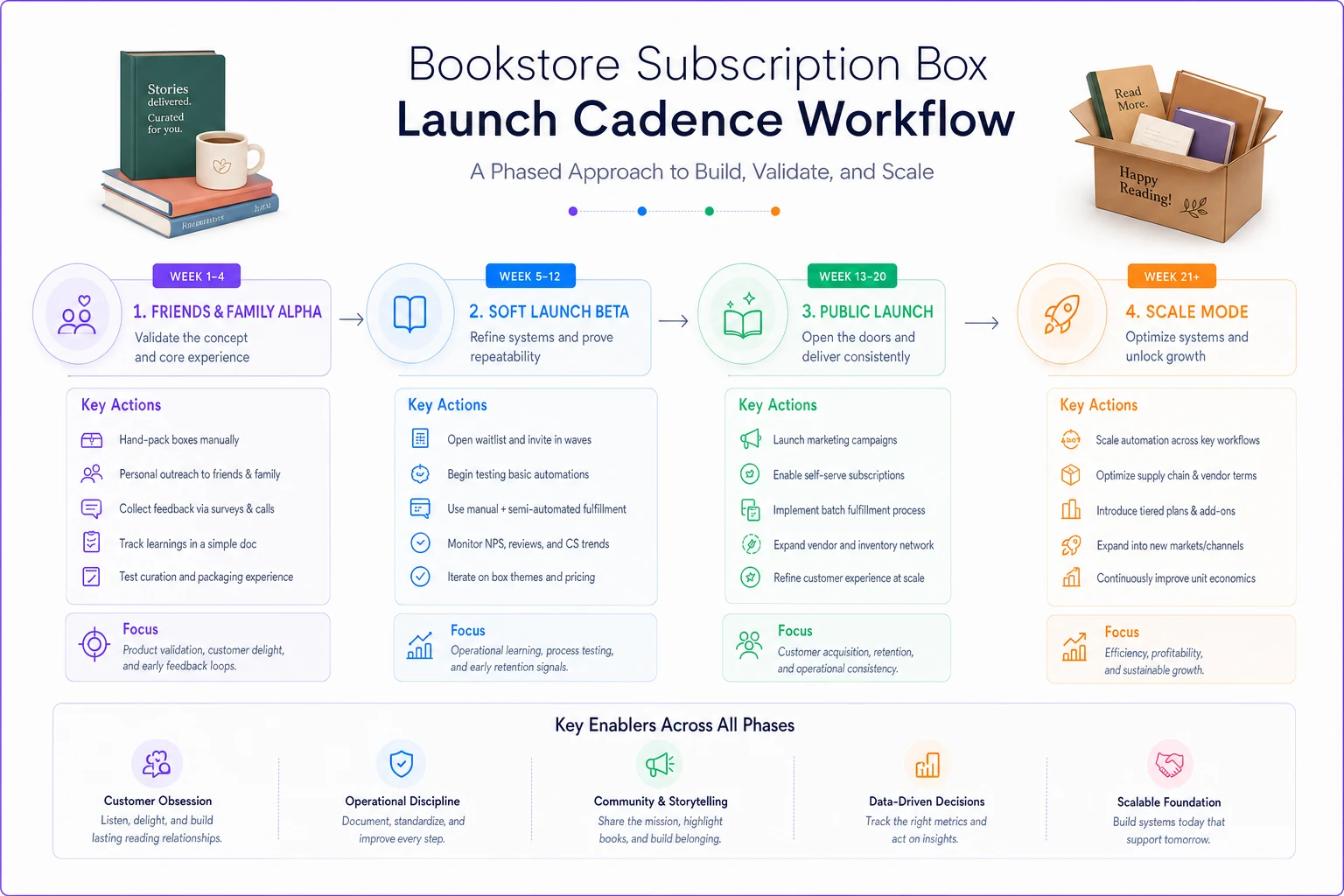
Here's a visual you can reference as you plan each phase.
This cadence seems slow, but it prevents the cascading failures that kill most subscription boxes. When you hit snags at 15 boxes, they're fixable. At 150 boxes, they're catastrophic.
You'll be tempted to skip phases. Don't. Every successful launch follows some version of this progression.
The worked P&L that keeps you honest
Realistic 100-subscriber P&L for a three-tier bookstore subscription box operation in month six:
Monthly Revenue:
-
Essential Tier
55 subscribers × $26 = $1,430
-
Curator Tier
35 subscribers × $42 = $1,470
-
Collector Tier
10 subscribers × $70 = $700
-
Total Revenue
$3,600
Direct Costs:
-
Products (avg 38% of revenue)
$1,368
-
Shipping (avg $7.50/box)
$750
-
Packing materials
$185
-
Pick/pack labor (5 hrs @ $18)
$90
-
Total Direct Costs
$2,393
Gross Margin: $1,207 (33.5%)
Operating Expenses:
-
Platform fees (2.9% + $0.30/transaction)
$115
-
Email/SMS tools
$45
-
Community platform
$29
-
Design/curation time (8 hrs @ $22)
$176
-
Customer service (4 hrs @ $18)
$72
-
Total Operating
$437
Net Operating Income: $770 (21.4%)
This is steady-state month six, not month one. Your first three months will likely operate at a loss while you debug operations and build initial scale. The stores that survive plan for this explicitly.
Automation isn't optional at scale
Once you pass 75 subscribers, manual fulfillment becomes a liability. The error rate jumps, fulfillment time expands, and margins compress from operational inefficiency.
Building systematic retention programs becomes crucial. The same operational foundation that makes events repeatable can power subscription fulfillment.
The specific automation points that matter most:
Subscription Management
Track preferences, pause requests, tier changes, and payment failures in one system. A bookstore manually managing this across spreadsheets and payment processors averages 3-4 hours weekly just on subscription maintenance.
Fulfillment Workflow
Generate pick lists by tier, print packing slips in batch, and track fulfillment status without jumping between systems. The difference between manual and automated fulfillment is roughly 6 minutes per box at 100+ unit volumes.
Churn Monitoring
Flag at-risk subscribers based on engagement patterns, not just payment failures. Automated alerts for the 45-day danger zone can prevent 20-30% of preventable churn.
Inventory Allocation
Reserve subscription inventory separately from floor stock. One accidental sale of allocated subscription inventory can cascade into 20 customer service emails and rushed reorders.
Modern bookstore operational software handles these workflows through AI-powered automation that learns your specific patterns and preferences. The operational efficiency gain typically pays for the platform cost at anything above 50 monthly subscribers.
The honest timeline to profitability
Months 1-3: Operating loss of $400-800/month while establishing operations
Months 4-6: Breakeven as volume increases and operations stabilize
Months 7-9: 10-15% margins as retention improves and costs optimize
Months 10-12: 18-25% margins if retention holds and operations scale
The stores that fail usually quit during months 2-4 when the operational complexity peaks but volume hasn't reached efficiency. The ones that succeed have enough capital to weather the learning curve and enough operational discipline to fix problems systematically rather than reactively.
This timeline isn't speculation. It's based on real bookstore performance data across multiple launches. Plan accordingly.
Make the launch decision with clear eyes
Subscription boxes can absolutely work for indie bookstores. But they're not passive income streams — they're operational commitments that require genuine infrastructure and consistent execution.
Before you launch, answer these honestly:
-
Can you float 3-4 months of operational losses while you learn?
-
Will you maintain fulfillment discipline when December floor traffic peaks?
-
Do you have 15-20 hours monthly for ongoing operations beyond packing?
-
Can you handle 20% monthly churn without taking it personally?
If those answers are yes, you have the operational foundation to build something sustainable. Start with the framework above, modify based on your local reality, and give yourself permission to iterate aggressively in those first 12 weeks.
The bookstores running profitable subscription boxes didn't get there through better curation or clever marketing. They got there through operational discipline, systematic testing, and the patience to let unit economics improve with scale. The margin is there — you just need the right operational framework to capture it.