



A bookstore in Portland ships 200 packages monthly. Their damage rate dropped from 8% to under 1% after switching box suppliers and implementing weight-based padding rules. They actually spend less on packaging now — about $140 less per month — because they stopped overprotecting lightweight orders and properly protecting heavy ones.
Most indie bookstores treat packaging like an afterthought until damage claims pile up. Then they overcorrect, wrapping everything like it's heading to Mars, burning through bubble wrap and eating into already thin margins.
The problem isn't choosing between cheap and protective packaging. It's understanding which books actually need protection, which carrier routes destroy packages, and where that insurance threshold makes financial sense.
Box sizing rules that actually match book categories
Standard media mail gets destroyed because stores use whatever box is handy. A single hardcover rattling around in a 12x9x4 box basically guarantees corner damage. But cramming three paperbacks into a tight mailer causes spine creasing when the postal worker shoves it into a sorting bin.
The sweet spot for single hardcovers: 10x8x3 boxes with half-inch clearance on all sides. For paperback bundles under 3 pounds: 9x6x2.5 rigid mailers. Anything over 5 pounds needs proper corrugated boxes, not those flimsy single-wall things that collapse.
Single trade paperback (under 1 lb)
-
Rigid mailer
9x6x1.5"
-
Padding
Single bubble wrap sheet
-
Cost per package
$1.85
-
Damage rate
0.3%
Hardcover or 2-3 paperbacks (1-3 lbs)
-
Box size
10x8x3"
-
Padding
Corrugated insert or air pillows
-
Cost per package
$2.40
-
Damage rate
0.5%
Multi-book orders (3-8 lbs)
-
Box size
12x9x4" or 14x10x6"
-
Padding
Honeycomb wrap for heavies, bubble for mixed
-
Cost per package
$3.20-3.80
-
Damage rate
0.8%
Bulk orders (over 8 lbs)
-
Double-wall corrugated, sized to order
-
Padding
Combination honeycomb + void fill
-
Cost per package
$4.50+
-
Damage rate
1.2%
The sizing mistakes that hurt: using 12x9x6 boxes for everything because you got a bulk deal, or those variable-depth boxes that never quite fit right and leave books sliding around during transit.
Insurance thresholds based on carrier performance
USPS Media Mail under $50? Skip insurance. The claim process takes 60+ days and approval rates hover around 40%. But anything over $75 going FedEx Ground absolutely needs it — their automated claim system actually pays out within two weeks.
Orders $25-50: Self-insure. Set aside $0.30 per package into a damage fund. You'll come out ahead unless your damage rate exceeds 3%.
Orders $50-100: Insure only on high-risk routes. Track which zip codes generate claims. Usually it's distribution hubs in Memphis, Chicago, and anywhere in Florida during hurricane season.
Orders $100+: Always insure, but use carrier insurance for USPS (cheaper at $2.45 per $100) and third-party for UPS/FedEx (about $1.80 per $100 through Shipsurance).
Bookstores that track damage by carrier route find that certain facilities destroy 5-10x more packages. A store in Austin discovered that anything routed through the Dallas hub had triple the damage rate. They started using FedEx for Dallas-area orders and cut damage claims by 60%.
Padding rules by book type and weight
Coffee table books need completely different protection than mass market paperbacks. Yet most stores use the same bubble wrap for everything.
For hardcovers with dust jackets: wrap in tissue paper first, then single layer of small-cell bubble wrap. The tissue prevents the bubble pattern from imprinting on glossy jackets during summer heat.
Paperback sets in the same box: alternate spine direction and use corrugated dividers every 3-4 books. This prevents the domino effect where one shifted book damages three others.
Art books and anything over $40 retail: honeycomb wrap outperforms bubble wrap by huge margins. Yes, it costs $0.40 more per package, but damage rates drop from around 3% to near zero. On a $75 art book, that's cheap insurance.
Children's board books are tanks — they need minimal padding. But young adult paperbacks with those bendy covers? They need rigid corner protectors or they'll arrive looking like someone sat on them.
The weight threshold that matters: 4 pounds. Below that, books shift but don't generate enough force to damage each other. Above 4 pounds, movement becomes destructive. That's when you need void fill that actually stays in place, not those air pillows that deflate halfway through transit.
Order profile packing standards
Standard single book order (most common)
-
Verify book condition at pick
-
Wrap if hardcover or over $30
-
Select box with 0.5" clearance minimum
-
Add corner protection for hardcovers
-
Single void fill layer
-
Shake test — nothing moves
-
Tape with 3" coverage on all seams
Total time: 45 seconds. Material cost: $1.85-2.40
Gift orders (15% of shipments)
-
Tissue wrap regardless of book type
-
Include packing slip in sleeve, not loose
-
Use branded tape if available
-
Add "fragile" sticker for orders over $50
-
Double-box if requested (add $2.20)
-
Include gift message card in protective sleeve
-
No pricing information visible
Total time: 90 seconds. Material cost: $2.80-3.50
Bulk educational orders
Heavy orders with skinny margins require different handling.
-
Pre-sort by weight class
-
Heaviest books at bottom
-
Corrugated sheet every 5 pounds
-
Wrap separately if mixing hardcover/paperback
-
Label box "1 of X" clearly
-
Include detailed packing list
-
Photo before sealing for claims
Total time: 3-5 minutes per box. Material cost: $4.50-8.00
Rare/collectible shipments
-
Photo book condition before packing
-
Acid-free tissue wrap
-
Rigid mailer inside box (double protection)
-
Corner guards on all four corners
-
"Do not bend" stickers on all sides
-
Signature confirmation required
-
Full insurance plus documentation
Total time: 3-4 minutes. Material cost: $6.00-10.00
Material cost comparison
The price spread between adequate and great packaging is smaller than most stores think. But the spread between suppliers is massive.
| Material Type | Uline | Amazon | Regional Supplier | Per-Package Impact |
|---|---|---|---|---|
| 10x8x3 boxes | $0.78 | $1.15 | $0.62 | Base cost |
| Bubble wrap (per ft) | $0.08 | $0.12 | $0.06 | +$0.24-0.48 |
| Air pillows | $0.15 | $0.22 | $0.11 | +$0.30-0.45 |
| Honeycomb wrap | $0.28 | $0.35 | $0.22 | +$0.44-0.66 |
| Tissue paper | $0.04 | $0.08 | $0.03 | +$0.08-0.12 |
| Packing tape (per pkg) | $0.12 | $0.18 | $0.09 | Required |
A store shipping 200 packages monthly saves $180 just by switching from Amazon to regional suppliers. That's before considering damage reduction.
False economy trap: buying 500 cheap boxes that sort of work versus 200 proper boxes that prevent damages. Those "saved" dollars disappear when damage claims hit 5% versus 1%.
Seasonal adjustments that prevent December disasters
Holiday shipping changes everything. Packages that survive normal handling get crushed in December's volume surge. Damage rates typically double between Thanksgiving and New Year's.
Starting November 15: upgrade all single paperbacks to boxes instead of mailers. Add 20% more void fill to everything. Switch to priority mail for anything over $40 — faster transit means less handling.
Starting November 15: upgrade all single paperbacks to boxes instead of mailers.
Summer requires opposite adjustments. Adhesive fails above 95°F, so reinforce tape on all seams. Bubble wrap can actually melt and stick to glossy covers, so switch to honeycomb or corrugated wrap for valuable books from June through August.
Hurricane season protocol: no media mail to Florida, Louisiana, or coastal Texas from August through October. Packages sit in flooded facilities. One store learned this after losing $800 in inventory when a distribution center flooded.
When operational software handles the decision tree
The complexity multiplies when you're making these packaging decisions 50 times a day. Is this order going to a high-risk zip code? Does this combination of books need extra protection? Should this gift order get premium treatment?
Most stores default to overprotecting everything because tracking all these variables manually is impossible. AI-powered operational software that knows your damage history, carrier performance, and order patterns can flag exactly which packages need extra attention.
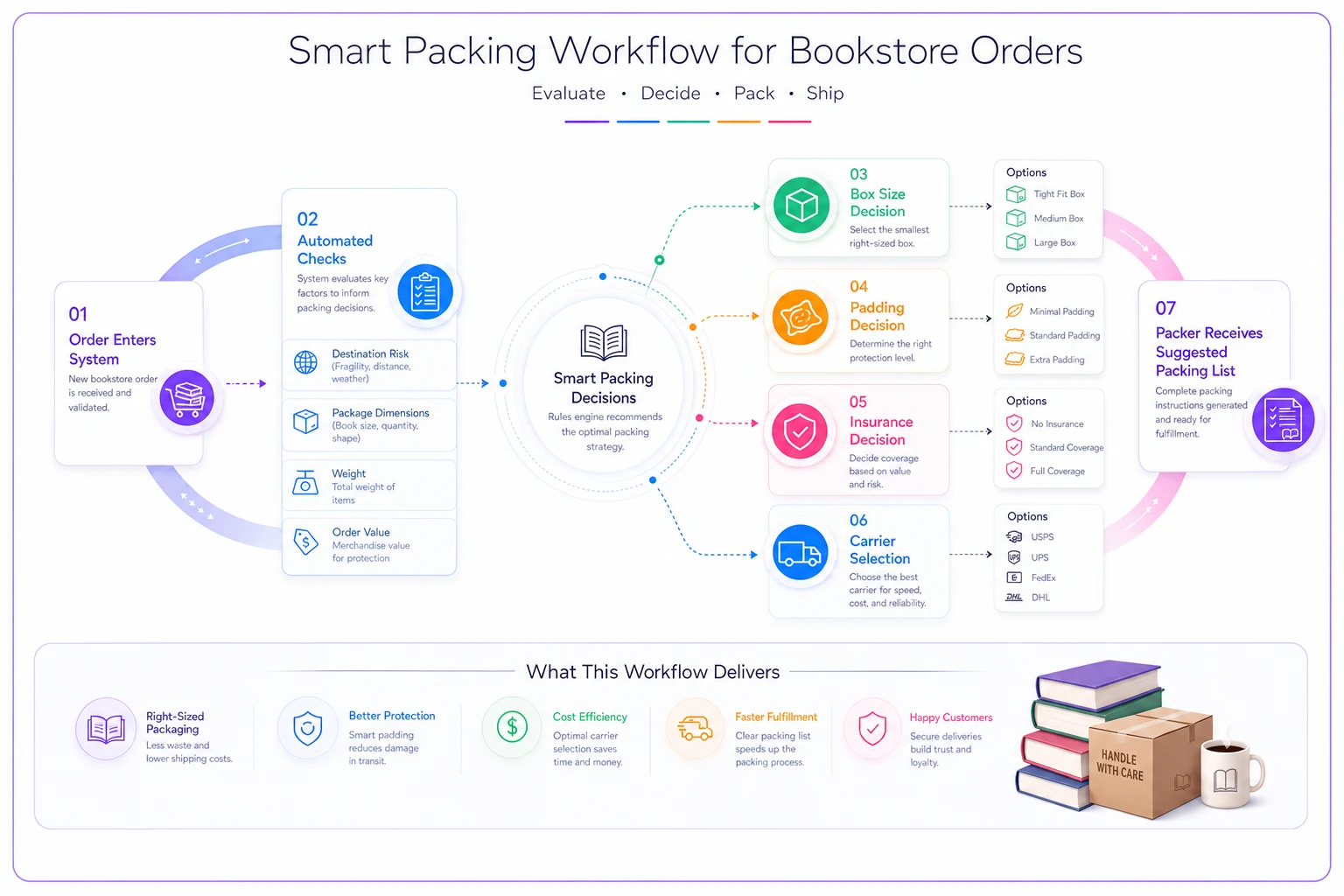
Stores getting their damage rates near zero aren't just following generic best practices. They're building institutional knowledge about what works for their specific mix of books, carriers, and customers. That knowledge lives in their operational systems, not just in whoever happens to be packing orders that day.
Cost reality check
Current state (overprotecting everything):
-
Average cost per package
$3.80
-
Monthly packaging spend
$760
-
Damage rate
3%
-
Monthly damage losses
$450
-
Total monthly cost
$1,210
Optimized packaging standards:
-
Average cost per package
$2.65
-
Monthly packaging spend
$530
-
Damage rate
0.8%
-
Monthly damage losses
$120
-
Total monthly cost
$650
That's $560 saved monthly, or roughly $6,700 annually. For a bookstore doing $400,000 in revenue, that's almost 2% of gross sales recovered just by packing smarter.
The bigger win is customer retention. A damaged book doesn't just cost you the replacement and shipping. That customer probably won't order again. At an average lifetime value of $200 per customer, every prevented damage incident is worth far more than the packaging cost difference.
Start with high-risk categories
Don't overhaul everything at once. Start by fixing packaging for your most damage-prone categories: Art and photography books (highest value, highest damage rate), cookbook sets (heavy, multiple items, corners vulnerable), vintage paperbacks (fragile, irreplaceable), and gift orders (customer expectation highest).
Track damage rates for one month, adjust packaging standards, then measure again. Most stores see improvement within two weeks.
The measurement that matters: damage rate by category, not overall. A 1% overall rate might hide a 5% rate in hardcovers that's killing your reputation with collectors.
Customers judge your entire operation by how their order arrives. They don't see your carefully curated inventory or friendly staff — they see a bent corner or torn dust jacket. Getting packaging right isn't just about controlling costs. It's about delivering on the promise you make when someone trusts you with their order.
Every damaged book is a miniature business failure. But with the right standards, most of them are preventable. The question isn't whether you can afford proper packaging standards. It's whether you can afford not to have them.