


Most indie bookstores already have the revenue sitting right there. It's in the cart someone abandoned at $47 last Tuesday. It's in the regular who used to come in every three weeks and hasn't shown up since April. It's in the fourteen people who RSVP'd to the author event and never walked through the door.
The problem isn't that these customers disappeared. It's that nobody built a system to notice when they went quiet and do something about it on a schedule. Recovery almost always loses to whatever's screaming louder that day — a shipment that came in wrong, a register that froze, a school order due Friday.
This is a systems problem, not a motivation problem. And the stores that get bookstore win-back cart recovery right aren't the ones with the best email copy. They're the ones who decided in advance which signal triggers what action, who does it, and when — then stopped relying on memory.
The three signals that actually tell you money is leaking
Win-back gets treated like one big category, which is exactly why it rarely gets done well. There are a few distinct signals, each with a different clock, a different reason behind it, and a different recovery play. Lump them together and you end up sending a generic "we miss you!" email to someone who abandoned a cart four hours ago because their card got declined. Wrong message, wrong moment.
Abandoned cart. Someone online got to checkout and stopped. This signal is hot and short. The intent was there minutes ago. Most of the recoverable money here evaporates inside 24–48 hours. After that, whatever pulled them away has usually won.
Lapsed customer. A repeat buyer — in-store or online — who's broken their normal rhythm. This one's slow-burning. There's no single moment of friction; the relationship just drifted. The recovery window is measured in weeks, sometimes a couple of months, and the play is about relevance, not urgency.
Post-event no-show. Someone cared enough to RSVP or buy a ticket, then didn't come. This is an underrated signal because the intent was high and recent, and the "failure" was often logistical — forgot, ran late, kid got sick — rather than a loss of interest.
What tends to happen is that stores try to solve all three with the same tactic — usually a discount — and then conclude "win-back doesn't work for us." It's not that it doesn't work. It's that a 10%-off coupon is the right answer for roughly one of these three signals and completely wrong for the other two.
Why recovery breaks down in real bookstore operations
The breakdown is almost never ignorance. Every owner knows they should follow up with lapsed regulars. The breakdown is structural.
In a 1–3 person shop, recovery work has no home. Receiving has a home. The register has a home. Events have a home. But "notice that Marcus hasn't bought in nine weeks and reach out" belongs to nobody, so it happens when someone remembers — which is roughly never during December and sporadically the rest of the year.
Then there's the data problem. Your abandoned carts live in your e-commerce platform. Your in-store purchase history lives in your POS. Your event RSVPs live in Eventbrite or a Google Sheet or a clipboard by the door. These three systems don't talk to each other, so the signal — the thing that should trigger a recovery action — is scattered across three places nobody checks in the same sitting.
A typical scenario: a customer buys a $90 preorder stack online, abandons a second cart two weeks later, then skips a ticketed event the following month. Three separate signals from one high-value person, sitting in three separate systems, and the store treats each as a non-event because no single screen ever shows them together.
This gets worse as you grow. More channels means more places for signals to hide. A store doing $200k with one sales channel can run win-back on intuition. A store doing $600k across retail, marketplace, web, and events cannot. The intuition stops scaling right around the point where the lost revenue gets big enough to actually matter.
The decision map: signal → window → action
Instead of asking "should we do win-back this week," you build a map once that answers "when this happens, that follows." The map removes the daily decision, which is the whole point.
| Signal | Recovery window | First touch (automated) | Follow-up (manual) | Typical offer | Realistic recovery rate |
|---|---|---|---|---|---|
| Abandoned cart | 0–48 hrs | Reminder email at ~1 hr and ~24 hr | Personal note only for carts over ~$75 | None first, free ship or small % on 2nd touch | 8–15% of carts |
| Lapsed customer (30–60 days) | 2–6 weeks | "New in your favorite section" email | Phone/text for top spenders | Curated pick, not a discount | 5–12% reactivated |
| Lapsed customer (90+ days) | 1–2 months | Re-intro email + what's new | Handwritten card for VIPs | Modest credit if needed | 3–8% reactivated |
| Post-event no-show | 0–7 days | "Sorry we missed you" + recap | Hold signed copy, offer pickup | Signed stock or event discount | 15–25% convert |
Two things worth noticing. First, the hottest and highest-intent signals — abandoned cart and no-show — have the shortest windows and the least reliance on discounting. Urgency plus intent means you often don't need to give up margin; you just need to show up fast. Second, the lapsed-customer plays lean on curation over coupons, because the issue was relevance drifting, not price.
The no-show row is the one most stores ignore entirely. Someone who RSVP'd for a signing and didn't make it is dramatically more likely to buy a signed copy over the next week than a random email subscriber. Holding one signed copy and sending a two-line "we saved one for you" note converts at rates that make blanket discounts look lazy by comparison.
The hybrid flow: what the machine does vs. what you do
Treating this as either fully manual or fully automated is a mistake on both ends. Fully manual doesn't scale and quietly dies every November. Fully automated feels robotic, which kills the personal touch that makes indie bookstores worth visiting in the first place.
The right split is based on value and emotion. Low-value, time-sensitive, repetitive touches get automated. High-value or emotionally meaningful touches stay human. Here's how that division actually runs for an abandoned cart:
-
Hour 1 — automated. A simple reminder email fires
"Still thinking it over? Your cart's saved." No discount. This alone recovers a meaningful chunk, because a lot of abandons are just distraction.
-
Hour 24 — automated. Second email, slightly warmer, maybe surfacing free shipping over a threshold if they're close. Still no desperation discount.
-
Cart over ~$75 and still unrecovered at 48 hrs — manual. This drops onto a short daily list. A staffer sends a genuine one-line note, references the actual titles ("noticed you had the new Erdrich in your cart — we've got two left, want me to hold one?"). This is where indie stores destroy Amazon. Amazon cannot do this. You can.
The lapsed-customer flow works the same way but stretched out. The automated layer keeps a lapsed reader seeing relevant arrivals so you never fully go dark. The manual layer is reserved for your top 20–30 customers by lifetime value — the people worth a real phone call or a handwritten card. You are not writing notes to everyone. You're writing notes to the fifteen people whose return actually moves the month.
This connects directly to how you map triggers across the whole customer journey, not just at the moment of loss. If you haven't built those trigger points yet, the groundwork in bookstore customer lifecycle operations: trigger maps, first-purchase playbooks and win-back P&Ls is where the signals get defined in the first place — recovery is the back half of that same lifecycle.
Quick visual of the hybrid flow:
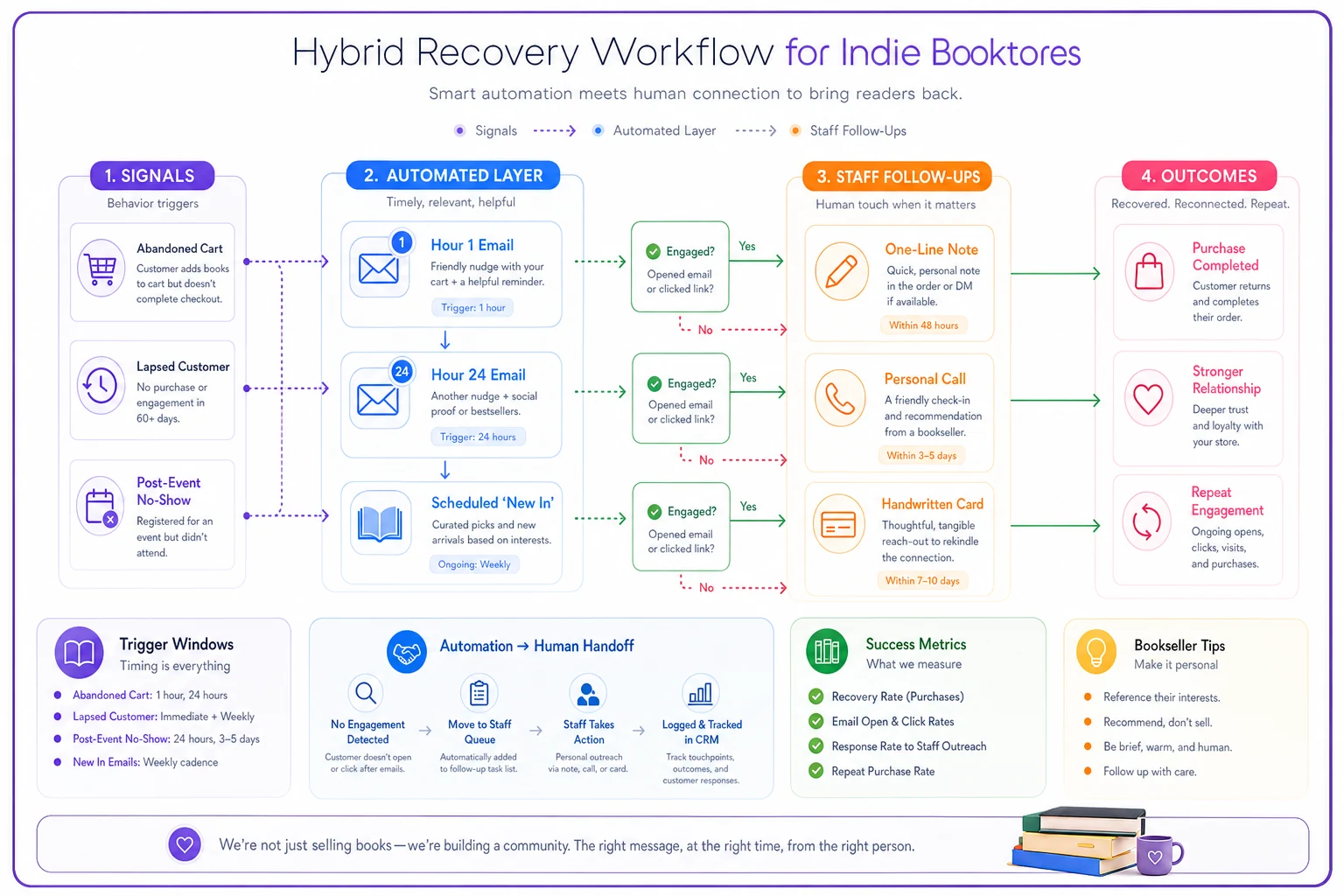
This diagram shows when automation handles the touch and when staff step in.
Scripts that don't sound like a chain store
The copy matters less than people think and more than automation vendors admit. The rule: automated touches should sound like your store, and manual touches should sound like a person who actually works there.
Abandoned cart, hour 1 (automated): > "Hey — your cart's still here whenever you're ready. We only keep a couple copies of most titles in stock, so reply if you'd like us to set one aside."
Abandoned cart, 48 hr manual note (over $75): > "Hi Dana — saw you were looking at [title] and [title]. We've got both on the shelf right now. Happy to hold them under your name through the weekend if that helps. — Sam at [Store]"
Lapsed regular, 60-day (automated): > "It's been a minute! A few things landed in [their top section] that we think are right up your alley — [two specific titles]. Come flip through them next time you're in."
Lapsed VIP, 90-day (manual, phone or card): > Not scripted. Genuinely just: "We were restocking the mystery section and thought of you — the new [author] came in and I set one aside in case you wanted first look."
Post-event no-show (automated within 24 hrs): > "Sorry we missed you last night! [Author] signed a few extra copies before heading out — we're holding them for folks who couldn't make it. Want us to set one aside?"
The no-show script does something subtle: it reframes the miss as still having access to the exclusive thing. That's the whole conversion. You're not guilt-tripping; you're extending the privilege.
A real scenario, with the math
A bookstore doing roughly $480k a year — about 70% in-store, 30% web and events combined. Small team, no dedicated marketing person.
Before building a recovery system, abandoned carts just vanished. The e-commerce platform was collecting them, nobody looked. Lapsed regulars left quietly. Event no-shows got nothing. The owner's gut estimate of recoverable revenue: "probably not much."
They mapped the three signals and set up the hybrid flow — automated first touches, manual follow-up only on carts over $75 and their top 25 or so customers. Rough results over the first four months:
-
Abandoned cart emails recovered around 11% of abandoned carts, which came to roughly $2,800–$3,400 in web sales that would've been zero.
-
The lapsed-regular nudges pulled back somewhere around 18–22 customers who'd gone 60+ days quiet. Hard to attribute perfectly, but conservatively $4k–$6k over the period.
-
Post-event signed-copy holds converted close to 1 in 5 no-shows into a sale. Low total volume, but near-pure margin — a few hundred dollars per event that used to be nothing.
Somewhere in the $9k–$13k range of recovered revenue in four months, against maybe 2–3 hours of staff time per week on the manual layer. The automated layer, once set up, cost essentially nothing to keep running.
The owner's real takeaway wasn't the dollar figure. It was that the revenue had always been there — it just never had a system assigned to catch it.
Where the right tooling earns its keep
Everything above can be run with a spreadsheet, your POS reports, and your e-commerce platform's built-in cart emails. For a lot of stores, that manual-plus-basic-automation version is genuinely enough to start, and starting there beats waiting for perfect software.
The friction shows up when the signals live in separate systems and you're the one manually stitching them together every week — pulling the lapsed list from the POS, the carts from the web platform, the no-shows from the event tool. That reconciliation is the part that quietly dies first when things get busy. An operational platform that pulls those signals into one view and fires the automated first touches on a schedule stops being a luxury at that point and starts saving the whole system from itself. The goal isn't to automate the human notes — it's to make sure the signal never gets missed so a human can decide whether it deserves a human touch.
Start with the two automated cart emails and a shared spreadsheet; upgrade tooling once signals live in more than one system.
The goal isn't to automate the human notes — it's to make sure the signal never gets missed so a human can decide whether it deserves a human touch.
When this makes sense — and when it doesn't
When to build the full system: You're running more than one sales channel, your lapsed-customer list is big enough that you can't hold it in your head, and you've got at least a couple hundred abandoned carts a year sitting unused. At that point the lost revenue is real money and the manual-only approach has already failed you at least once.
When to keep it simple: If you're a single-channel, low-volume shop where you genuinely recognize most regulars by name, skip the automation layer entirely. Your personal recognition is the system. Just add the two automated cart emails — low effort, high return — and handle the rest in person.
Who should NOT do this: Anyone treating win-back as a discount machine. If the plan is "email everyone 20% off and hope," you'll train your best customers to wait for coupons and erode the margin on sales that would've happened anyway. The entire point of the signal map is to use discounts surgically — mostly on the slow-burn lapsed segments — and almost never on the hot, high-intent signals.
The bigger picture
Recovery isn't a campaign you run once and revisit quarterly. It's a standing capability — a set of tripwires that notice when a customer goes quiet and route the right response to the right person on the right clock. The indie stores that treat it this way aren't working harder than the ones who don't. They're just not relying on willpower to catch money that's already slipping out the door.
Once recovery is running cleanly, it feeds the next question: how do you turn those recovered customers into reliable income instead of one-time saves? That's a different build — the recurring-revenue and P&L work covered in turn one-off buyers into repeat income: a bookstore recurring-revenue testing and P&L framework — but it only works if you've first stopped the leak. Catch the second chance, then build the third, fourth, and fifth on top of it.