

Every indie bookstore owner thinks they know their customers. The regulars who come in for poetry readings. The mom who preorders every middle-grade fantasy release. The professor who special-orders obscure academic titles.
What's actually happening beneath that surface familiarity is that customer behavior follows predictable patterns most bookstores completely miss. Not because owners don't care, but because there's no operational framework for tracking and responding to those patterns in a two-person shop.
After building operational software for bookstores ranging from single-location indies to small chains, the same gap shows up everywhere. Stores capture maybe 15% of customer behavior signals — usually just transaction data — while missing the behavioral triggers that actually predict future purchases, churn risk, and lifetime value.
The three-segment reality most bookstores discover too late
Walk into any indie bookstore and ask about customer segments. You'll hear about "the regulars" and "tourists" and maybe "event attendees." These gut-feel categories aren't wrong — they're just operationally useless.
The segments that actually matter look different: Discoverers (35-45% of customers): First purchase within 90 days, no clear category preference yet, high churn risk but real potential. These customers typically find you through events, gift-buying, or foot traffic. Their second purchase probability sits around 22% without any follow-up, but jumps closer to 48% with a basic outreach sequence. Builders (25-30% of customers): Made 2-5 purchases, starting to show category preferences, beginning to engage with your communications. This is where lifetime value gets determined. A builder who makes their fourth purchase within six months has roughly an 82% chance of becoming a long-term customer. Sustainers (20-25% of customers): 6+ purchases annually, clear preferences established, lower per-transaction value but consistent frequency. Despite being the smallest segment by count, these customers typically generate around 55% of annual revenue.
The remaining percentage? One-time gift buyers and tourists who were never coming back regardless of what you did. What breaks this model at most bookstores is the complete absence of any systematic response when customers move between segments. A discoverer makes their first purchase and... nothing happens. Maybe they get added to an email list. There's no trigger, no workflow, no real attempt to move them toward builder status.
Building trigger maps that actually work with two-person operations
"Trigger map" sounds like enterprise software territory, but the concept is straightforward: when specific customer behaviors happen, specific operational responses follow.
Here's what a functional trigger map looks like for a bookstore with limited staff:
First Purchase Triggers:
-
Receipt shows fiction purchase → 7-day email with staff picks in the same subgenre
-
Receipt shows children's book → 14-day email about storytime schedule
-
Receipt shows special order → flag for personal follow-up when item arrives
-
Purchase happens during event → 3-day thank-you with next month's event calendar
Behavior Pattern Triggers:
-
Second purchase within 30 days → add to "new regular" manual outreach list
-
No purchase in 90 days after being monthly → win-back sequence starts
-
Three purchases in the same category → targeted recommendation email for that category
-
Event RSVP but no-show → gentle follow-up with event recording or summary
Value Threshold Triggers:
-
Single purchase over $75 → handwritten thank-you card protocol
-
Annual spend crosses $200 → VIP early access to sales and events
-
Preorder placed → automatic reminder system for pickup
A quick visual of the trigger map in action.
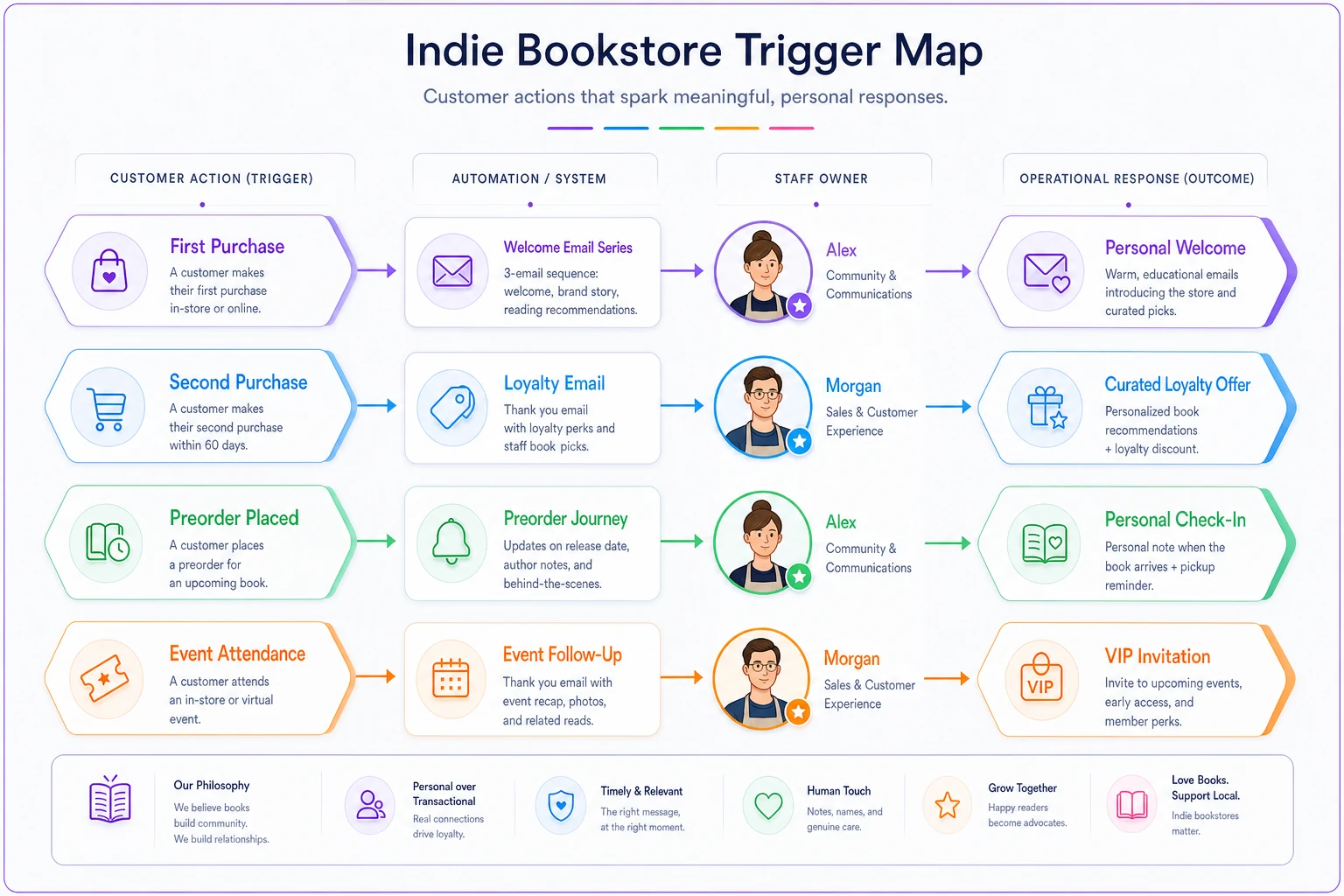
If you can't automate, assign a weekly 15-minute trigger check to ensure first-purchase and preorder triggers aren't missed.
The operational challenge isn't identifying these triggers — it's executing them consistently when you're also running register, receiving shipments, and planning events.
The preorder predictor pattern nobody talks about
Preorders reveal more about a customer's lifecycle position than almost any other behavior, yet most bookstores treat them as simple transactions.
A customer who places their first preorder has already made several implicit decisions: they trust you'll fulfill it, they're planning purchases months ahead, and they've chosen you over Amazon's convenience. That customer has a strong probability of reaching sustainer status within 12 months. But what typically happens? Customer places preorder, maybe gets a confirmation email, then nothing until the book arrives. Sometimes not even a pickup reminder.
Preorder customers are explicitly telling you their interests months in advance. They're raising their hands saying "I care about this author or series enough to wait for it." The operational response should be systematic:
-
Immediate confirmation with expected arrival date
-
Monthly update if release date is 60+ days out
-
Arrival notification with a 48-hour hold commitment
-
Follow-up 7 days post-pickup with related recommendations
-
Flag for similar future preorder opportunities
One bookstore in Portland implemented this exact sequence and saw preorder volume increase around 40% year-over-year. More importantly, preorder customers' annual spend increased by roughly $120 per customer.
Event attendance as a lifecycle accelerant
Most bookstores run events and track basic attendance numbers. What they don't track is the correlation between event attendance and purchase behavior.
The patterns across multiple stores are consistent:
-
First-time event attendees who buy something have a strong chance of returning within 60 days
-
Customers who attend 3+ events annually spend more than twice what non-attendees spend
-
Event attendees refer new customers at a much higher rate than transaction-only customers
Yet operationally, most stores treat event attendees and purchasers as separate populations. The guest list doesn't talk to the POS system. The follow-up email goes to everyone who RSVP'd, not segmented by who actually showed up or bought anything.
A proper operational framework connects these dots:
Pre-event:
-
Check attendee list against customer database
-
Flag first-time attendees for a special welcome
-
Note regular customers attending their first event
During event:
-
Track who actually shows (not just RSVPs)
-
Note purchases made by attendees
-
Capture contact info for non-customers
Post-event:
-
Different follow-ups for attendees vs. no-shows
-
Purchase-triggered recommendations for buyers
-
First-time attendee welcome sequence initiates
This doesn't require complex technology. One store runs this entire system with a clipboard, a spreadsheet, and scheduled emails. Building the right event follow-up system matters more than having perfect automation.
The win-back P&L nobody calculates
Every bookstore has lapsed customers. The question is whether trying to win them back actually makes financial sense.
Costs per 100 lapsed customers:
-
Email series creation
2 hours staff time (~$30)
-
Postcard design and printing
$85
-
Postage
$42
-
20% discount on return purchase
~$140 in margin
-
Total cost
$297
Typical returns:
-
8-12 customers return
-
Average purchase
$35
-
6-month value of returned customer
$105
-
Total 6-month revenue
$840-1,260
-
Less discount impact
$700-1,120
-
Net gain
$403-823
| Cost / Return | Amount |
|---|---|
| Email series creation | 2 hours staff time (~$30) |
| Postcard design and printing | $85 |
| Postage | $42 |
| 20% discount on return purchase | ~$140 in margin |
| Total cost | $297 |
| Net gain (6-month) | $403-823 |
The key insight here is that win-back economics only work if you can identify which lapsed customers are actually worth pursuing. A customer who made one $15 purchase and disappeared isn't worth a postcard. A customer who spent $200 annually for two years and then went quiet — that's a different story.
The segmentation for win-back should follow value tiers:
-
Tier 1 (top 20% by historical value)
Personal outreach, handwritten note, meaningful offer
-
Tier 2 (middle 40%)
Email sequence plus postcard, moderate discount
-
Tier 3 (bottom 40%)
Email only, minimal cost
Most stores either blast everyone with the same message or do nothing at all. Neither approach makes operational sense.
First-purchase playbooks for two-person teams
The first 30 days after a customer's initial purchase largely determine whether they become a regular or disappear. Yet most bookstores have no systematic approach to this window.
Here's a realistic playbook that actually works with limited staff:
Day 0 (Purchase day):
-
Capture email at register (incentivize with a bookmark or 10% off next purchase)
-
Quick verbal mention of an upcoming event or new arrival
-
Receipt in bag with return policy visible
Day 3-7:
-
Thank-you email with store story and values
-
One specific recommendation based on their purchase
-
Mention an upcoming event tied to their interest
Day 14:
-
Follow-up with a short curated list (3-5 books) based on the purchase
-
Mix of bestsellers and staff picks
-
"Customers who bought X also loved Y" section
Day 30:
-
Check if customer returned
-
If returned
move to regular communication cadence
-
If not
trigger a gentle re-engagement with a timely offer
This isn't complex. The stores seeing 40%+ first-to-second purchase rates aren't doing anything magical — they're just executing basics consistently.
The compound effect of lifecycle optimization
A bookstore in Austin started tracking customer lifecycle metrics seriously about 18 months ago. They didn't transform overnight, but the cumulative effect became hard to ignore:
-
First-to-second purchase rate increased from 24% to 41%
-
Average customer lifetime value rose from roughly $180 to $275
-
Event attendance up 60%, with most attendees making purchases
-
Email engagement doubled once segmentation replaced blast campaigns
The owner put it simply: "We're not doing anything revolutionary. We just stopped assuming customers would figure out how to become regulars on their own."
That gets at the core operational failure in most indie bookstores. They rely on organic customer development instead of building any systematic approach to lifecycle management.
Simple KPIs that actually indicate lifecycle health
Tracking everything is as useless as tracking nothing. Here are five metrics that actually drive operational decisions for bookstores:
-
1. First-to-second purchase rate (target
35-45%)
Measured within 90 days. Below 25% means your first-purchase experience needs work. -
2. 90-day active percentage (target
40-50%)
What percentage of customers made a purchase in the last 90 days? Below 30% points to retention problems. -
3. Preorder attachment rate (target
15-20%)
Percentage of customers who've ever placed a preorder. Below 10% means you're not converting customers into planners. -
4. Event-to-purchase conversion (target
60-70%)
Of event attendees, how many buy something within 7 days? Below 50% suggests a disconnect between events and inventory. -
5. Lifetime value by cohort (track monthly cohorts) Are customers acquired recently worth more or less than historical averages? Declining LTV usually means acquisition quality problems.
These aren't perfect metrics, but they're trackable with basic POS data and they actually drive decisions.
Where manual intervention beats automation
The temptation with customer lifecycle management is to automate everything. But certain touchpoints need a human, especially in indie bookstores where personal connection is most of the value proposition.
Manual intervention makes sense for:
-
Customers crossing into the top 20% by annual spend
-
Special order arrivals for regular customers
-
Failed event RSVPs from usually-reliable attendees
-
Win-back attempts for previously high-value customers
-
Birthday acknowledgments for kids' book buyers
-
Condolence notes surfaced through purchase patterns
One store keeps a simple "manual touch list" updated weekly. It takes maybe 30 minutes to review and a couple of hours to execute — but it drives loyalty that no automated email can match.
The operational reality check
Building comprehensive customer lifecycle operations sounds great until you're facing a Tuesday afternoon with one person on register, another receiving shipments, and nobody available to execute any of this.
The stores making real progress don't try to do everything at once. They pick one segment, one trigger, one workflow, and nail it before adding complexity. Turning one-off buyers into repeat customers starts with getting the basics right first.
Start with first-purchase follow-up. Get that working consistently. Then add event attendance tracking. Then preorder workflows. Each layer builds on the previous one without overwhelming a small team.
The biggest obstacle isn't technology or even time — it's the mental shift from reactive customer service to proactive lifecycle management. Once that clicks, the operational pieces start falling into place.
Most indie bookstores will never have Amazon's recommendation engine or Barnes & Noble's marketing budget. But they can build customer relationships systematically, responding to behavioral signals with the right message at the right time. The stores doing this well aren't just surviving — they're building operations that customers genuinely prefer over the alternatives.
The gap between stores that thrive and stores that quietly close increasingly comes down to operational discipline around customer lifecycle. Not inspiration, not curation, not community feel — but the unglamorous work of tracking, triggering, and responding to customer behaviors consistently.
That's not the romantic vision of indie bookstore ownership. But it's the operational reality that separates the stores that last from the ones that don't.