



Most indie buyers negotiate the wrong thing at the wrong time. They fight for an extra 2% off cover in July, then eat a stockout in November because the publisher's warehouse slipped three weeks and nobody built a rule for what happens when a partial box shows up on the dock. The discount was never the problem. The delivery timing and the cash tied up in early commitments were.
Seasonal buying is where all your operational weaknesses show up at once — forecasting, cash flow, vendor relationships, receiving discipline, and your calendar. A term you sign in August has consequences that ripple through your holiday sales floor and your January bank balance. So this isn't a "how to ask for a better discount" post. It's about the system that connects your pre-season prep, your negotiation, your acceptance rules, and your emergency sourcing back to the reorder windows that actually govern your buy cadence.
Get that system right and seasonal vendor negotiation stops being a once-a-year scramble and becomes something repeatable.
Why seasonal negotiation breaks differently than regular buying
Regular replenishment is forgiving. If a backlist reorder lands a week late, you notice, you grumble, and it barely dents anything. Seasonal buying has no slack. The window is the window. A holiday face-out title that arrives December 18 might as well not exist.
That compressed timeline changes the math on everything you negotiate. In normal buying, dating terms (net-30 vs net-60) are a nice-to-have. In seasonal buying, dating is often the whole game, because you're committing cash months before the sell-through that pays for it. A store that buys $40k of holiday inventory in September on net-30 is financing that entire buy out of slow-season revenue. The same buy on extended dating — invoices due in January against December sales — is a completely different cash position, even at the exact same discount.
The pattern worth internalizing: in seasonal buying, timing terms usually beat price terms. An extra 2 points off cover on a $40k buy is $800. Moving that invoice from October to January can free up thousands in working capital during your tightest months, and that freed-up cash is what lets you chase reorders on the titles that are actually selling.
Buyers who only fight on discount are optimizing the smallest lever.
The pre-season checklist (do this before you talk to a single rep)
The negotiation is mostly won before the call. Walk into a seasonal buy without knowing your own numbers and you're negotiating blind — and the rep knows it. Work through this before you commit to anything:
Never miss a sale or stock shortage again.
Bookstorely helps you manage inventory, orders, and customer relationships seamlessly.
- Integrated inventory tracking
- Customer purchase history
- Sales reporting & analytics
No credit card required
-
Pull last year's seasonal sell-through by title and category. Not just what you bought — what actually sold inside the window, and what you were still clearing in February. That February pile is your overbuy warning.
-
Map your reorder windows to publisher lead times. If a publisher needs 3 weeks to fulfill and your last profitable reorder date is December 5, your real cutoff for that vendor is mid-November. Write the actual dates down.
-
Set your cash ceiling by month, not by season. Know how much you can commit in September vs November. A single seasonal number hides the crunch months.
-
Flag the "must-have" titles vs the "nice-to-have" volume. You negotiate hard and commit early on titles you're confident about. Keep flexibility on everything else.
-
Know your returnability by vendor. A non-returnable term is fine on a proven seller and dangerous on a speculative one. This should shape how much you buy, not just what price you pay.
-
Have your emergency-sourcing alternates identified in advance. More on this below, but you should already know which wholesaler or peer store can backfill a specific title fast before you ever need them.
This prep connects directly to having a real quarterly buying rhythm that cuts stockouts and frees up cash — seasonal negotiation is really just the high-stakes version of the cadence you should already be running the rest of the year.
The mistake most stores make here: they treat the pre-season buy as one big event instead of a series of decisions tied to calendar windows. When you don't segment by window, you over-commit early to hit a discount tier, and then you have no cash or flexibility left when the actual demand signal shows up in late November.
The negotiation scorecard
Reps are good at steering conversations toward the one term that helps them and away from the three that would help you. A scorecard fixes that. Instead of reacting to whatever they lead with, you score the whole deal across the terms that actually matter for a seasonal buy.
| Term | Why it matters seasonally | Weight | What "good" looks like |
|---|---|---|---|
| Dating / payment timing | Frees cash during your commit months | High | Invoices due against sell-through, not on receipt |
| Delivery date commitment | The window is unforgiving | High | Firm ship date + written slippage remedy |
| Returnability | Caps your overbuy downside | High | Returnable on speculative titles |
| Partial-ship handling | Prevents fragmented, unusable deliveries | Medium | Defined rules (see below) |
| Discount off cover | Real, but smallest lever | Medium | Tier you'd hit anyway, not one you stretch for |
| Freight terms | Erodes margin quietly | Medium | Freight-paid over a threshold |
| Reorder responsiveness | Determines if you can chase winners | Medium | Confirmed lead time in writing |
| Co-op / marketing support | Nice bonus, easy to overvalue | Low | Only counts if you'd use it |
Score each term 1–3 on the actual offer, multiply by weight, and you get a number you can compare across vendors. The point isn't the math precision — it's that you stop letting a strong discount paper over weak delivery and payment terms. A deal that scores high on discount and low on everything else is exactly the deal that hurts you in December.
One thing worth noting: when you show up with a scorecard mindset and ask about dating and delivery remedies first, reps recalibrate. They realize they're dealing with a buyer who's tracking the whole deal, not just hunting for a number. The quality of the terms tends to improve. Leading with "what's your best discount" signals the opposite.
Scripts that actually shift terms
You don't need to be aggressive. You need to be specific and anchored to your numbers. A few that work:
On dating:
> "I can commit to the full seasonal quantity now if the invoice dates to January. If it's due on receipt, I have to split this buy and commit less up front — which probably means I miss your tier."
On delivery commitment:
> "This is a seasonal buy, so a firm ship date matters more than usual. If it slips past [date], what's the remedy — do we adjust terms, or convert the late portion to returnable?"
On partial shipments:
> "If you can't ship complete, I'd rather you hold and ship together than send me a partial box I can't merchandise. If it does come partial, I need the balance within [X] days or the remainder cancels clean."
On returnability for speculative titles:
> "I'll take the volume on the frontlist titles firm. On the newer authors, I need those returnable — otherwise I have to cut the quantity in half to manage the risk."
For deeper mechanics on structuring these conversations and the cash math behind them, this pairs well with the detailed breakdown in negotiating publisher terms on indie volumes — the seasonal version just raises the stakes on the timing side.
The common failure here is negotiating each term in isolation. Reps love to give you one concession and act like the conversation is over. Bundle instead: trade commitment size and speed for the terms you actually care about. Your willingness to commit early and in volume is your currency — spend it on dating and delivery, not just discount.
Partial-ship acceptance rules (write these down before the season)
Partial shipments are where seasonal buying quietly bleeds. A box shows up with 40% of the order, your receiving person logs it, shelves it, and now you've got a fragmented display, a half-open PO, and no clear trigger for when the rest is supposed to land. Three weeks later you're chasing a rep to find out where the balance is — during the busiest week of your year.
-
Define a minimum useful fill. Decide the threshold below which a partial isn't worth merchandising (say, under 50% of a title's order). Below that, you flag rather than shelve.
-
Set a balance-arrival deadline. Every partial gets a "balance due by" date logged against the PO the moment it's received.
-
Assign a merchandising hold. For seasonal face-outs, don't build the display on a partial — hold until you hit your minimum fill, or explicitly decide to run with what you have.
-
Create the cancel trigger. If the balance isn't in by the deadline and the reorder window is closing, the remainder cancels and you activate emergency sourcing (next section) rather than waiting.
-
Reconcile before you pay. Partial invoices get matched against what actually arrived — not what was ordered. This is where credits go missing.
What breaks at scale: with a couple of vendors, you can track partials in your head. Once you're running 15–20 seasonal POs across multiple publishers and wholesalers, the ones falling short of full fill get lost, and you either overpay on invoices or discover the gap when a customer asks for a title you thought you had. Standing rules are what keep the tracking from depending on one person's memory during the exact weeks that person is slammed.
Log balance-due dates against the PO in your system so receiving staff get an automatic reminder.
Standing rules are what keep the tracking from depending on one person's memory during the exact weeks that person is slammed.
Emergency sourcing tied to your reorder windows
Here's the connection most buyers miss: your emergency sourcing plan is only useful if it's tied to specific calendar dates. "We'll figure it out if something's late" is not a plan. By the time you know something's late, the window may already be too tight for the slow-but-cheap option.
-
Well before the cutoff reorder through your primary vendor at best terms.
-
Approaching the cutoff switch to your fast wholesaler even at a worse discount, because speed now beats margin.
-
At or past the cutoff peer-store borrow, expedited direct, or accept the stockout and redirect demand to a comparable title in stock.
The trade-off is always speed vs margin, and the calendar tells you which one wins. A title reordered through a wholesaler at 3 points less discount but arriving in time is worth infinitely more than the same title at full discount arriving after the demand's gone.
A worked example. Say a mid-size store commits $38k across seasonal titles in September. One frontlist title — call it 120 copies — is selling faster than projected by mid-November. Primary publisher lead time is 3 weeks; the last profitable sell date is December 20, so the primary cutoff is around November 29. The store hits its reorder trigger November 24, inside the window, and reorders 80 copies through the publisher at full terms. But the publisher confirms a partial: 50 now, balance uncertain. That uncertainty pushes the balance past the safe window. Instead of waiting, the store cancels the balance per its partial-ship rule and pulls the remaining 30 from a wholesaler at a few points worse discount, arriving December 6. Net effect: the store captures roughly $1.2k–$1.5k in holiday sales it would've lost to a stockout, at a margin cost of maybe $60–$90 on the wholesaler copies. That's the trade the calendar made for them — and it only worked because the rules and the alternate source were decided in advance, not improvised.
The stores that handle this well don't have better luck. They have their reorder windows, partial-ship rules, and backup sources all mapped to the same calendar, so when a shipment slips the response is already decided.
When this level of structure is overkill
If you're a very small shop doing one modest holiday buy from two or three vendors you trust, a full scorecard and tiered escalation plan is more machinery than you need. Trust and a good relationship carry a lot of weight at that scale, and formalizing everything can make you look like you're preparing for a fight that isn't there.
Where the structure earns its keep is when you're juggling enough seasonal volume that no single person can hold the whole picture — multiple vendors, overlapping windows, real cash at stake in your tight months, and a team doing the receiving. That's when informal memory fails and standing rules start saving you real money.
And it's genuinely a bad idea to bolt on all of this the week before you buy. This is pre-season work. Build the scorecard and the rules in your slow period, so the negotiation itself is just execution.
Keeping the whole thing coordinated
The reason seasonal buying feels chaotic isn't that any one piece is hard. It's that the pieces — forecast, cash ceiling, negotiation, receiving, partial tracking, reorder cutoffs, emergency sourcing — usually live in different heads and different spreadsheets, and the season moves too fast to reconcile them manually.
Here's a simple visual for how these pieces link to calendar-driven triggers.
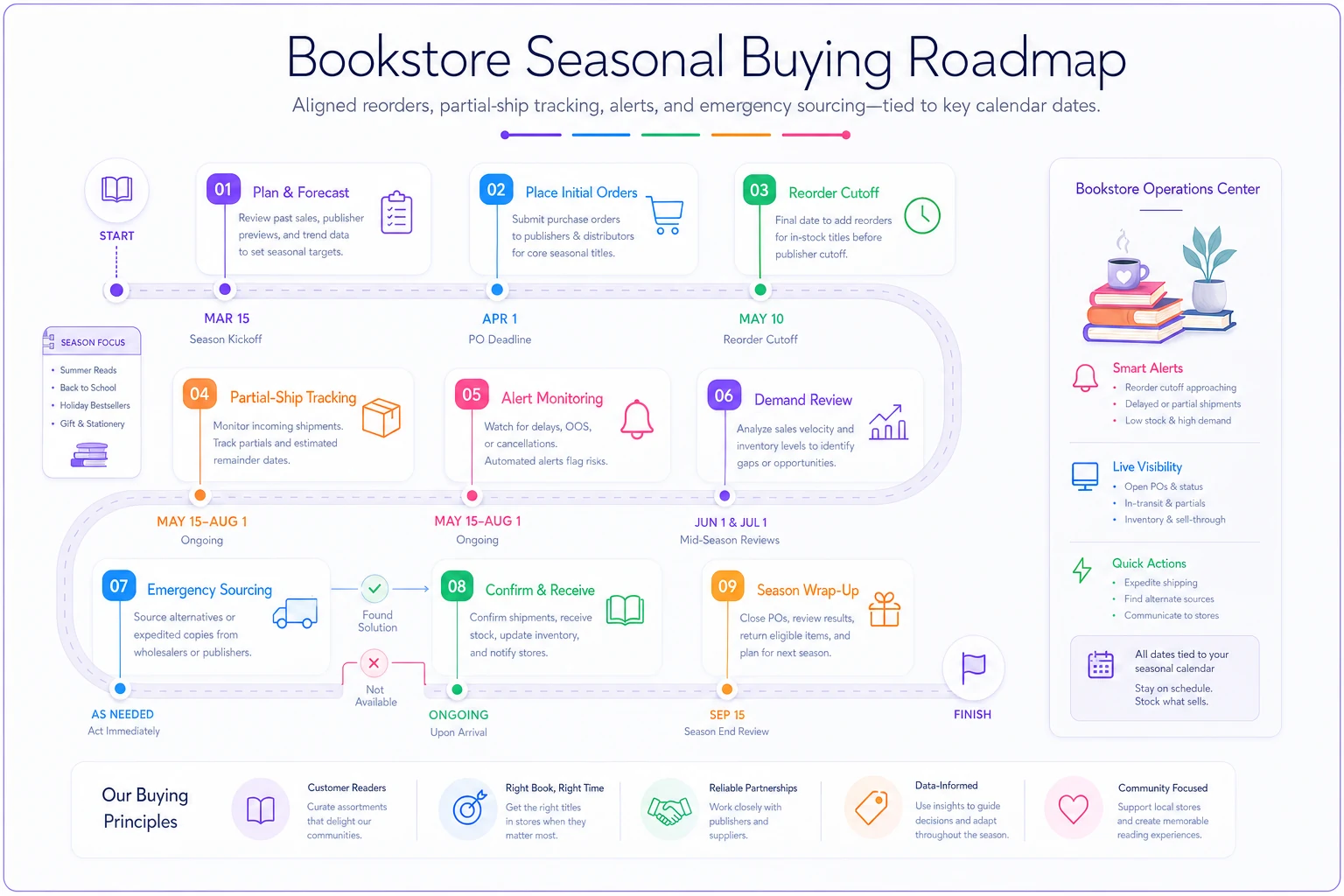
This is where a shared operational system pulls its weight: reorder cutoffs calculated from actual vendor lead times, partial-ship deadlines logged against each PO, alerts that fire when a title crosses its escalation date instead of when someone happens to check. The point isn't to remove judgment from the buy — it's to make sure the calendar-driven triggers don't slip through the cracks during the exact weeks your team has no spare attention. When the routine tracking runs on its own, you get to spend your energy on the calls and trade-offs that actually need a human in the room.
The takeaway
Seasonal vendor negotiation isn't a discount hunt. It's a connected system where the terms you sign, the way you accept shipments, and the dates you've drawn on your reorder calendar all have to line up — because the season gives you no room to fix mismatches on the fly. Build the pre-season checklist, negotiate the whole deal instead of just the price, write your partial-ship and emergency-sourcing rules down before you need them, and tie every trigger to a real date. Do that once, refine it each year, and the annual scramble turns into something you actually run instead of survive.
Ready to elevate your bookstore’s operations?
Join 500+ bookstores using Bookstorely to boost sales, optimize stock, and delight book lovers.