


School and library orders are probably the most misunderstood revenue stream in independent bookstores. These institutional buyers want to spend their entire allocated budget with you—literally thousands of dollars per order—but most stores treat them like regular retail customers who happen to buy 40 copies of the same title.
The operational complexity isn't usually what kills these relationships. It's the absence of any real process. A school order worth several thousand dollars becomes a margin-crushing nightmare that takes three weeks to fulfill while your regular customers wonder why the shelves look thin.
I've watched this play out more than once. A store in the midwest landed a $6,200 middle school order in late July—exciting on paper, brutal in practice. No packaging protocol, no quote template, no clear delivery timeline communicated upfront. They fulfilled it, barely, but the librarian called a district-approved wholesaler the following spring. Not because the books were wrong. Because the experience felt unreliable.
Why schools actually stop ordering from indie stores
School procurement operates on entirely different timelines than retail. A teacher submitting a purchase order in June needs those books delivered by specific dates in August, invoiced on net-30 terms with proper documentation for their business office, and packaged so 32 copies of To Kill a Mockingbird can be distributed without opening individual shipments.
Most bookstores quote these orders using retail pricing minus whatever discount feels right that day. No volume breaks at specific quantities. No standardized terms that align with school fiscal years. No clear communication about when orders need to be placed to guarantee term-start delivery.
The school calls another vendor next year. Not because you did anything wrong exactly—but because you treated an institutional buyer like a consumer who wandered in off the street.
Building a quote template that actually converts
Your school library bookstore bulk orders SOP starts with understanding how procurement officers evaluate quotes. They're comparing your proposal against others, and the decision often comes down to clarity rather than price.
A working quote template needs these non-negotiable elements:
-
Header Section - Quote number with date - Valid-through date (typically 30 days) - School/library billing and shipping addresses - Contact name and purchase order reference
-
Pricing Grid - ISBN, title, author, quantity - List price per unit - Your discount percentage - Net price per unit - Extended line total - Clear subtotal before shipping
-
Terms Block - Payment terms (Net 30 standard for schools) - Shipping method and estimated cost - Delivery timeframe - Return policy for defective items - Minimum order requirements
The critical mistake happens in the discount structure. Setting arbitrary percentages based on gut feeling leaves money on the table and confuses buyers who expect consistency.
Volume discount tiers that protect margin
Institutional pricing needs predetermined breaks that make operational sense. These tiers balance competitive pricing with sustainable margins:
| Order Size | Discount Off List | Operational Impact |
|---|---|---|
| 1–24 copies | 20% | Standard retail margin |
| 25–49 copies | 25% | Bulk shipping efficiency kicks in |
| 50–99 copies | 30% | Can order direct from publisher |
| 100–249 copies | 35% | Qualifies for publisher institutional rates |
| 250+ copies | 40% | Maximum discount, still maintains roughly 15% margin |
The 25-copy threshold aligns with typical classroom sizes. The 100-copy break matches publisher minimums for institutional pricing. The 250+ tier competes with wholesale educational suppliers while preserving enough margin to cover fulfillment costs.
Apply discounts at the line level, not the order total. A school ordering 30 copies of one title and 15 of another gets the 25% discount only on the first item. This prevents margin erosion on mixed orders—and honestly, most schools don't push back on it once you explain how the tiers work.
Minimum order agreements that make sense
Schools understand minimum orders—they deal with them from every vendor. But your minimums need operational justification, not arbitrary thresholds.
Set your minimum at around $500 for institutional billing. This covers the administrative overhead of processing purchase orders, managing net terms, and handling the inevitable follow-up communications. Below that, require payment at time of order via credit card or check.
For special handling requests—classroom bundles, individual student labeling, split shipments to multiple buildings—establish a $1,000 minimum. The extra labor only makes sense at higher volumes.
A simple Memorandum of Understanding that outlines these minimums alongside your standard terms goes a long way. Schools appreciate having documentation for their files, and it prevents confusion when new staff take over ordering. We've seen relationships fall apart mid-year simply because the original contact left and nobody documented what had been agreed.
Packaging rules that prevent classroom chaos
Teachers receiving 35 copies of a novel shouldn't spend an hour unwrapping individual books. Your packaging protocols for classroom orders need to be clearly different from standard retail shipping.
-
Classroom Bundle Standards - Groups of 5 or 10 books shrink-wrapped together - Clear exterior label showing quantity and title - Packing slip attached outside the box - Books spine-out for easy verification
-
Multi-title Orders - Separate boxes for each title when possible - Clear dividers between titles in mixed boxes - Master packing list plus individual lists per box - Color-coded labels matching the purchase order
Shrink-wrap classroom bundles in groups of 5 or 10 so teachers can distribute copies quickly without opening packages.
The shrink-wrap investment pays for itself quickly in reduced damage claims and eliminated confusion during distribution. Teachers can hand a wrapped bundle to each row without touching anything until students receive their copies.
For orders exceeding 100 books going to a single location, palette shipping is worth offering. Per-unit cost drops meaningfully, and schools typically have loading docks built for it. Include palette shipping as an option on quotes exceeding roughly $2,500.
This connects directly to the packing standards that reduce damage and returns we've covered for general shipments—but institutional orders need even stricter protocols given the volume and handling requirements.
Invoice timing that matches school fiscal calendars
School business offices run on rigid payment schedules. Miss their processing windows and you're waiting an extra 30 to 60 days for payment, which kills your cash flow during peak season.
-
For August delivery orders - Invoice immediately upon shipment - Include purchase order number prominently - Send digital and physical copies - Follow up within 10 days if unpaid
-
For mid-year orders - Invoice on the last day of the month - Batch all orders from that school together - Reference all relevant PO numbers - Keep formatting consistent
Schools typically process invoices on the 15th and last day of each month. An invoice dated August 28th gets processed September 15th. One dated September 2nd waits until September 30th. This isn't bureaucracy for the sake of it—it's just how their systems work, and ignoring it costs you real money in delayed cash.
Create a dedicated institutional invoice template that's clearly different from retail receipts. Include your federal tax ID, remit-to address, and any vendor numbers assigned by the district. Missing these triggers rejection and restarts the payment clock entirely.
Term-start fulfillment timeline
August is a disproportionate chunk of annual institutional sales for most stores, but most scramble through it without any real plan. A structured timeline prevents the chaos that destroys margins and relationships.
-
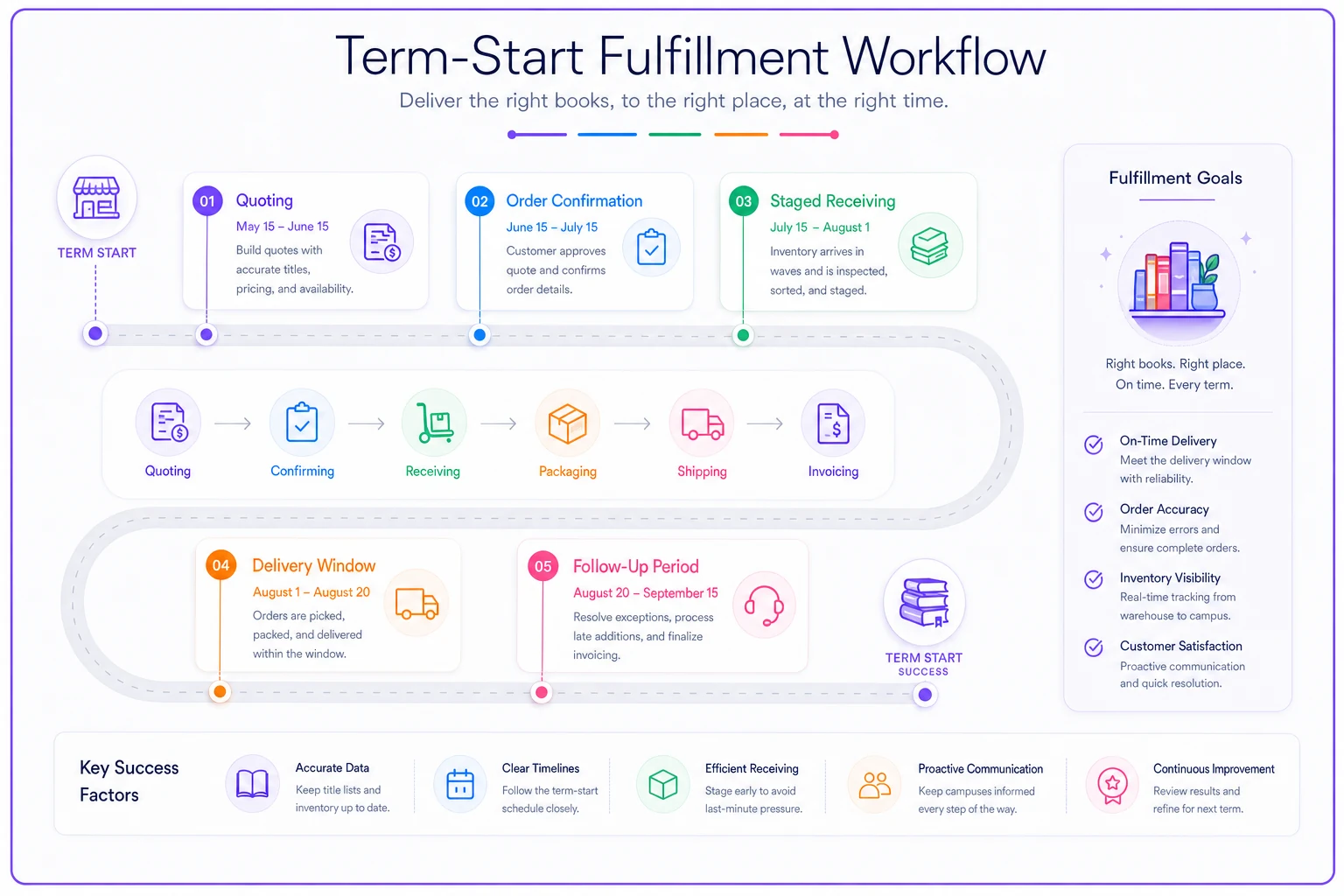
May 15 – June 15
Quote Season
- Teachers finalizing fall curriculum - Libraries spending remaining budget - Quote turnaround within 48 hours is critical here -
June 15 – July 15
Order Confirmation
- Purchase orders submitted - Verify inventory availability - Lock in pricing with publishers -
July 15 – August 1
Staged Receiving
- Books arriving from publishers - Pre-packaging classroom sets - Quality checking all orders -
August 1 – August 20
Delivery Window
- Shipping based on requested dates - Direct communication with teachers - Tracking confirmations sent immediately -
August 20 – September 15
Follow-up Period
- Invoice collection - Damage/shortage resolution - Next semester planning conversations
This assumes standard publisher availability.
A quick visual of this staged timeline:
For titles requiring special orders or custom editions, shift everything back 2 to 3 weeks and communicate those adjusted timelines clearly during quoting. One thing that catches stores off guard: a title going into a new print run mid-July with a 3-week lead time is basically a missed August delivery if nobody flags it in June.
Staffing model for institutional orders
Your regular retail staff can't absorb institutional fulfillment without it affecting the floor. These orders need dedicated processing time.
-
Under $10,000 in institutional orders - One staff member, around 15 hours per week - Focus on order processing and packaging - Can be handled during slower retail periods
-
$10,000 – $25,000 in orders - Dedicated fulfillment person, around 30 hours per week - Separate workspace for staging and packing - Direct coordination with receiving
-
Over $25,000 in orders - Full-time institutional coordinator - Part-time packaging assistant - Dedicated storage/staging area
Budget roughly 1 labor hour per $400 in institutional sales. It's not a perfect formula—some orders are messier than others—but it accounts for quoting, order processing, packaging, and customer communication across the full lifecycle. A $12,000 order typically runs somewhere around 28 to 35 hours of total labor depending on complexity.
Schedule institutional fulfillment during morning hours before retail traffic picks up. The focused time without interruptions makes a real difference in accuracy.
Managing competing priorities when orders stack up
The hard part happens when multiple large orders land simultaneously. Three schools each wanting several hundred books by August 25th, while your regular customers expect their special orders and your events need inventory.
-
Orders with penalty clauses – Some districts include late delivery penalties
-
Full payment upfront – These fund other inventory purchases
-
Historical reliable payers – Schools that consistently pay within terms
-
New institutional relationships – Investment in future revenue
-
Problem accounts – Chronic late payers or difficult contacts
This might feel uncomfortable, but institutional relationships have wildly different values. A school ordering $15,000 annually and paying in 30 days deserves priority over one ordering $3,000 and taking 90 days to pay. We lost a decent account once by prioritizing a flashier new order over a small but rock-solid library that had ordered from us for four years. Took a while to earn that back.
When to decline institutional business
Not every school order is worth taking. Saying no protects your margins during peak season.
-
Discounts exceeding 45% off list
-
Payment terms beyond Net 45
-
Delivery to individual student homes
-
Custom binding or special editions you can't reliably source
-
Less than a 2-week fulfillment window during peak season
Calculate the true cost of institutional sales including labor, carrying costs for net terms, and the opportunity cost of tied-up capital. Orders generating less than 12% net margin after all costs generally aren't worth pursuing unless the relationship has genuine strategic value—like a district that could scale into something much larger.
The technology layer that changes everything
Manual quote generation, spreadsheet order tracking, and paper-based fulfillment create the friction that makes institutional sales feel impossibly messy. Each quote takes an hour to prep, every order needs constant status checking, and nobody quite knows what's shipped versus what's still sitting in the back.
Operational software built for bookstore workflows can automate most of the repetitive elements while preserving the relationship aspects schools actually value. Quote templates pull from your catalog with current pricing and availability. Volume discounts apply automatically based on quantity breaks. Packaging requirements generate pick lists organized for efficient classroom bundling.
The bigger shift is in order visibility. Instead of calling to check on status, schools access a portal showing exactly which titles have been received, what's being packaged, and when delivery is expected. That transparency eliminates a lot of back-and-forth while quietly building trust. AI-powered systems can also flag when schools are likely to place their next orders based on past patterns—useful for reserving inventory or suggesting early ordering on popular titles before they go out of stock.
This institutional framework also connects naturally with the event P&Ls and pricing structures you've established, since many schools want author visits or educational programs bundled with their book orders.
Building institutional sales into a predictable revenue stream
School library bookstore bulk orders SOP shouldn't be reactive. The stores handling this well treat institutional sales as a distinct business unit with its own metrics, workflows, and growth targets.
-
Quote-to-order conversion rate
-
Average order value by institution type
-
Days sales outstanding for payment
-
Fulfillment accuracy percentage
-
Repeat order rate year-over-year
The patterns emerge fast. Schools that order in May almost always order in May. Libraries buying 200 copies for summer reading will need similar quantities next year. That predictability lets you plan inventory, staffing, and cash flow months ahead instead of scrambling each August.
Schools and libraries in your community have real budget allocated for books. They want to spend it locally. The question isn't whether you'll capture this revenue—it's whether you've built the operational foundation to handle it without it costing you more than it's worth.