


The hardest part of running a bookstore with a two- or three-person crew isn't the hiring. It's that everything your team knows lives in exactly one head at a time. Your part-timer who's worked the register for three holidays knows which regulars pay with store credit, how the consignment shelf gets restocked, and the weird trick for getting the receipt printer to stop jamming. Then she graduates, moves to Portland, and takes all of it with her.
For tiny teams, knowledge management isn't a corporate luxury. It's the difference between a smooth December and a chaotic one where the owner is answering the same three questions forty times a shift. And because bookstores lean so heavily on seasonal hiring — holiday surges, summer reading pushes, back-to-school library orders — the ramp-up problem repeats constantly. You're never done training. You're just between training cycles.
This is a systems problem, not a personality problem. The good employees aren't the ones who "just get it." They're the ones who got a decent handoff. Below is how the whole thing connects — roles, micro-training, knowledge capture, and a quarterly rhythm — and where it tends to fall apart as you grow past a solo operation.
Why tribal knowledge quietly breaks a small shop
Most independent bookstores run on what I'd call oral tradition. There's no written record of how things actually get done because for a long time there didn't need to be. When it's just the owner and one trusted person, everything gets communicated in real time. You correct mistakes as they happen. You explain the return policy while ringing up the return.
The trouble starts the moment a third or fourth person enters the picture, especially a temporary one. Now the owner is the single point of failure for every process. A typical example: a seasonal hire is left alone for two hours on a Saturday, a customer wants to place a special order for an out-of-print book, and there's no written path for how that gets handled. The hire either makes something up, guesses wrong, or texts the owner mid-lunch. Multiply that across every non-obvious task and the "help" you hired is generating more work than they absorb.
The cost of missing documentation shows up in three places:
-
Ramp time. New hires take three or four shifts to become net-positive when they could take one.
-
Error rate. Mispriced used books, botched consignment credits, mishandled holds.
-
Owner interruption. The owner never gets a real day off because they're the knowledge base.
None of these show up as a line item. That's exactly why they get ignored until a bad season forces the issue.
The four pieces that make ramp time shrink
Solid bookstore HR knowledge management for small teams comes down to four connected components. Each one feeds the next. Skip one and the others get weaker.
| Component | What it does | Fails when... |
|---|---|---|
| Role templates | Defines who owns what during a shift | Everyone "helps with everything" and nothing is truly owned |
| Micro-training modules | Teaches one task in under 10 minutes | Training is a single overwhelming first-day firehose |
| Knowledge-capture templates | Turns what people know into reusable docs | It lives in someone's memory or a random Slack thread |
| Quarterly skills audits | Checks what the team actually knows | You assume competence instead of confirming it |
The mistake most owners make is treating these as separate projects — "I'll write an onboarding doc someday." They're actually one loop. A role template tells you which micro-trainings a person needs. The micro-trainings get written from your knowledge-capture playbooks. The quarterly audit tells you which trainings aren't sticking, which sends you back to fix the capture template. Round and round.
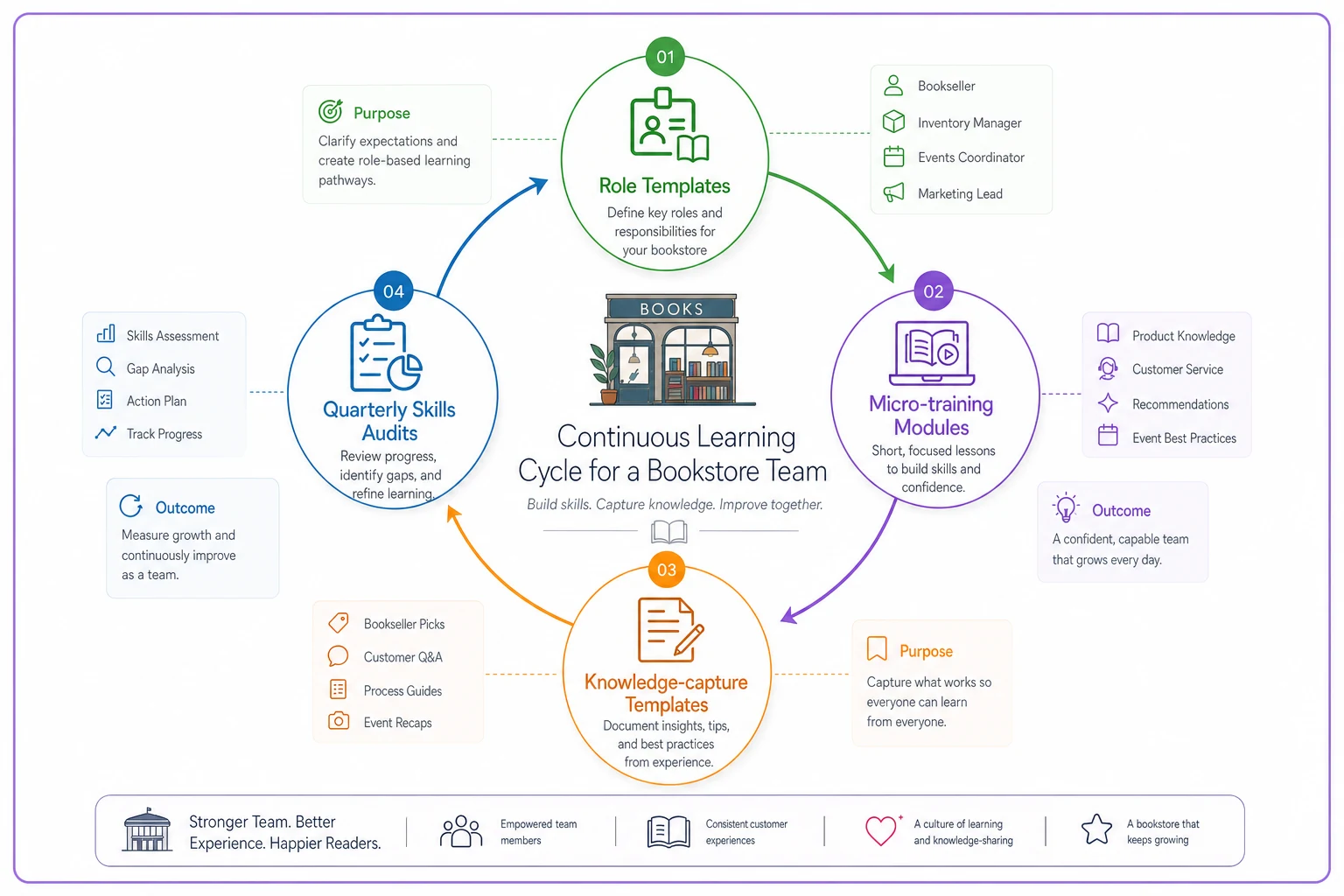
This shows the loop between the four components and how each feeds the next.
Role templates: stop hiring "a person," start hiring a role
The single biggest upgrade for a tiny team is separating the role from the human. When you hire "someone to help during the holidays," you get a generalist who's mediocre at ten things. When you hire for a defined role — "holiday register and gift-wrap lead" — you get someone who's genuinely good at three things and knows what's not their problem.
A role template for a bookstore doesn't need to be fancy. It needs to answer four questions clearly:
-
What does this person own during a shift? (Register, floor recovery, holds shelf, receiving, etc.)
-
What are they explicitly NOT responsible for? This matters more than people think — it prevents the "I thought Sarah was doing that" gap.
-
What decisions can they make alone, and what needs an owner? Price overrides, refunds above a threshold, accepting damaged returns.
-
Who do they escalate to, and how? Text, call, note in the log.
The "NOT responsible for" line is the one owners almost always skip, and it causes the most friction. Two seasonal hires both assuming the other person restocked the new-release table means the best display in the store sits empty on the busiest Saturday of the year.
If you already run defined shift structures, role templates slot right on top of them. Our breakdown on weekly shift templates for small bookstores pairs naturally here — the shift tells people when, the role template tells people what they own.
Micro-training beats the first-day firehose
The standard bookstore onboarding is a two-hour walkthrough on day one where the owner explains everything at once and the new hire retains roughly a third of it. By day three they've forgotten how the layaway system works and they're too embarrassed to ask again.
Micro-training flips this. Instead of one giant session, you break knowledge into single-task modules — five to ten minutes each — done right before someone actually needs the skill. A module for "processing a customer hold" is a short script plus a checklist, not a lecture. The person reads it, does it once with supervision, and moves on.
A good micro-training script has a consistent shape:
-
The trigger "A customer wants to hold a book we have in stock."
-
The steps numbered, 5–8 max.
-
The common mistake "Don't forget to write the pickup deadline on the slip — unclaimed holds after 7 days go back to the floor."
-
Who to ask if stuck.
Micro-modules work for seasonal staff specifically because seasonal staff will never master the whole store. They don't have time. But they can absolutely master the six tasks their role touches during a surge. For a deeper walkthrough of compressing onboarding into something a holiday hire can actually absorb, the two-hour onboarding script for seasonal surges covers the surge-specific version of this.
Knowledge-capture: getting it out of people's heads
This is the part everyone knows they should do and almost nobody does, because it feels like busywork with no immediate payoff. The trick is to stop treating documentation as a big writing project and start capturing knowledge as work happens.
The most practical method for a tiny team is the "next time you do it, record it" approach. You don't sit down and write a manual. The next time anyone handles a non-obvious task — a publisher return, a consignment payout, a damaged-shipment claim — they jot the steps into a shared template while doing it. Fifteen minutes of capture beats two hours of trying to reconstruct it from memory later.
A workable knowledge-capture playbook for a bookstore usually covers:
-
Recurring-but-rare tasks. Things done monthly or seasonally that are always half-forgotten — publisher co-op claims, quarterly consignment reconciliation, inventory count prep.
-
Vendor-specific quirks. Which distributor requires what, who your rep is, order minimums, cutoff times.
-
"Only Julia knows this" items. The single-person-dependency list. Every one of these is a liability.
-
Customer-facing policies. Returns, holds, special orders, event refunds — written the way you'd actually say them at the counter.
Make 'capture while doing' the default — a quick 10-minute note beats reconstructing the steps later.
The tasks most worth documenting are almost never the daily ones. Daily tasks get learned through repetition anyway. It's the monthly and seasonal tasks — the ones you do just often enough to think you remember but rarely enough to actually forget — that quietly eat hours. Capture those first.
Quarterly skills audits: confirm, don't assume
The last piece is the one that keeps the whole system from rotting. A quarterly skills audit is a simple check: for each person, which tasks can they do confidently, which need a refresher, and which have they never actually done alone?
You can run this in about 30 minutes with a grid. List core tasks down one side, staff across the top, and mark each cell:
-
G — can do it solo, confidently
-
Y — can do it with the checklist in hand
-
R — has never done it alone
The value isn't the grid itself. It's what the pattern reveals. When you see three people all marked "R" on processing damaged returns, you've found a store-wide blind spot before it becomes a costly mistake. When one person is the only "G" across five critical tasks, you've found your single point of failure — and your next training priority.
Time the audit to your hiring cycle. Run it a few weeks before your seasonal ramp so you know exactly what to train new staff on, and what your returning people need refreshed. Skills fade. The person who was solid on the POS last December has spent eleven months not touching half its features.
A real scenario
A used-and-new bookstore with an owner plus two part-timers was losing roughly a full day of the owner's week to interruptions during the fall ramp — questions, corrections, redoing tasks a seasonal hire got wrong. Consignment payouts were consistently late because only the owner knew the process, and one botched batch of holds during a big author event cost them somewhere around $200–$300 in walked-away sales.
They didn't do anything fancy. Over about six weeks they wrote role templates for two positions, captured nine micro-training modules for the tasks generating the most questions, and built one shared doc covering consignment and returns.
The next seasonal hire was handling holds and register solo by the end of her second shift instead of her fifth. The owner's interruption load dropped noticeably — not to zero, but enough that she took a full Saturday off for the first time in over a year. The late consignment payouts stopped because two people now knew the steps. Nothing dramatic. Just knowledge that stopped living in one head.
Where a shared system helps — and where it's overkill
Once you've got these pieces written down, the natural question is where to keep them. For a genuinely tiny team, a well-organized shared folder or a simple wiki is completely fine. Don't over-engineer this.
Where lightweight operational software starts to earn its place is when the pieces need to connect — when a role template should automatically surface the right micro-training checklist for a new hire, when a completed task logs itself so you're not chasing whether the holds got processed, or when the quarterly audit pulls from actual task history instead of memory. AI-assisted operational tools can help here by turning scattered notes into searchable, role-tagged procedures and flagging which knowledge only lives with one person. But that's an accelerant, not the foundation. If the underlying role definitions and captured knowledge don't exist, no software fixes it.
When a shared system makes sense: you're past three people, you hire seasonally more than once a year, or the owner is regularly the bottleneck.
When it's overkill: you're solo or a stable two-person shop where both people know everything and turnover is basically nil. Write the vendor quirks down anyway — but skip the tooling.
Pulling it together
The reason knowledge walks out the door of small bookstores isn't that owners don't care. It's that the shop runs fine on tribal knowledge right up until the moment it doesn't — a resignation, a surge, a sick day during a big event. By then it's too late to capture anything.
The fix is a loop, not a project. Define the roles. Break the training into small pieces tied to those roles. Capture the rare-but-important tasks while you're doing them. Check quarterly whether it actually stuck, and feed what you learn back into the next round.
Done consistently, it turns every seasonal hire from a three-week drag into a two-shift asset — and it means the store keeps knowing what it knows, no matter who's standing behind the counter.