

Most people shopping for christian book distributors start the same way: three browser tabs, a couple of directory pages with 40 names each, and they give up after calling two of them. Then they go with whoever a friend uses. That's how a store ends up locked into net‑15 billing when their cash cycle runs net‑45, or a church bookstore that can't get Spanish‑language titles without a special order every single time.
Directories don't help because they list names, not fit. A distributor that works great for a 2,000‑member church running a resource table on Sundays is often a terrible fit for an independent store trying to maintain a deep backlist and run events. So instead of another list, this is a scoring system — one you can run in an afternoon, apply to three candidates, and come out with a defensible choice.
Below are the ten things that actually separate a good distributor from a painful one.
The 10‑Point Vetting Checklist
Every point here maps to a real failure mode. These aren't abstract nice-to-haves — each one quietly costs money or sanity when it goes wrong.
-
1. Catalog depth in your actual categories. Not total SKU count — depth in what you sell. A general wholesaler might carry 400,000 titles but only 300 in your denomination's specific study material. Ask for a sample pull: "Here are 25 ISBNs we order regularly. How many can you fill today, and what's the fill rate on the rest?"
-
2. Fill rate and backorder behavior. A distributor that's "95% in stock" but silently backorders the other 5% for six weeks is worse than one that's 88% and tells you immediately. Ask directly: What happens to a line item you can't fill — cancel, backorder, or substitute?
-
3. Discount structure and tiering. Faith wholesalers often run 40–46% off retail for stores, lower for churches buying in small quantities. Dropship services give you far less margin because they're carrying the fulfillment cost. Get the full tier table in writing, including volume thresholds.
-
4. Minimum order requirements. A $250 minimum per order destroys a small church bookstore reordering twenty units at a time. Watch for both dollar minimums and free‑freight thresholds — they're different numbers and both matter.
-
5. Shipping cost and speed. Freight is where quoted margin disappears. A 44% discount with $18 freight on a $90 order is closer to 24% net. Get real freight numbers on a realistic order size, not the headline discount.
-
6. Return policy and terms. Can you return overstock? What's the window — 90 days, 120, never? Is there a restocking fee? For seasonal faith retail (Advent, Lent, VBS materials), a hard return window is a dealbreaker.
-
7. Payment terms vs. your cash cycle. Net‑30 sounds standard until your inventory takes 70 days to sell through. Terms misalignment is the most common cash squeeze for small faith retailers. Worth its own section below.
-
8. Data quality and feed format. Do they provide clean metadata — ISBN, correct editions, cover images, category codes? Messy feeds create duplicate editions and mis-shelved stock. If they hand you a CSV with inconsistent ISBN formatting, that's a tax you pay every single week.
-
9. Dropship / fulfillment capability. If you sell online or through a church app, can they ship direct to your customer under your name? Some faith wholesalers handle this well; others treat it as an afterthought.
-
10. Support responsiveness and account handling. Do you get a named rep or a ticket queue? Test it before you sign: email a real question and time the response. A distributor that takes four days to answer a pre-sale question will not get faster once you're locked in.
Payment terms vs. your cash cycle. Worth its own section below.
The Comparison Scorecard (CSV)
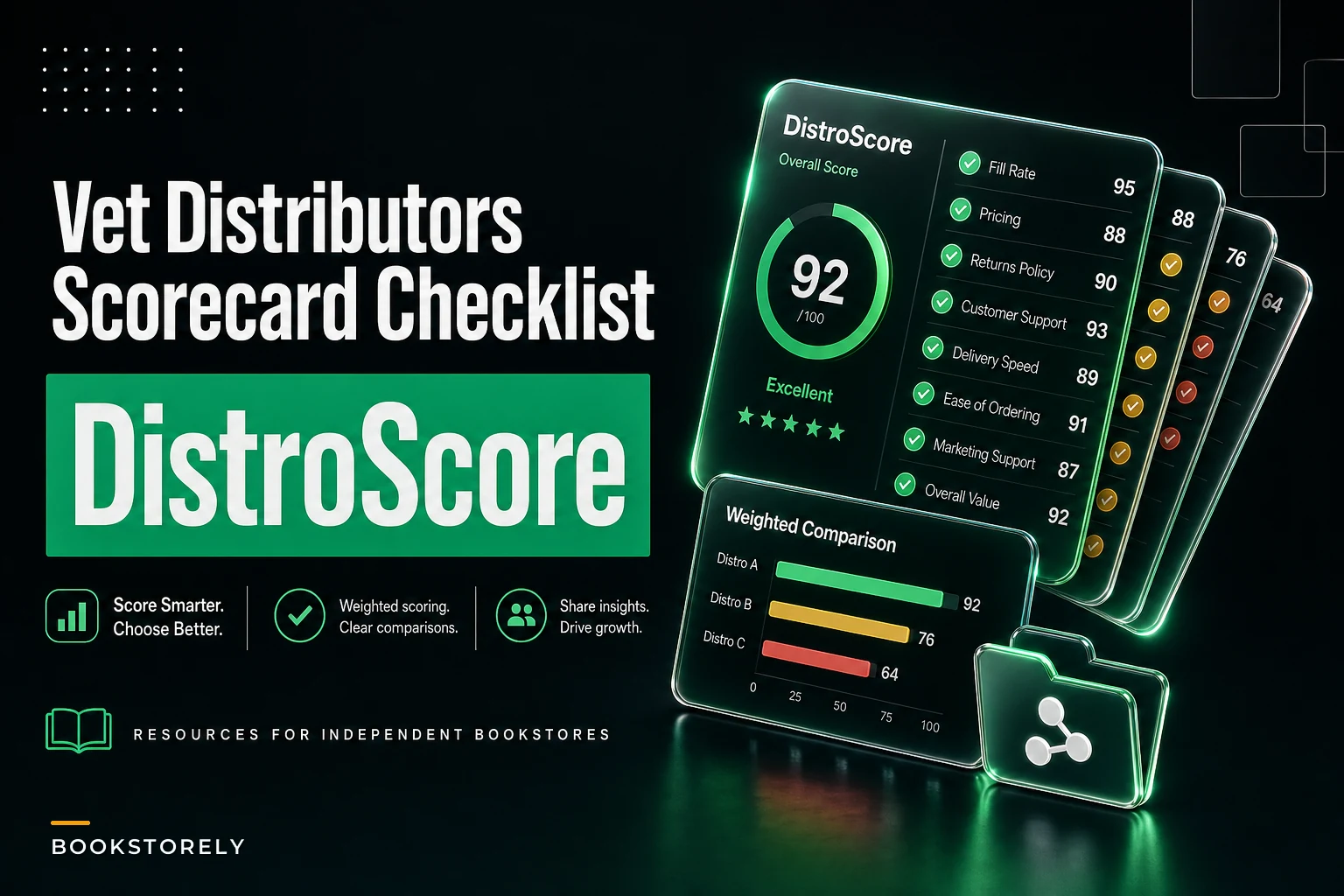
Paste the block below into a text file, save it as distributor_scorecard.csv, and open it in any spreadsheet. Score each distributor 1–5 on every row, then weight the rows that matter most to your operation. Payment terms and freight usually deserve double weight for cash-tight operations.
Never miss a sale or stock shortage again.
Bookstorely helps you manage inventory, orders, and customer relationships seamlessly.
- Integrated inventory tracking
- Customer purchase history
- Sales reporting & analytics
No credit card required
| Criteria | Weight | Distributor A | Distributor B | Distributor C | Notes |
|---|---|---|---|---|---|
| Catalog depth (your categories) | 3 | ||||
| Fill rate / backorder honesty | 3 | ||||
| Discount structure | 2 | ||||
| Minimum order requirement | 2 | ||||
| Shipping cost (real order) | 3 | ||||
| Return policy | 2 | ||||
| Payment terms vs cash cycle | 3 | ||||
| Data / metadata quality | 2 | ||||
| Dropship capability | 1 | ||||
| Support responsiveness | 2 | ||||
| WEIGHTED TOTAL |
The weights aren't gospel. A store with no online channel should drop dropship to zero, and a church that never returns stock can lower the return-policy weight. The point is forcing a conscious decision on each line instead of letting the smoothest sales rep win on vibes.
Three Distributor Archetypes, Compared
Rather than name specific companies — terms change constantly — it's more useful to think in archetypes. Almost every christian book distributor falls into one of three buckets, and each wins in a different situation.
When you're trying to figure out which type actually fits your operation, the table below is a decent starting point. The rows that matter most will depend on whether you're holding inventory, how tight your cash cycle is, and how much your congregation relies on denomination-specific titles versus general Christian bestsellers.
| Factor | Large general wholesaler (with faith inventory) | Faith‑specialist wholesaler | Dropship service |
|---|---|---|---|
| Catalog breadth | Huge, but faith is one slice | Deep in faith/ministry | Varies, often large via network |
| Faith category depth | Mixed — strong on bestsellers, thin on denominational | Strong across the board | Depends on upstream source |
| Typical store discount | ~40–45% | ~42–46% | ~15–30% net |
| Minimums | Often higher | Moderate | Usually none |
| You hold inventory? | Yes | Yes | No |
| Returns | Formal, sometimes strict | Often flexible | Usually none |
| Best for | High-volume stores wanting one invoice | Faith stores & churches needing depth | Online-only or low-cash operations |
When each one actually makes sense
The large general wholesaler works when you're already ordering general-market books and want faith titles on the same invoice, same freight, one monthly payment. The consolidation is the actual value. It stops making sense when your faith depth matters more than convenience — you'll end up special-ordering the exact study guides and devotionals your congregation keeps asking for.
The faith‑specialist wholesaler is the right default for most church bookstores and independent Christian stores. Deeper catalog, more flexible returns on seasonal material, and reps who know the category. The tradeoff is an additional vendor relationship and another invoice if you also carry general titles.
The dropship service makes sense when you have no warehouse space, no cash to tie up in inventory, or you're testing a title before committing. It's a bad idea as your primary source. Margin is thin, and you lose control of the customer experience — a late or poorly packed order arrives with your store's name on it.
Any store whose brand depends on fast, carefully packed orders should not rely on dropship as a main channel. It's a supplement, not a foundation.
A Worked Example With Real Numbers
Say you're a church bookstore reordering a typical mid‑size batch: 60 units, retail value around $900.
-
- Faith specialist 44% discount → cost ~$504. Free freight over $400, so $0 shipping. Net landed cost: ~$504.
-
- General wholesaler 42% discount → cost ~$522. Freight $22 because this order didn't hit their higher free‑freight tier. Net: ~$544.
-
- Dropship (same titles, direct to buyers) ~22% net margin, no inventory held, but you only earn on units actually sold. On those same 60 units sold over a month, realized margin lands near $198 — far less, but zero cash tied up and zero overstock risk.
The dropship number looks ugly on a per-order basis, which is the point: it's not competing on margin, it's competing on cash flow and risk. If this church is already sitting on slow-moving stock, $198 with no risk might genuinely beat $504 with cash locked up. Context decides, not the headline discount.
Contract Terms to Watch
The pricing conversation is the easy part. The contract is where distributors quietly protect themselves at your expense. Most of the painful surprises aren't in the discount table — they're buried in clauses that don't come up until you're trying to leave or push back on a price change.
-
- Auto-renewal clauses. Some agreements renew for another full term unless you cancel 60–90 days out. Calendar the cancellation window the day you sign.
-
- Price-change notice. How much warning before discounts shift? "At distributor's discretion, effective immediately" is a red flag.
-
- Return window and restocking fees. Confirm these in the contract, not just verbally from a rep.
-
- Freight responsibility on returns. Who pays shipping on damaged or defective items? It should be them.
-
- Minimum purchase commitments. Watch for annual volume minimums that trigger penalties or discount clawbacks if you fall short.
-
- Data ownership. If they provide your catalog feed, make sure you can export and keep your product data if you leave.
One thing people often miss: tax handling. If a distributor dropships to your customers across state lines, you need clarity on who's responsible for collection. That ties directly into your own multichannel sales‑tax remit workflow. Don't assume the distributor handles it — most don't.
Red Flags During Vetting
Not every bad distributor is obvious upfront. Some of the worst fits come from companies with polished websites and friendly reps. Pay attention to these signals during the vetting process, because they tend to predict exactly what the relationship looks like once you're committed.
-
- They won't give you a written discount tier table.
-
- "Fill rate" gets quoted but they dodge the backorder question.
-
- The sample ISBN pull fills poorly and they blame your list.
-
- Pre-sale emails take days to get a response.
-
- Metadata in the sample feed is inconsistent — mixed ISBN formats, missing editions, no cover images.
-
- They pressure you to sign a multi-year term for a "better rate" before you've placed a single order.
That last one matters most. A distributor confident in their service lets you start on standard terms and earn the better rate through volume. The ones demanding a long lock-up upfront are usually protecting against churn they already expect.
Sample Outreach Scripts
Initial inquiry email:
> Subject: New account inquiry — [Store/Church name] > > Hi [Name], > We're a [church bookstore / independent Christian bookstore] in [city] placing roughly [X] orders a month in the [categories] space. Before we open an account I'd like to confirm a few things: > > 1. Your store discount tiers and the volume thresholds for each > 2. Free‑freight minimum and typical freight on a ~$900 order > 3. Return policy — window and any restocking fee > 4. Payment terms available to a new account > > I've attached 25 ISBNs we reorder regularly — could you tell me the current fill rate on those? Thanks for your time.
Follow-up when a rep goes quiet:
> Subject: Re: New account inquiry > > Hi [Name], following up on the questions below — we're comparing a couple of distributors this week and want to include your numbers. If there's a better contact for the fill‑rate question, happy to reach out directly.
The follow-up quietly signals you're comparing options, which tends to produce a faster and more honest reply.
A Short Real Scenario
A church bookstore running mostly Sunday resource-table sales was buying everything through one general wholesaler because it was simple. The problem: denominational study guides were almost always backordered, so volunteers were placing special orders for twenty units at a time and waiting three to four weeks. Eventually members just stopped asking and bought elsewhere online.
Running the ten-point scorecard, catalog depth scored a 2 out of 5 for their actual categories — even though the distributor scored reasonably well on everything else. They added a faith‑specialist as a second source specifically for study material. Fill rates on their core titles went from "usually backordered" to same-week, and resource-table sales climbed a noticeable amount over the following quarter. Not because they marketed harder, but because the books were simply there when people asked.
The lesson wasn't "switch distributors." The scorecard exposed one weak line nobody had isolated before, and the fix was adding a source, not replacing one.
Make the Decision Repeatable
The real win here isn't choosing one distributor today — it's building a process you can rerun. Save the scorecard. Save the outreach scripts. When your volume grows or a distributor's terms drift, you re-score in an afternoon instead of starting from a blank directory page again.
Keep it documented somewhere your team can actually find it, the same way you'd store any core operating procedure.
Save the scorecard and outreach scripts where your team can actually find them.
Here's a simple workflow you can follow each time you re-evaluate distributors.
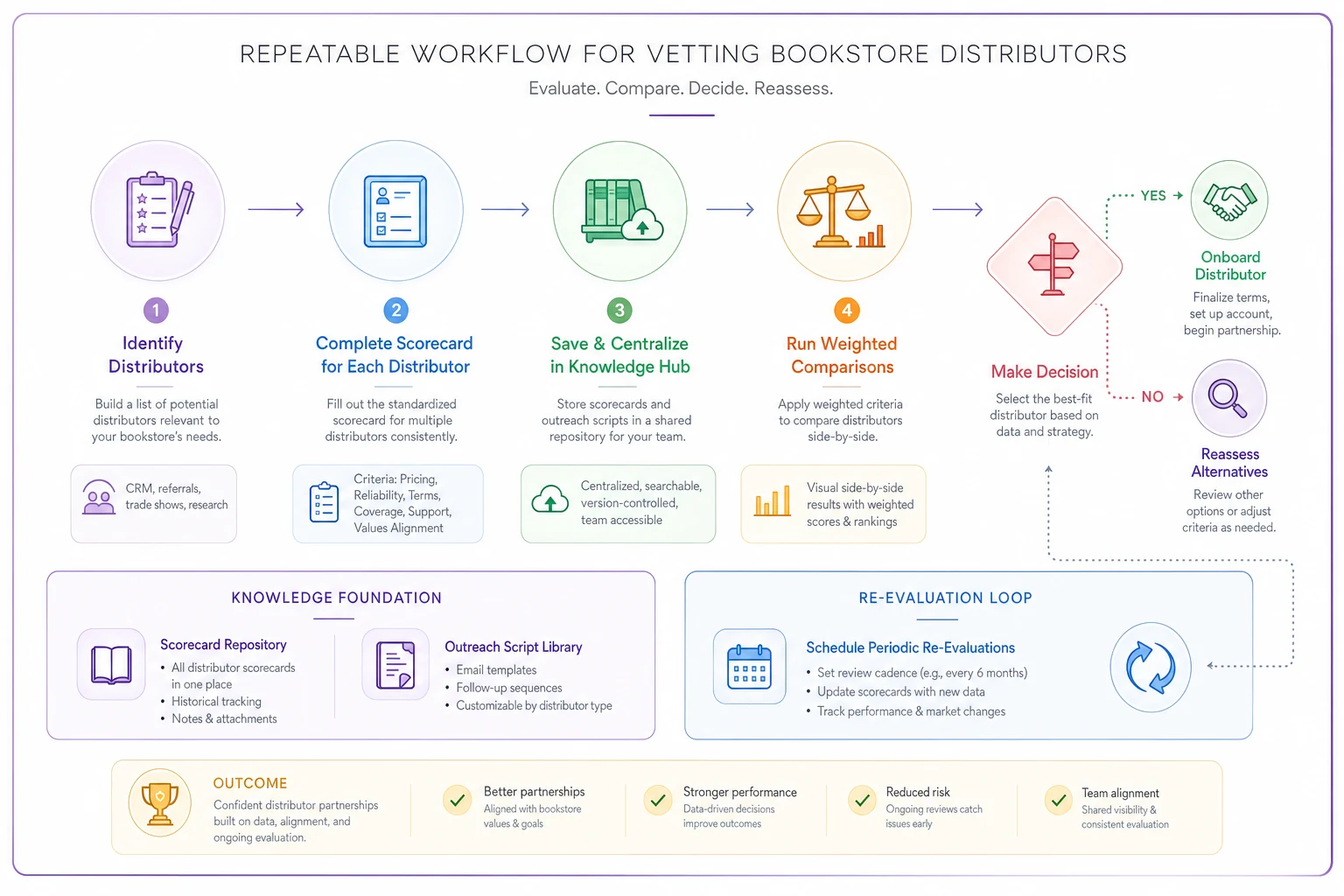
If you're a one- or two-person shop, folding this into your broader knowledge management for tiny bookstore teams means the next person who places orders doesn't have to reconstruct why you chose who you chose. And if your operation deals with seasonal staffing swings — VBS season, Advent rush — the same kind of documented, repeatable thinking that protects your shifts and fulfillment during stress periods applies here too.
Run the three candidates, weight the rows that match your cash reality, and let the weighted total — not the friendliest sales call — make the decision.
Ready to elevate your bookstore’s operations?
Join 500+ bookstores using Bookstorely to boost sales, optimize stock, and delight book lovers.