

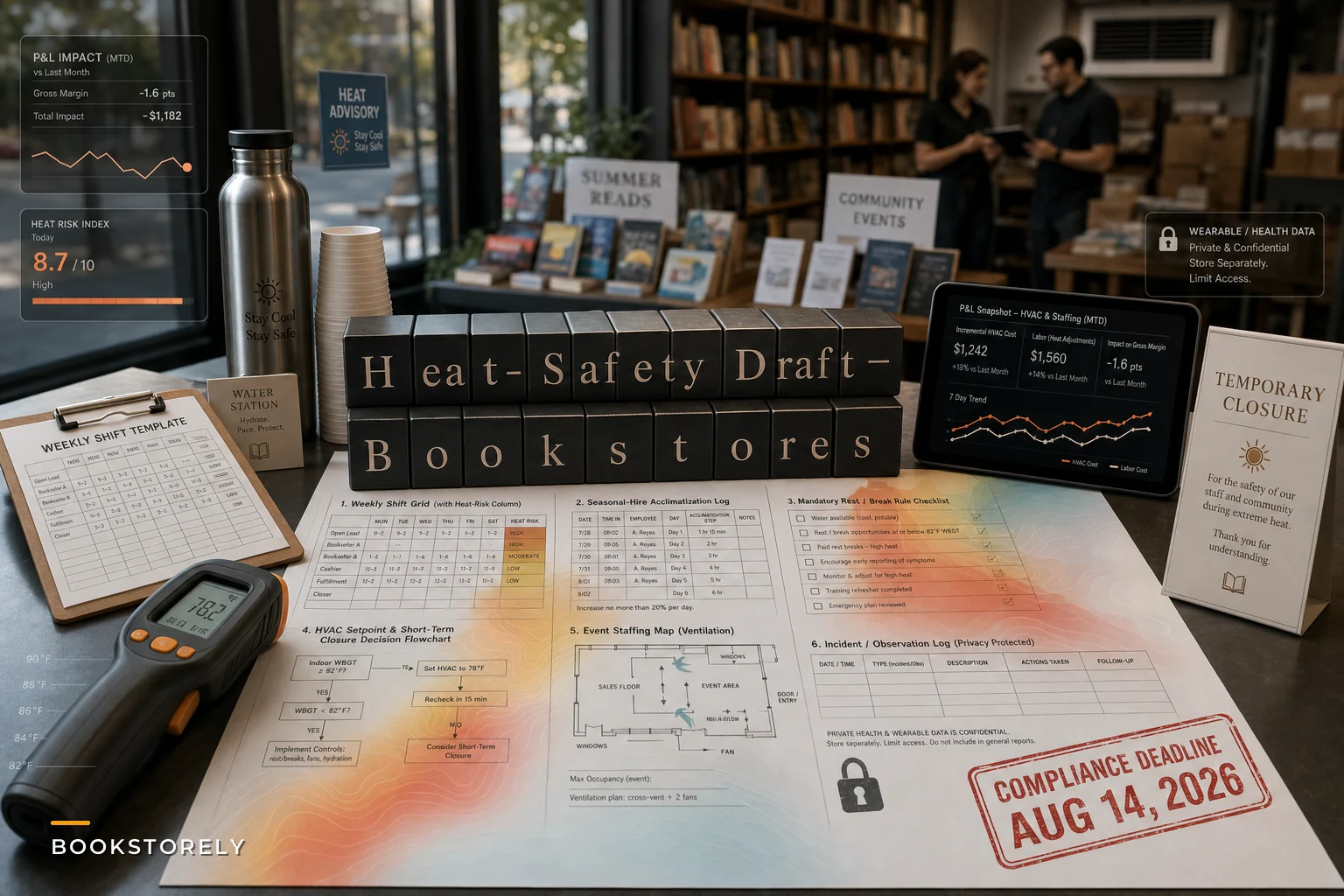

Most bookstore owners saw the Cal/OSHA headline and mentally filed it under "warehouse problem." That's the wrong call. The August 14, 2026 discussion draft expanding Sections 3395 and 3396 under AB 2243 pushes high-heat procedures into a much wider set of indoor workplaces — and indie bookstores, with their old buildings, marginal HVAC, and back rooms that trap heat like an oven, fall squarely inside that scope.
The comment window closes September 21, 2026. The official Cal/OSHA rulemaking page has the full draft if you want to read it yourself. But the reason to pay attention isn't the legal language. It's that the operational changes — mandated observation windows, acclimatization schedules, annual plan distribution, possible wearable monitoring — land directly on the part of your business that's already fragile: a two- or three-person schedule with no slack built in.
Below is what actually changes on the floor, where the friction shows up, and what a 1–4 person shop should adjust before any of this becomes enforceable.
Start with the room that overheats: your back office
Every bookstore has one. The receiving area behind the register. The mezzanine storage. The back office sharing a wall with sun-baked brick. It's where used-book intake happens, where preorders get packed, where someone spends 90 minutes in July with a box cutter and a laptop.
That room is the compliance problem — not the sales floor, which is usually air-conditioned for customers anyway. The draft's expanded indoor provisions generally key off temperature thresholds inside the work area, and back rooms routinely run 8–15°F hotter than the retail space. A shop with a comfortable 74°F floor can easily have an 86–88°F receiving area on a hot afternoon.
Put a thermometer in the back room and log readings on hot days.
The pattern worth noticing: the tasks that get pushed into the hot room are almost always the invisible ones. Fulfillment. Intake. Reconciliation. Packing. Nobody schedules them precisely — they happen "whenever there's a gap." Which means under the new rules, your least-planned work is exactly what triggers break requirements, observation windows, and cool-down obligations. You can't manage what you never put on a schedule.
What the draft actually asks of a small employer
Strip away the legal phrasing and the practical demands cluster into five areas. A recent breakdown from Environmental Safety Update covers the employer-facing pieces in detail, but for a bookstore the relevant ones are:
| Requirement area | What it means on the floor | Where small shops get caught |
|---|---|---|
| Acclimatization | New/returning staff eased into hot-area work over ~14 days | Seasonal holiday hires thrown straight into a hot stockroom |
| High-heat procedures | Cool-down breaks, water access, observation on hot days | No second person present to "observe" a solo shift |
| Plan distribution | Written Heat Illness Prevention Plan given at hire + annually | The plan exists in a binder nobody has opened since 2019 |
| Temperature awareness | Knowing the actual temp in each work area | Nobody has a thermometer in receiving |
| Health/wearable data | If wearables are used, securing that data | Treating body-temp readings casually, like a fitness tracker |
Here's a quick visual of the basic compliance workflow for a small shop: identify hot zones, tag tasks, update schedules, log acclimatization, and maintain observation on high-heat days.
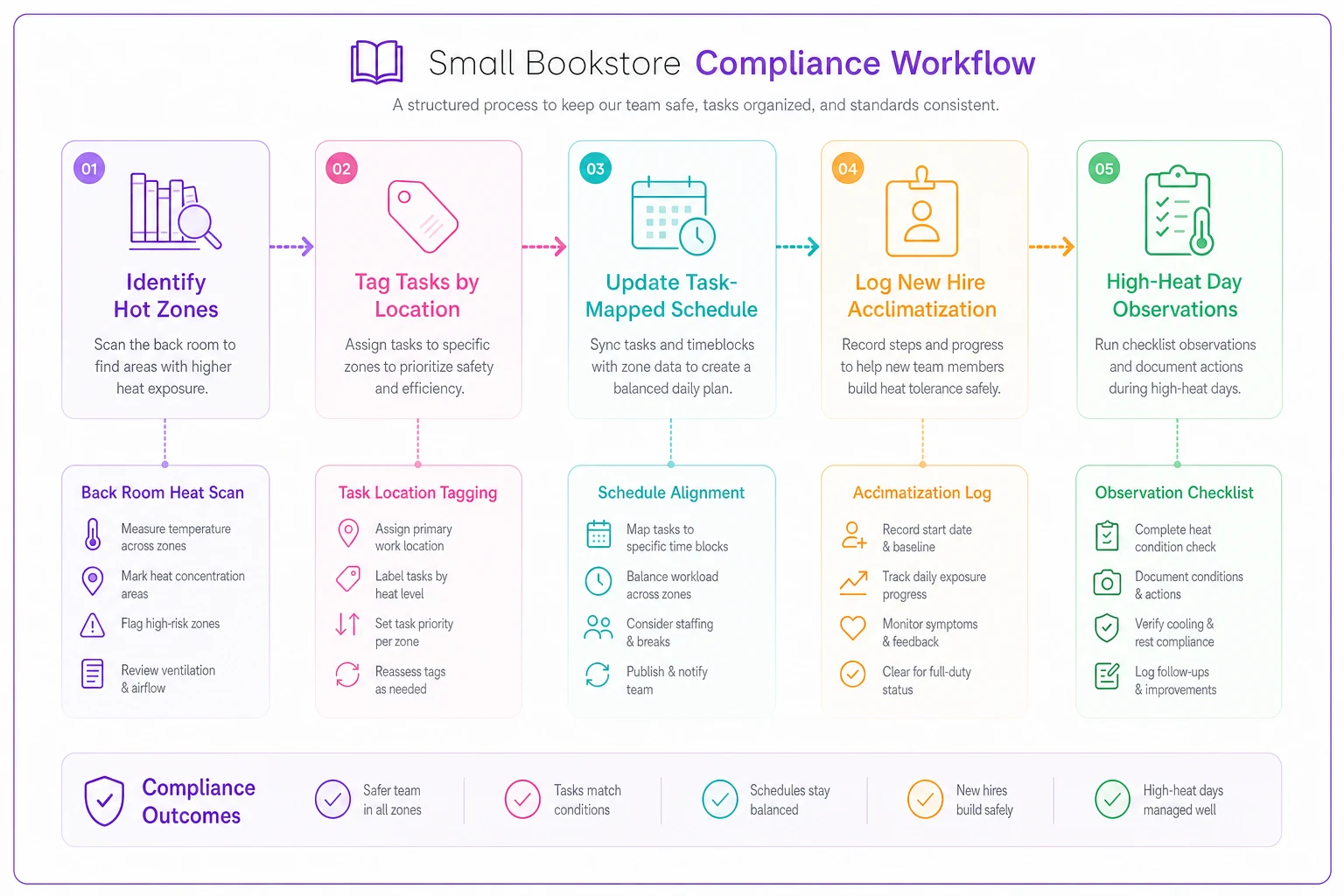
The two that quietly break a small operation are observation and acclimatization. Observation assumes a coworker is around. A lot of indie shops run solo shifts, especially mid-week mornings. Acclimatization assumes you have time to ramp someone in — but seasonal surge hiring is the opposite of gradual. You bring someone on in late November and they're packing shipments in a warm back room by their second hour.
The deeper problem this exposes: your schedule has no visibility into *conditions*
This is the underlying issue, and it's bigger than heat rules.
Most small bookstore schedules track who and when. Almost never what task and under what conditions. A shift says "Maya, 10–4." It doesn't say "Maya, 10–4, of which roughly two hours are receiving in the back room." So when a regulation arrives that cares about task location and environmental exposure, the schedule can't answer the question. Compliant on paper, blind in practice.
This same gap causes a dozen other quiet problems — uneven workloads, one person always stuck with returns, events understaffed because nobody mapped the setup labor. The heat draft just makes that gap legally expensive.
A task-mapped schedule fixes both at once. If you've already moved toward the kind of structure outlined in our weekly shift templates for 1–4 person bookstores, you're most of the way there — you just need to add a conditions layer: which blocks happen in the hot zone, and who's present when they do.
A real scenario: the mid-August event weekend
Two-owner shop in the Central Valley. Roughly 1,400 square feet. Back room with a single wall-unit AC that struggles when outside temps push past 95°F. Two to three author events a month.
Old pattern: on event Saturdays, one owner spent the early afternoon in the back prepping stock, staging signed copies, packing pre-orders — call it two straight hours in an 87–89°F room while the other owner ran the floor. Solo in the hot zone, no observation, no break structure, no thermometer.
After mapping it out honestly, they made three changes: split the back-room prep into two shorter blocks with floor-and-back roles swapping, added a cheap $20 thermometer with a logged reading, and moved the heaviest packing to the cooler morning window before the building heated up. Setup didn't take longer overall — it just stopped concentrating heat exposure on one person for two hours straight. The event ran the same. The owner who used to do all the prep felt noticeably less wrecked by 3 p.m.
Compliance and a saner workday turned out to be the same project.
The seasonal-hiring trap
Acclimatization is where holiday staffing collides with the draft. The rule generally expects a gradual ramp — shorter durations in hot conditions early, building over roughly two weeks. Your surge hire timeline is the enemy of that.
-
Tag your hot-zone tasks before the season starts. Receiving, packing, back-stock — anything that lives in the warm room.
-
Keep week-one hires out of sustained hot-zone work. Put them on the floor, register, gift wrap, customer-facing tasks. Ramp their back-room time up across the first two weeks.
-
Never schedule a brand-new hire solo in the hot zone. Pair them, at least early on. Satisfies observation and trains them faster.
-
Log the ramp somewhere. Even a shared note
"Started back-room blocks Dec 4, extended Dec 11." That's your acclimatization record.
-
Front-load heavy fulfillment to cooler morning hours during any hot stretch — which in most of California can absolutely happen in early fall.
None of this requires software. It requires deciding, on purpose, that back-room work goes on the schedule with a location tag. Same discipline that keeps returns from silently landing on one person every week.
When wearables are and aren't worth it
The draft authorizes wearable monitoring under certain conditions, and it's tempting to over-index on the technology angle. For most 1–4 person bookstores, wearables are a bad idea right now.
-
When it might make sense a shop with a genuinely hot, hard-to-cool work area, staff doing sustained physical work, and a real willingness to manage the resulting data seriously.
-
When it's a bad idea basically every small shop where the back room hits high temps only on certain days and the real fix is scheduling around the heat, not measuring bodies.
-
Who should absolutely not do this any owner who'd treat body-temperature readings the way they treat a step counter. Physiological data pulled from an employee is sensitive health information. Once you collect it, you own securing it, limiting access, and keeping it out of HR decisions.
Commentary from the California Workplace Law Blog on the stakeholder-comment process is worth reading if you're seriously weighing monitoring options. But for most shops, the cleaner path is environmental measurement — thermometers in each work area — not personal monitoring. Same scheduling intelligence, zero employee health data collected.
Your before-September checklist
Regardless of whether the draft passes exactly as written, none of the following will hurt you, and all of it makes the shop run better:
-
[ ] Put a $15–25 thermometer in every work area, especially receiving and back stock. Note readings on hot days.
-
[ ] Identify your hot-zone tasks and write them down.
-
[ ] Add a location and conditions tag to your existing shift schedule.
-
[ ] Stop scheduling solo shifts that require sustained hot-zone work with no one else present.
-
[ ] Pull your Heat Illness Prevention Plan out of the binder. If it doesn't exist, draft a simple one now.
-
[ ] Build a distribution habit
plan given at hire, re-shared annually. Keep a signed acknowledgment.
-
[ ] Rework seasonal onboarding so week-one hires ramp into back-room work gradually.
-
[ ] Shift heavy fulfillment and packing to cooler morning windows during hot stretches.
-
[ ] If you're even considering wearables, write your data-handling rules before buying anything — or skip them entirely.
-
[ ] Submit a comment before September 21 if the specifics affect your shop; small-employer voices are consistently underrepresented in these dockets.
Submit a comment before September 21 if the specifics affect your shop; small-employer voices are consistently underrepresented in these dockets.
For managers outside California
Don't dismiss this. California's safety standards have a long track record of becoming the template other states and large employers copy. Even where nothing is legally required, staff increasingly expect the protections they read about. Building task-and-condition visibility into your schedule now is cheap insurance against a rule that might be coming for your state in a year or two — and it makes your operation more legible either way.
The through-line here isn't heat. It's that a schedule tracking only names and hours can't answer real operational questions — about safety, workload fairness, or who's doing the invisible back-room labor. The Cal/OSHA draft is just the thing forcing the issue into the open. Fix the visibility, and the compliance mostly takes care of itself. Ignore it, and you'll be scrambling to reconstruct records for work you never wrote down in the first place.
The through-line here isn't heat. It's that a schedule tracking only names and hours can't answer real operational questions — about safety, workload fairness, or who's doing the invisible back-room labor. The Cal/OSHA draft is just the thing forcing the issue into the open. Fix the visibility, and the compliance mostly takes care of itself. Ignore it, and you'll be scrambling to reconstruct records for work you never wrote down in the first place.