


Most bookstores don't lose money on Christian distributors because they picked a bad one. They lose money because the pick was fine but the onboarding was a mess — the tax-exempt cert never got loaded, the data feed came in with mangled BISAC categories, the first consignment reconciliation took three weeks, and by the time everything was running smoothly, they'd already eaten a couple hundred dollars in returns freight and a pile of staff hours nobody billed for.
So this isn't a directory. You already know the big names. What you're missing is a repeatable way to score a distributor before you commit, a checklist to get them live without surprises, and a set of scripts so you don't fumble the money conversations. That's what's below.
Score before you sign: the 12-criteria evaluation matrix
The mistake most stores make is evaluating on catalog and price, then discovering the operational stuff — feed quality, returns terms, EDI reliability — after they're already dependent on the distributor. Flip that. Half your evaluation should be operational, not commercial.
Twelve criteria worth scoring, grouped so you can see the balance:
| # | Criterion | What you're actually checking | Weight |
|---|---|---|---|
| 1 | Catalog depth & fit | Do they carry your core imprints (Bibles, curriculum, devotional, academic)? | 12% |
| 2 | Net pricing & discount tiers | Real landed cost after freight, not headline discount | 12% |
| 3 | Data feed quality | Clean ISBNs, BISAC/category accuracy, cover images, stock counts | 11% |
| 4 | Returns policy | Return window, restocking fees, who pays freight | 10% |
| 5 | Fill rate / availability | % of a typical order actually shipped complete | 10% |
| 6 | EDI/API reliability | Order ack, ASN, invoice — do they work, and how fast | 9% |
| 7 | Net terms & credit | Net 30/60, credit line size, early-pay discount | 8% |
| 8 | Consignment options | Available? On what categories? Reconciliation cadence | 6% |
| 9 | Shipping speed & accuracy | Days to receive, mis-ship rate | 6% |
| 10 | Tax-exempt handling | How they process church/ministry exemption certs | 5% |
| 11 | Promotional support | Co-op, sample copies, event stock, seasonal displays | 5% |
| 12 | Support responsiveness | Real human, real turnaround on a claim | 6% |
Tax-exempt handling sits at a low weight in the matrix, but for church bookrooms and ministry buyers it's not optional — a distributor who makes you re-submit a certificate on every single order will quietly cost you staff time forever. If exemption matters to your buyers, that 5% becomes a hard gate, not just a score.
Turning the matrix into a weighted scorecard
Score each criterion 1–5, multiply by the weight, sum it. Anything under roughly 3.3 weighted total isn't worth onboarding no matter how attractive the discount looks — the operational drag will eat the margin. A quick example of what this looks like in practice:
-
Distributor A
strong catalog (5), decent discount (4), messy data feed (2), generous returns (5) → that feed problem alone will cost catalog cleanup hours every month.
-
Distributor B
narrower catalog (3), slightly worse discount (3), pristine feed (5), reliable EDI (5) → lower headline value, dramatically lower operational cost.
Distributor B almost always wins the actual P&L. The clean feed and reliable order acknowledgments save more than two extra points of discount ever delivers, because staff time is your scarcest input. A messy feed doesn't just annoy you — it creates duplicate editions and phantom stock that show up as oversells and returns weeks later.
Contract clauses to read twice
The commercial terms are usually fine. The clauses that bite are the quiet operational ones. Pay attention to these specifically:
Never miss a sale or stock shortage again.
Bookstorely helps you manage inventory, orders, and customer relationships seamlessly.
- Integrated inventory tracking
- Customer purchase history
- Sales reporting & analytics
No credit card required
-
Restocking fees on returns. "Returns accepted" and "returns accepted at 15% restocking plus freight" are wildly different economics. For slow-moving devotional or academic titles, that restocking fee can erase the margin on a return entirely.
-
Return window and condition rules. Some faith-based distributors run tight 90-day windows with strict shelf-wear language. If you carry seasonal stock — Advent, Lent, VBS curriculum — a short window means you're eating leftover inventory.
-
Minimum order / minimum annual volume. A minimum annual commitment can trap a small store into over-buying. Check whether a shortfall triggers a penalty or just a discount tier drop.
-
Price protection. If a title's price drops after you buy, are you credited? For Bibles and reference where you hold depth, this matters more than you'd expect.
-
Consignment title and liability. On consignment, who owns the risk if a box is damaged in your backroom? Get this written down explicitly, and photograph condition on receipt.
-
Termination and data. When you leave, do you get a clean export of your purchase history and open credits? Missing consignment credits at termination is a real, common way to lose money.
-
Auto-renewal. Net terms and pricing tiers that silently renew at worse rates. Put the renewal date on a calendar the day you sign.
The pattern worth remembering: negotiate returns and consignment language harder than the discount. Discount is a number you can model. A bad returns clause is an open-ended liability that surfaces months later when you're already committed.
The onboarding checklist: technical + operations
This is where most of the wasted time actually happens. You've signed, everyone's excited, and then three weeks disappear into feed mapping and a tax cert nobody loaded. Run it as a sequence with owners and due dates.
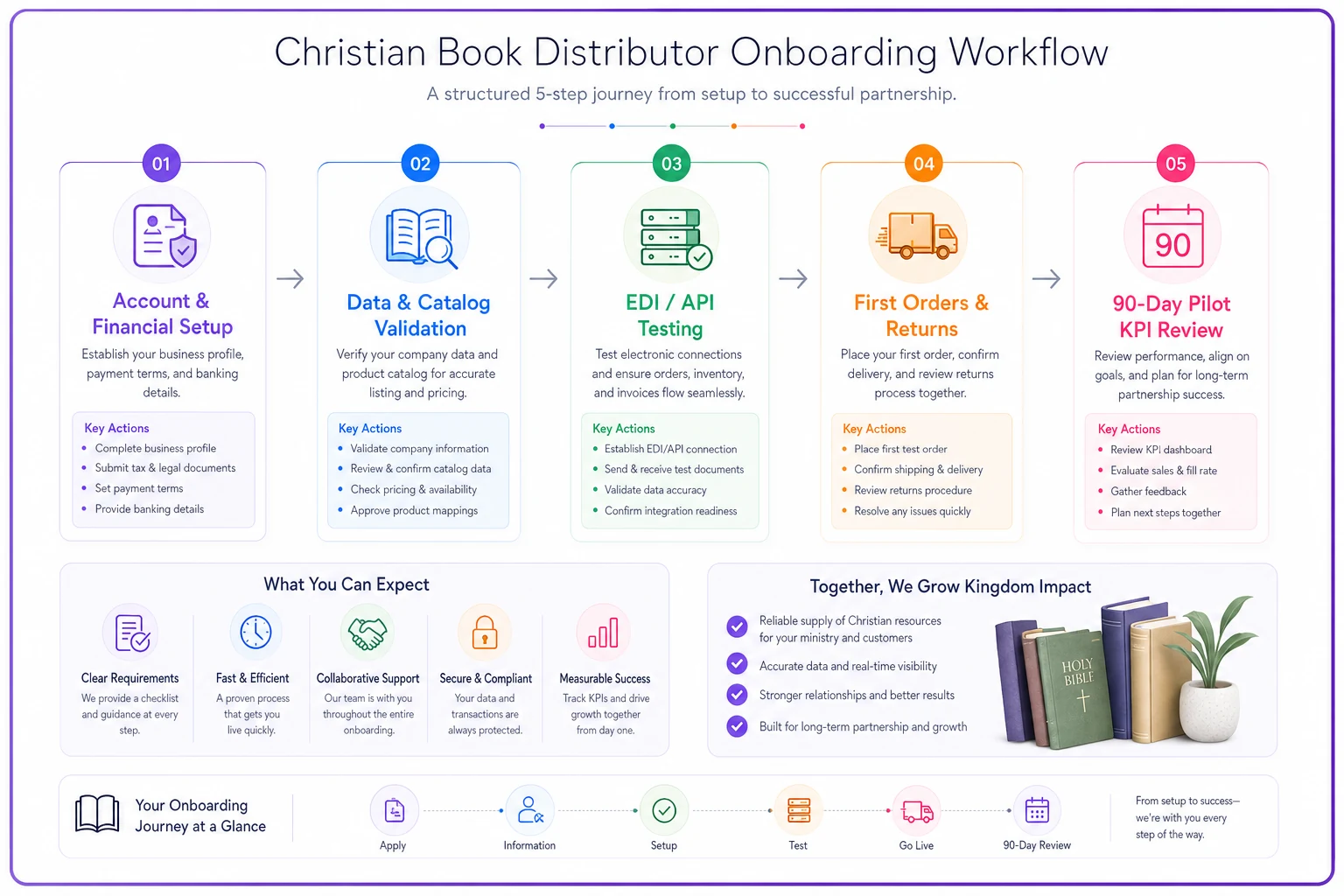
1. Account and financial setup
-
Open the trade account; confirm your assigned rep and the escalation contact — not just the general support line.
-
Submit and confirm the tax-exempt / resale certificate is stored on file, not processed per-order. Get written confirmation of which orders it applies to. Worth aligning with your broader multichannel sales-tax remit workflow so a church order doesn't get taxed by accident.
-
Confirm credit terms in writing — Net 30/60, credit limit, early-pay discount.
-
Load remit-to details, payment method, and early-pay discount rules into your AP process before the first invoice hits.
2. Data and catalog
-
Request a sample product data feed (full or category slice) before full ingestion.
-
Validate
ISBN-13 formatting, BISAC/category accuracy, price fields, cover image URLs, and stock/availability flags.
-
Map their category codes to your internal taxonomy. Decide how you'll handle duplicate editions before they enter your catalog, not after you've already got a mess.
-
Set feed refresh cadence — nightly is ideal — and confirm the file format won't change without notice.
3. EDI / API testing
-
Run a test purchase order end-to-end
PO out → order acknowledgment → advance ship notice (ASN) → invoice.
-
Time each step. If the order ack takes 24+ hours, your reorder logic needs to account for that buffer.
-
Deliberately test an out-of-stock line so you can see how backorders and substitutions get communicated.
-
Confirm invoices reconcile automatically against POs — or flag now that you'll be reconciling by hand.
4. First real orders and returns
-
Place a small real sample order — one box, mixed categories — rather than a large opening buy.
-
Receive it against the ASN. Log fill rate, any mis-ships, and any damage.
-
Immediately test the returns path with one or two units
request an RMA, note the turnaround, confirm the credit posts correctly.
-
Document the whole flow in your team's shared knowledge base so it's not locked in one person's head. If you don't have a system for that, your HR and knowledge management setup for tiny teams is exactly where this should live.
Visual reference for the sequence.
The thing most stores miss: test returns on purpose, early, while the relationship is warm. Almost everyone tests the happy path — order arrives, great. Almost nobody deliberately tests a return and a backorder during onboarding, which is precisely when you have the rep's attention and the leverage to fix a broken process before it becomes routine.
Run a 90-day pilot with a KPI scorecard
Don't make a distributor your primary on day one. Run a scored pilot. Track these monthly and review at day 90:
-
Fill rate — % of ordered units shipped complete. Below roughly 92% and your shelves have holes you didn't plan for.
-
Order-to-receive days — average, and worst case.
-
Mis-ship / damage rate — units wrong or damaged per hundred received.
-
Return turnaround — days from RMA request to credit posted.
-
Invoice accuracy — % of invoices that matched the PO without a manual fix.
-
Data feed error rate — how many catalog records needed correcting after ingestion.
-
Effective margin — after returns freight, restocking fees, and staff correction time.
That last metric is the whole point. A distributor can post a 90% fill rate and still cost you money if the data feed is dirty enough that someone spends an hour a day fixing categories, or if returns freight quietly stacks up. Effective margin is what decides whether they become primary, secondary, or dropped.
A realistic pilot scenario: a store runs two Christian distributors side by side for a quarter. One shows a 96% fill rate with near-zero feed errors; the other shows 89% fill and a feed that needs correcting on roughly one order in four. The second one had a slightly better headline discount — but after freight on backorders and the correction time, its effective margin came in a couple of points below the first. Easy call, and one you could only make because you scored the pilot instead of going on gut feel.
Negotiation scripts that actually move terms
You don't need to be aggressive. You need to be specific and give the rep something they can say yes to.
On net terms:
> "We're consolidating our faith-based buying and want you to be a primary. To make the cash flow work on our side, we need Net 60 instead of Net 30. If that's a stretch, can we do Net 45 with a 2% early-pay discount if we pay inside 15 days?"
On consignment:
> "For seasonal and event categories — Advent, VBS, author events — we'd rather take them on consignment so we're not sitting on unsold stock after the season. Can we set up consignment on those SKUs with a monthly reconciliation, and firm buys on everything else?"
On promotional support:
> "We're planning three ministry events this year and a seasonal display refresh. What co-op, sample copies, or event stock can you commit to if we feature your imprints? We can send you photos and sell-through numbers afterward."
Offering the sell-through data back is what separates a store reps actually invest in from one they don't. Promotional support is a trade, and you're offering your half.
When this level of rigor makes sense — and when it doesn't
Worth the full matrix and pilot: you're adding a distributor you expect to route real volume through, especially if church and ministry orders with tax exemption and event stock are involved. The operational risk is high enough that a bad onboarding costs real money.
Overkill: you're placing an occasional fill-in order for a single title you can't get elsewhere. Don't run a 90-day pilot to buy twelve copies of one book. Just order it.
Who should slow down: single-operator stores mid-season. Onboarding a new distributor during your Christmas or VBS rush is asking for the tax cert and feed problems to hit at your busiest, most understaffed moment. Onboard in the slow weeks — same logic as scheduling any operational change around your team's real capacity, the same reason you'd rethink shift and staffing plans around predictable stress periods rather than pile changes onto peak load.
A quick real scenario
A church bookroom running somewhere around $60k–$70k in annual product moved from a single distributor to a two-distributor setup after a pilot. The old arrangement had a fill rate hovering around 88%, and the tax-exempt certificate had to be re-confirmed on nearly every order because it was never stored on file — that alone was eating a chunk of the volunteer coordinator's time each week.
After scoring two options and running a 90-day pilot, they settled on a primary with a stored exemption cert and a nightly clean feed, and a secondary for catalog gaps. Fill rate came up to the mid-90s, the tax re-confirmation problem basically disappeared, and returns started posting credits in days instead of weeks. Nothing dramatic on the revenue line — but a noticeably calmer backroom and a couple of points of recovered effective margin, mostly from eliminating freight on backorders and the manual correction time.
The distributor you pick matters less than how you onboard and score them. A clean data feed, a stored tax-exempt cert, a returns path you've actually tested, and a 90-day pilot measured on effective margin will do more for your P&L than squeezing another point of discount out of the contract. Score before you sign, test the ugly paths early, and let the pilot — not the sales pitch — decide who becomes your primary.
Ready to elevate your bookstore’s operations?
Join 500+ bookstores using Bookstorely to boost sales, optimize stock, and delight book lovers.