

Consignment looks simple on the shelf and gets messy in the ledger. A local author drops off 20 copies. A small press sends you a face-out display on 60/40 terms. Your rep offers 90-day dating on a spring order so you can pay after the sell-through. None of these feel like accounting problems when they happen — they feel like relationships. Six months later you're staring at a balance you can't explain, a vendor who swears you owe them for 14 copies you're pretty sure you returned, and a P&L that overstated revenue because you booked consignment sales like you owned the stock.
The reason bookstore consignment accounting governance matters isn't that the math is hard. It's that consignment sits at the intersection of inventory, cash, vendor relationships, and revenue recognition — four systems with their own timing. When those timings drift out of sync, the errors don't announce themselves. They accumulate.
This is a systems article, not a list of tips. The goal is to show how the whole thing connects, where it breaks as you add more consignors and channels, and what a governance layer actually looks like for a one-to-three person shop.
Why consignment breaks differently than normal purchasing
With a standard wholesale order, ownership is clean. You buy the book, it's your inventory, you sell it, revenue hits the full retail price and the cost sits in COGS. Done.
-
You don't own the inventory — so it shouldn't sit in your inventory asset account, but physically it's on your shelf mixed with owned stock.
-
You only recognize your split as revenue — not the full sale price. The consignor's share is a payable, not your money, even though it passed through your register.
-
Payment timing is decoupled from the sale — you sell today, but you reconcile and pay the consignor weeks or a month later.
The register doesn't know any of this. Your POS rings up a $24 book the same way whether you own it or hold it on consignment. Unless you've tagged that SKU and built a rule around it, every consignment sale silently inflates your revenue and understates a liability. The books look fine. They reconcile against your bank deposits. That's the trap — the error is internally consistent, so nothing flags it.
A typical example: a store carries around 40 consignment titles from 12 local authors, averaging maybe $600–$800 in monthly consignment sales. On 60/40 terms in the store's favor, roughly $240–$320 of that each month belongs to the authors. If it all gets booked as store revenue, the store is overstating monthly revenue by that amount and carrying an invisible payable. Across a year, that's a $3k+ liability that never made it onto the balance sheet — and a tax picture that's quietly wrong.
The three flavors of consignment-adjacent risk
Most stores don't deal with pure consignment. They deal with a messy blend of arrangements that all behave like consignment for accounting purposes because they decouple the sale from the settlement. Here's how they differ and why they need different reconciliation cadences.
Never miss a sale or stock shortage again.
Bookstorely helps you manage inventory, orders, and customer relationships seamlessly.
- Integrated inventory tracking
- Customer purchase history
- Sales reporting & analytics
No credit card required
| Arrangement | Who owns stock | When you recognize revenue | Main reconciliation risk |
|---|---|---|---|
| True consignment split (60/40, 70/30) | Consignor | Only your split, at point of sale | Miscounted sell-through; unpaid consignor balances |
| Partial-ship credits | You (owned) | Full retail at sale | Credit for undelivered units never applied |
| Negotiated dating (30/60/90-day terms) | You (owned) | Full retail at sale | Payable timing vs. actual sell-through mismatch |
Partial-ship credits and negotiated dating aren't technically consignment, but they create the same governance headache: a gap between what happened physically and what's settled financially. If you ordered 30 copies, got 22, and were promised a credit for the 8 backordered — that credit is a receivable sitting in limbo until someone reconciles it. If your rep gave you 60-day dating, the invoice is real and owed, but your cash timing depends on how fast the stock actually moves.
The mistake most stores make is treating all three the same way at month-end. They aren't the same. A consignment split needs a sell-through reconciliation. A partial-ship needs a delivery-vs-invoice reconciliation. Negotiated dating needs an aging and cash-timing reconciliation. Different questions, different cadences, different documents.
If you've already tightened your backroom process for missing credits, this builds directly on that — the backroom workflow for miscounted returns and missing consignment credits handles the physical counting side, while this article handles the accounting governance that sits on top of it.
Policies you actually need to write down
Governance is boring until it's the only thing that saves you from a vendor dispute you can't win because you have no records. The policies below are the minimum — not about bureaucracy, but about making the reconciliation possible later.
1. Intake policy for consignment stock Every consignment item gets a signed agreement before it hits the floor. The agreement locks in: the split, the term length, return conditions, who eats damaged or stolen copies, and the payment cadence. No verbal deals. A surprising number of author disputes come down to "we never agreed to that split" — which is entirely preventable at intake.
2. SKU tagging policy Consignment stock must be flagged distinctly in your system — a consignment flag, a vendor tag, or at minimum a naming convention. If your POS can't distinguish a consignment sale from an owned sale at the moment it rings, your revenue recognition is broken from the start and no amount of month-end cleanup fully fixes it.
3. Recognition policy Write down the rule: for consignment sales, recognize only the store's split as revenue; the consignor's share posts to a consignment payable liability at the point of sale. For dated and partial-ship purchases, recognize normally but track the credit or payable separately.
4. Reconciliation cadence policy Define who reconciles what and when. Most small teams don't fail because they skip reconciliation entirely — they fail because the cadence is "whenever someone remembers." Consignment needs a fixed rhythm.
5. Payout and credit-application policy No consignor gets paid, and no vendor credit gets applied, without a reconciliation report backing it. Payment follows reconciliation, never the other way around.
Reconciliation cadences that scale with you
The right cadence depends on volume. Here's the pattern that holds up as a store grows from a handful of consignors to a few dozen.
Under ~10 consignors: monthly is fine. One pass at month-end covering sell-through, payables, and credits. This folds naturally into your monthly close.
10–30 consignors with multiple dated orders: you need a mid-month checkpoint. Not a full close — just a 20-minute pass to catch anything obviously off before it compounds. Partial-ship credits especially rot if left a full month, because the vendor's memory of what they owe you fades fast.
Past ~30 consignors or running consignment across multiple channels: weekly light-touch reconciliation on sell-through, monthly full settlement. At this scale, a single missed month can hide dozens of small discrepancies that become nearly impossible to untangle.
One thing worth understanding: reconciliation frequency should scale with the number of independent parties, not with revenue. Ten authors each owed $40 is far more reconciliation work than one publisher owed $4,000, even though the dollars are smaller. Every party is a separate ledger, a separate dispute risk, a separate count.
A small-team monthly reconciliation checklist
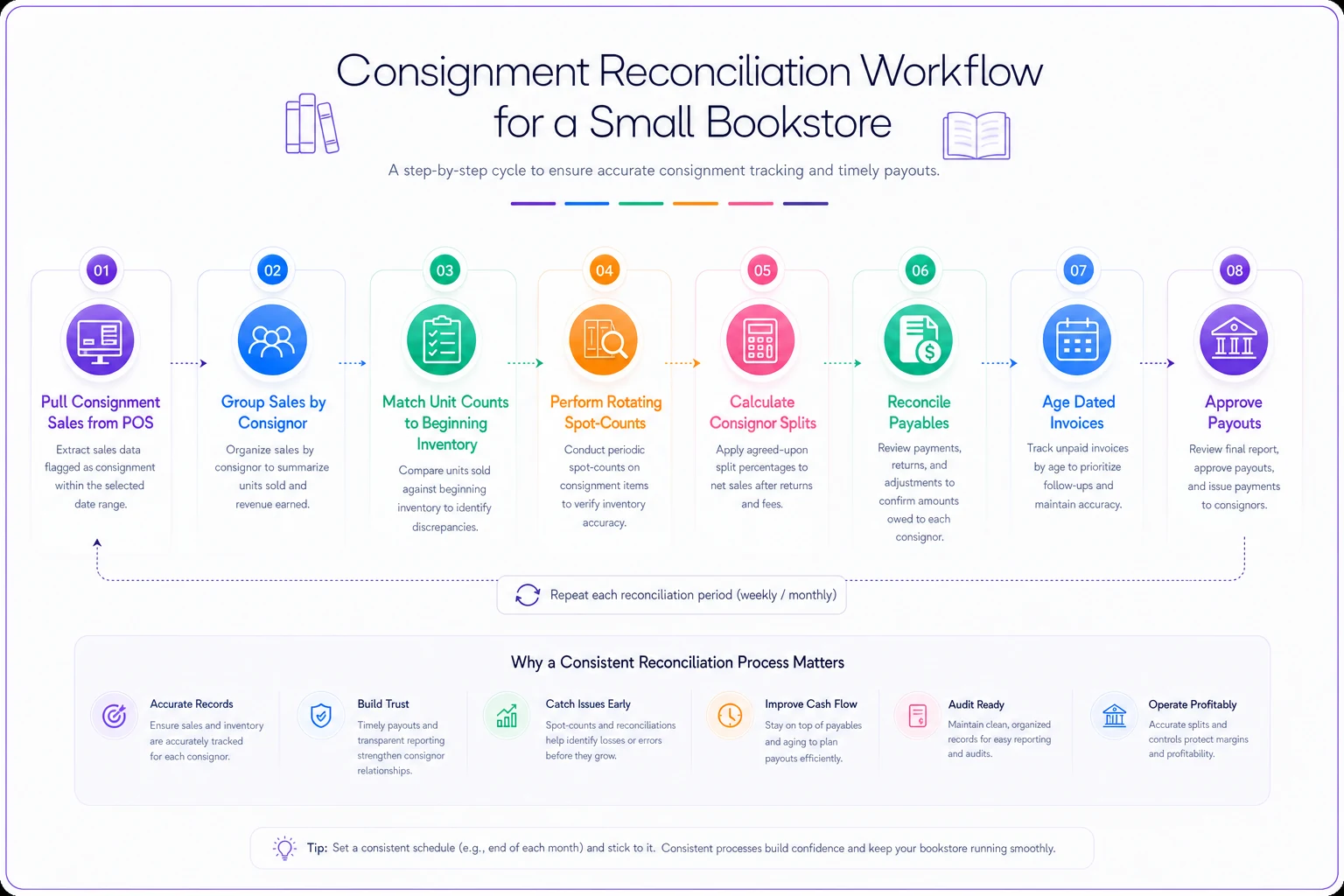
This is the actual pass — built for a 1–3 person shop, meant to take under an hour once your tagging is clean.
-
Pull all consignment-flagged sales for the period from POS
-
Group sales by consignor
-
Match unit counts sold against beginning consignment inventory per consignor
-
Physically spot-count 2–3 consignors' remaining stock to validate (rotate which ones each month)
-
Calculate each consignor's split owed
-
Reconcile calculated payable against the running consignment payable liability balance
-
Pull all partial-ship orders received in the period; confirm every promised credit was issued and applied
-
Age all dated invoices; flag anything approaching term
-
Generate consignor statements
-
Approve payouts; record payment and clear the payable
-
File the reconciliation report with the month's close documents
Rotate spot-counts so each consignor is validated at least once per quarter.
The spot-count step is the one people skip, and it's also the one that catches theft, damage, and miscounts. You don't count everyone every month — you rotate, so over a quarter you've validated everybody at least once.
Sample journal entries for consignment revenue recognition
Here's where the policy becomes actual bookkeeping. Assume a $30 book on a 60/40 split in the store's favor. Store keeps $18, consignor gets $12.
At the point of sale (consignment item): Dr Cash / Card Clearing $30.00 Cr Consignment Revenue $18.00 Cr Consignment Payable $12.00
Only $18 hits revenue. The $12 is a liability from the moment it rings. You never touch inventory here — because the book was never your asset.
When you pay the consignor at month-end: Dr Consignment Payable $12.00 Cr Cash $12.00
For a partial-ship credit — say you ordered 30 copies at $15 cost, received 22, and are owed a credit for 8 ($120): Dr Accounts Payable $120.00 Cr Vendor Credit Receivable $120.00
That receivable sits open until the vendor actually issues the credit memo. When they do, you clear it against the next invoice. If you never book it, you have no record to chase — which is exactly how partial-ship credits vanish.
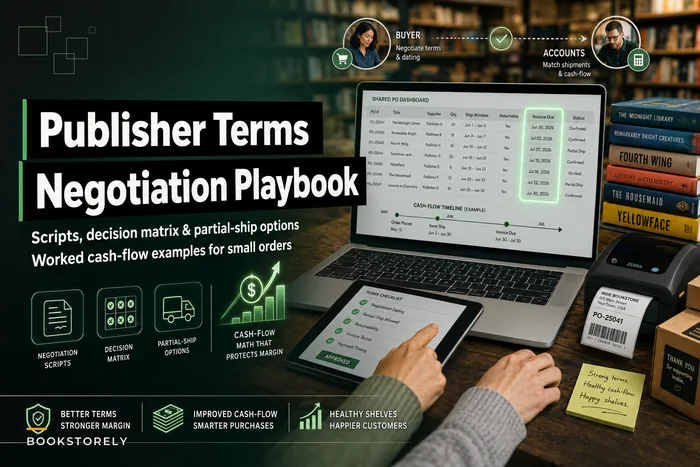
For negotiated dating, the entry is standard purchasing — Dr Inventory, Cr Accounts Payable at receipt — but the governance is in the aging, not the entry. A 90-day term means that payable needs to be tracked against sell-through so you don't hit the due date with unsold stock and no cash to cover it. The cash-flow math behind those dating terms is worth working out in advance; the publisher terms negotiation piece on partial-ship options and cash-flow gets into how to structure those deals so the timing actually works in your favor.
A monthly consignor statement template
Every consignor should get the same simple statement. Consistency here kills disputes before they start.
CONSIGNOR STATEMENT — [Month/Year] Consignor: [Name] Agreement terms: [e.g., 60/40 store split] Beginning inventory on hand: [units] Units received this period: [units] Units sold this period: [units] Units returned/removed: [units] Ending inventory on hand: [units] Gross retail sold: $[amount] Consignor share (40%): $[amount] Prior balance owed: $[amount] Payment issued this period: $[amount] Balance carried forward: $[amount]
The ending-inventory line is doing quiet work — it forces a count reconciliation every single month and gives the consignor a number to object to now, when it's still fixable, rather than a year later when nobody remembers what was on the shelf.
Where this breaks as you grow
The single-store, ten-author version of this is manageable in a spreadsheet. What breaks it:
Adding channels. The moment consignment stock can sell online as well as in-store, your reconciliation has to pull from two sales systems and net them per consignor. Miss one channel and every statement is wrong.
Adding consignors faster than you add process. Every new author is another agreement, another split, another monthly statement, another count. Manual reconciliation time grows roughly linearly with consignor count. Around 25–30, the spreadsheet approach starts eating a full day a month and errors creep in from sheer volume.
Staff turnover. If the one person who "knows how the consignment stuff works" leaves and it all lived in their head and a personal spreadsheet, you inherit a black box. Governance means the process survives the person.
This is where operational software earns its place — not as a magic fix, but because the tagging, the per-consignor sell-through calculation, the statement generation, and the payable tracking are exactly the kind of repetitive, error-prone work that shouldn't depend on human memory. A platform that flags consignment SKUs automatically, tracks the payable in real time as sales ring through, and generates consignor statements on a cadence removes the two failure points that cause almost every dispute: forgotten counts and inconsistent statements. The AI-assisted piece is mostly quiet — surfacing discrepancies between expected and actual sell-through before they become arguments, and flagging dated invoices that are aging toward term. You still make the calls. The system just makes sure nothing slips through because someone got busy during a holiday rush.
A real scenario
A used-and-new indie shop carried consignment work from about 18 local authors and small presses, plus regular dated orders from two regional distributors. They booked every consignment sale as full revenue and paid authors "roughly what seemed right" quarterly — from memory and a rough tally.
The problems showed up at tax time. Revenue was overstated somewhere in the $4k–$5k range across the year, money that actually belonged to consignors. Two authors were underpaid and quietly stopped restocking. One distributor's partial-ship credit for about 30 backordered units, worth close to $400, was never applied because nobody tracked it.
The fix wasn't complicated. They flagged consignment SKUs, switched to booking only their split at point of sale, moved to monthly reconciliation with rotating spot-counts, and started sending consistent monthly statements. Within a couple of months the payable balance was accurate and reconciled to actual counts. The distributor credit got recovered. The two authors came back once they got clean, on-time statements — because the underpayment had never been malice, just a broken process. The store's revenue number dropped on paper, but it was finally true, which made every downstream decision more reliable.
When tight consignment governance makes sense — and when it's overkill
When it's worth the effort: you have more than a handful of consignors, you're mixing consignment with dated and partial-ship orders, you sell across more than one channel, or you've ever had a payout dispute. Any of those, and the governance pays for itself in avoided errors and preserved relationships.
When it's overkill: you take one or two local authors, a dozen copies each, cash-basis, and settle in person. A signed one-page agreement and a running note is enough. Over-engineering a tiny consignment program is its own kind of waste.
Who should not skip it: anyone whose consignment revenue is a meaningful slice of monthly sales, and anyone whose books get reviewed by a lender, landlord, or the taxman. The moment your numbers get audited by anyone, "we booked it all as revenue and paid people from memory" stops being charming.
Consignment isn't dangerous because it's hard. It's dangerous because it feels casual while it quietly touches four different parts of your books. Governance is just the decision to stop trusting memory and start trusting a repeatable process — one that scales when you add the twentieth author instead of collapsing under them. Get the tagging right, book only your split, reconcile on a real cadence, and send the same statement to everyone every month. That's the whole system. Everything else is just discipline.
Ready to elevate your bookstore’s operations?
Join 500+ bookstores using Bookstorely to boost sales, optimize stock, and delight book lovers.