

Most bookstore owners don't lose money on the sticker price of what they buy from Christian book distributors. They lose it in the fine print — the restocking fee nobody flagged, the 45-day invoice that quietly became net-15, the "free freight over $500" that got redefined mid-year. By the time you notice, you've bled two or three margin points across a whole season.
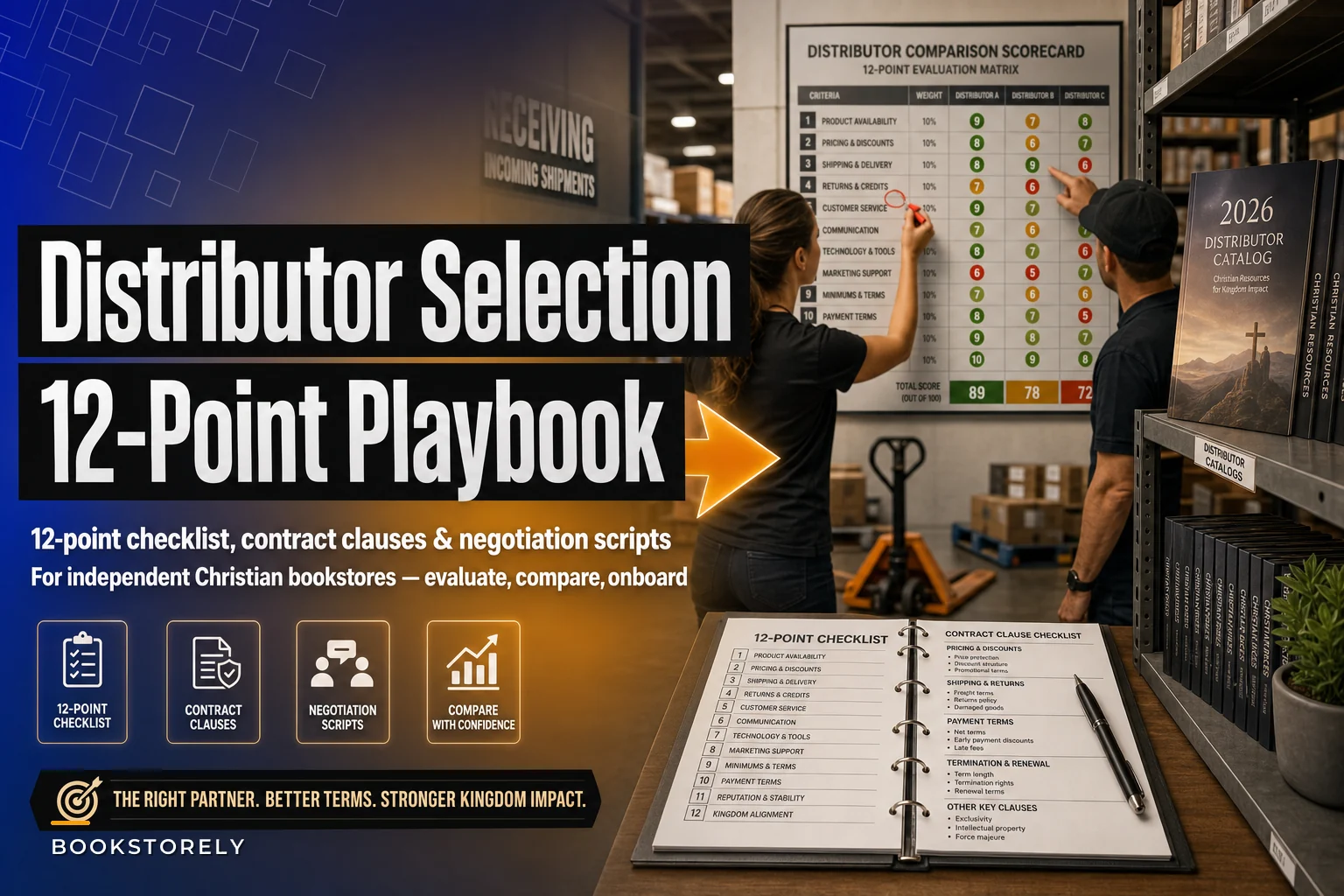
This guide is built to stop that. It opens with a 12-point scorecard you can print and score in one sitting, then walks through each point with the exact questions to ask, the red flags that should make you pause, sample contract language you can copy, and simple cost math so you can see the actual dollars.
You can grab the downloadable 12-point PDF checklist and the XLSX decision-matrix template at the bottom, plus three negotiation scripts and five copy-paste contract clauses.
1) Who this guide is for and when to use it
This is for independent and small Christian bookstores — and church bookstores running lean — that are either adding a new distributor, renegotiating an existing one, or trying to figure out why margin keeps slipping despite steady sales.
-
You're bringing on a new distributor and want to compare two or three side by side.
-
Your current terms are up for renewal and you suspect they've drifted.
-
You're consolidating vendors and need a fair way to score who stays.
-
A distributor changed a policy (freight minimums, return windows) and you want to re-evaluate before signing again.
If you're doing broad sourcing strategy rather than distributor selection specifically, this is the tactical layer underneath that — the actual evaluation and contract work.
2) Quick 12-point checklist (summary table)
Score each distributor 1–5 on every line. Weight the rows that matter most to your store (there's a weighting column in the spreadsheet). Anything scoring a 1 or 2 on a high-weight row is a conversation before you sign.
Never miss a sale or stock shortage again.
Bookstorely helps you manage inventory, orders, and customer relationships seamlessly.
- Integrated inventory tracking
- Customer purchase history
- Sales reporting & analytics
No credit card required
| # | Evaluation Point | What a strong score looks like |
|---|---|---|
| 1 | Trade discount depth | 40%+ off retail on core inventory |
| 2 | Invoicing cadence | Net-30 or better, predictable billing |
| 3 | Chargeback clarity | Written, capped, disputable |
| 4 | Lead times | 2–5 business days, published |
| 5 | Minimum order quantity | Low or waivable MOQ, reasonable free-freight threshold |
| 6 | Partial-ship policy | Ships available stock, backorders tracked |
| 7 | Return window & restocking | 90+ days, restocking fee under 10% or waived |
| 8 | Data & integration | EDI/API or clean catalog files, ISBN accuracy |
| 9 | Reporting cadence | Regular sales/backorder/credit reporting |
| 10 | Values & content alignment | Clear content policy, screening process |
| 11 | Contract exit terms | Reasonable termination + dispute path |
| 12 | Responsiveness | Named rep, answers within a day |
Print this, score it, and let the low numbers show you where to push.
3) Financial terms: pricing, discounts, chargebacks, invoicing
This is where the money actually lives. Two distributors can advertise "up to 45% off" and deliver completely different net margins once you factor in freight, chargebacks, and billing speed.
What to ask:
-
What's the standard trade discount on my core categories, and does it change by volume tier?
-
Is the discount off list/retail or off a distributor price?
-
What triggers a chargeback, and is there a cap?
-
Net-30, net-45, or net-15? Are there early-pay discounts?
Red flags: "Discount varies" with no tier sheet. Chargebacks with no written cause list. Invoicing that starts at ship date instead of delivery date — that quietly shortens your payment window without anyone announcing it.
Sample margin math. Say you buy a title with a $17.99 retail price at 42% off:
-
Cost
$17.99 × (1 − 0.42) = $10.43
-
Add freight allocation of ~$0.70/unit on an LTL order = $11.13 landed
-
Sell at full retail
gross margin = ($17.99 − $11.13) ÷ $17.99 ≈ 38%
Now the same title at 40% off with $1.40/unit freight because you didn't hit the free-freight threshold:
-
Cost
$10.79 + $1.40 = $12.19 landed
-
Margin ≈ 32%
Same book. Six margin points gone — not from price, from freight and a two-point discount difference. Across a $40k annual buy that's roughly $2,400 you never see.
> "Payment terms are Net-30 from date of delivery. Buyer is entitled to a 2% discount on invoices paid within 10 days. Distributor may not alter discount tiers or payment terms without 60 days' written notice."
4) Inventory & logistics: lead times, MOQs, partial ships, shipping
The pricing can look great and still cost you if you can't get stock when a Sunday-morning rush or an author event hits.
What to ask:
-
What are typical lead times, in writing, for in-stock and backordered items?
-
Is there a minimum order quantity or minimum dollar amount?
-
What's the free-freight threshold, and is it per-order or monthly?
-
Do you ship partials when part of my order is available, or hold the whole thing?
-
Parcel or LTL, and who chooses?
The partial-ship trap. A distributor that holds your entire order until every line is in stock can strand a whole shelf reset for weeks over one backordered devotional. Insist on partial shipment of available stock with backorders auto-tracked.
Require partial-shipment language with auto-generated backorder notices so you can reallocate shelf space immediately.
LTL vs parcel quick math. For orders over roughly 150–200 lbs, LTL usually beats parcel per pound — but LTL adds a liftgate/residential fee if you don't have a dock. A typical example: a 220-lb restock quoted at ~$95 LTL vs ~$180 in parcel boxes. The LTL wins unless the $45 liftgate fee and a mid-week delivery window don't work for a one-person shop.
-
MOQs that force overbuying on slow categories.
-
Free-freight thresholds that jumped without notice.
-
"Lead times vary seasonally" with no actual numbers attached.
Insist on partial shipment of available stock with backorders auto-tracked.
5) Returns, credits and restocking
Returns are where credits go to die. The distributor issues them slowly, or against future orders only, and your backroom loses track of what's owed.
What to ask:
-
What's the return window — 90 days, a year, seasonal-dated?
-
Is there a restocking fee? What percentage?
-
Do you require RA numbers, and how are credits issued — cash, or credit memo only?
-
What's the verification protocol on the receiving end?
Common audit traps:
-
Credits issued as memos that expire before you place another qualifying order.
-
Restocking fees applied to defective returns (those should be free).
-
"Received damaged" claims from the distributor with no photo requirement — you eat the loss.
The fix is a receiving protocol tight enough to match every credit to a return. If miscounted returns and vanishing consignment credits are a recurring headache, that discipline closes the gap regardless of whether the vendor is faith-based or not.
> "Buyer may return non-defective, resalable merchandise within 120 days for full credit issued as cash or applied to any open invoice. Restocking fees do not apply to defective or misshipped items. Distributor must provide dated photo evidence for any damage claim exceeding $50."
6) Consignment, exclusivity and special-order terms
Consignment sounds risk-free until the reconciliation work eats your Saturdays. Exclusivity sounds prestigious until it locks you out of a better source.
What to watch:
-
Consignment Who owns the stock, who insures it, and how often is it reconciled? Get a fixed reconciliation cadence in writing.
-
Exclusivity Never sign category exclusivity without a performance-out. If you can leave when they underperform, it's tolerable. If not, walk.
-
Special orders What's the markup, lead time, and can the customer cancel? Special orders with non-cancelable terms turn into dead stock when the customer changes their mind.
Red flag: Exclusivity clauses with auto-renewal and no performance benchmark. That's a lock-in dressed as a partnership.
7) Data & integration: EDI/API, reporting, catalog accuracy
Bad data from a distributor becomes bad data in your system — wrong ISBNs, duplicate editions, prices that don't match what's on the shelf. That shows up later as oversells and mispriced inventory.
What to ask:
-
Do you support EDI or an API, or is it flat-file catalog exports?
-
How often is the catalog updated, and how accurate is ISBN/price/availability data?
-
Can I get regular sales, backorder, and credit reporting without requesting it each time?
Catalog accuracy is a margin issue, not just a tech one. A distributor whose availability field is wrong 10% of the time means you're promising customers stock that isn't there, then eating the cancellation or the rush freight to fix it. Most owners don't think about that until they've already had a few bad Saturdays.
If you sell across marketplaces and channels, distributor data accuracy also feeds your tax and remittance work — the cleaner the source data, the smoother your multichannel sales-tax remit workflow runs at month-end.
8) Values alignment & content policies
This is the point that separates Christian book distributors from general trade wholesalers, and it deserves real scrutiny — not a handshake.
What to ask:
-
Do you have a written content policy, and can I see it?
-
How do you screen titles for objectionable material?
-
If a title becomes controversial in my community, what's the return/pull process?
-
Do you carry across denominations, or is the catalog theologically narrow?
A mismatch here isn't just philosophical. If a distributor's catalog skews toward content your congregation or customer base objects to, you'll spend staff time filtering titles manually on every order. Get their screening standard in writing so your buying decisions aren't a surprise later.
Red flag: No written content policy, or vague "we curate for the Christian market" language with no actual criteria. Ask for specifics.
9) Contract essentials and sample clauses
Beyond price, four clauses decide how much control you keep: payment terms, dispute resolution, termination, and indemnity.
> "Disputes shall first be addressed through good-faith negotiation within 30 days. Unresolved disputes will proceed to mediation before litigation, in the buyer's home jurisdiction."
> "Either party may terminate this agreement with 60 days' written notice. Upon termination, buyer may return unsold, resalable inventory for full credit, and distributor will settle all outstanding credits within 45 days."
> "Distributor warrants that all supplied titles comply with applicable law and its stated content policy, and will indemnify buyer against claims arising from mislabeled or non-compliant materials it supplied."
That last one matters specifically for faith-based buying, where content warranties protect you if a supplied title turns out to be something it wasn't represented as.
10) Negotiation scripts and the score-weighted decision matrix
Score each distributor on the 12 points, apply weights (freight and discount usually weigh heaviest for small stores), and the matrix does the comparing for you instead of gut feel.
How the weighted matrix works:
-
Score each distributor 1–5 on all 12 points.
-
Assign a weight (1–3) to each row based on what hurts your store most.
-
Multiply score × weight per row.
-
Sum the totals. Highest total wins — but check any high-weight row scoring below 3 before signing.
Three negotiation scripts you can copy:
> "We're placing roughly $X annually across your catalog. Based on that volume, can we move to your next discount tier now rather than after a trial period? Happy to commit to a quarterly order rhythm to make that work on your end."
> "The order minimum for free freight is a stretch for a store our size. Can we set the threshold monthly instead of per-order? That lets us hit it consistently and keeps orders flowing."
> "Before we sign, we need the restocking fee waived on defective and misshipped items, and credits issued as cash or against any open invoice — not memo-only. That's a firm requirement for us."
11) Onboarding checklist and 30/60/90 pilot plan
Don't move your whole buy to a new distributor on day one. Pilot it.
-
- [ ] Signed terms with the clauses above confirmed in writing
-
- [ ] Rep name, direct contact, and escalation path documented
-
- [ ] Catalog file imported and ISBN/price accuracy spot-checked
-
- [ ] First test order placed on a small, low-risk category
-
- [ ] Return/credit process tested with one deliberate return
Pilot timeline:
Days 1–30: Small orders only. Verify lead times, invoice accuracy, and catalog data against reality.
Days 31–60: Scale to normal volume in two or three categories. Test a partial ship and a return; time how fast the credit lands.
Days 61–90: Full evaluation. Compare actual landed cost and fill rate against what was promised. Renegotiate or expand.
Whoever owns receiving and reconciliation during the pilot should have it written into their role so nothing slips — the same documentation discipline that keeps tiny bookstore teams from losing process knowledge when one person is out.
12) Red flags and when to walk away
Some of these are dealbreakers on their own:
-
No written terms — everything is "we'll work it out." You won't.
-
Chargebacks or restocking fees with no cap or cause list.
-
Exclusivity with auto-renewal and no performance-out.
-
Credits that are memo-only and expire.
-
No content policy from a distributor that markets itself as Christian.
-
A rep you can't reach during your pilot — it only gets worse after you're committed.
Walk when a high-weight row scores a 1 and the distributor won't move on it in writing.
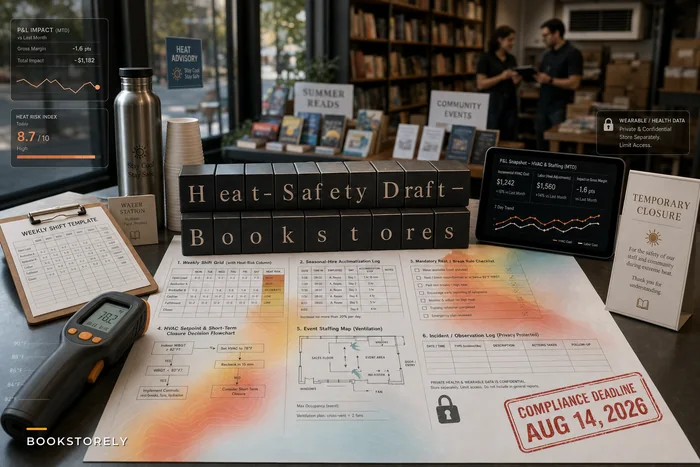
Worth flagging: regulatory changes can also shift your evaluation. California's August 2026 heat safety draft has implications for how small bookstores manage warehouse and receiving conditions — worth reviewing if you're in that state before you finalize any distributor logistics arrangements.
A real scenario
A church-affiliated bookstore running about $50k in annual purchasing was buying from a single Christian distributor at 40% off with per-order free-freight minimums it rarely hit. Freight was quietly running an extra ~$1.10 per unit on smaller reorders, and restocking fees were getting applied to a couple of misshipped cartons each season.
After scoring two distributors on the 12-point matrix and using the freight and returns scripts, they moved the free-freight threshold to monthly, got restocking waived on defective/misship items, and pushed the discount to 42% on core categories with a committed quarterly rhythm.
The distributor evaluation process below captures roughly how that comparison played out across the 12 points:
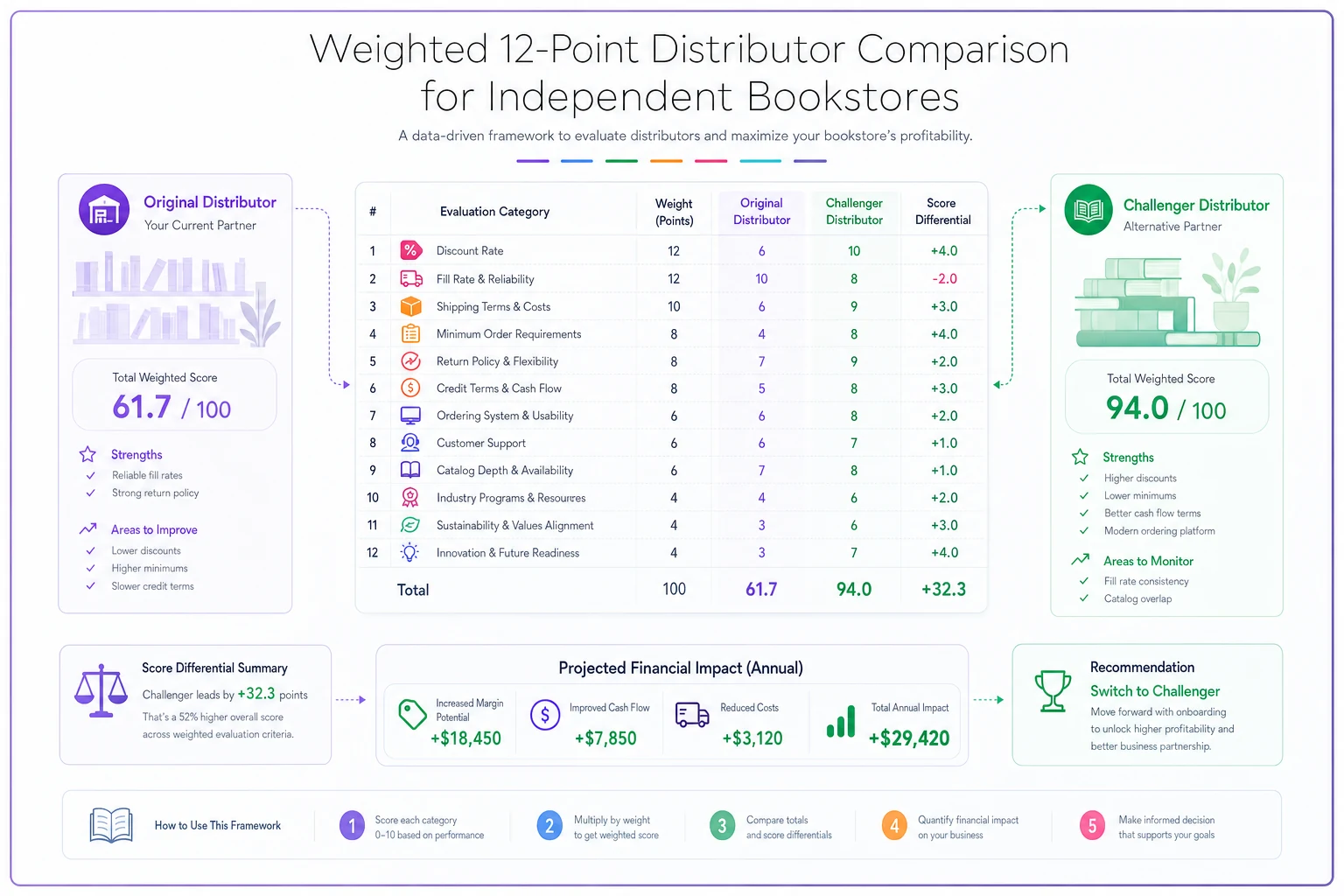
Most of the gap wasn't in discount rate. It was in freight structure, returns handling, and how fast credits actually hit the account. The matrix made that visible in a way that gut feel wouldn't have.
Downloads
Downloads
-
12-point PDF checklist — print and score in one sitting
-
XLSX decision-matrix template — weighted scoring for two or three distributors
-
3 negotiation scripts — discount, freight, returns
-
5 copy-paste contract clauses — payment, returns, dispute resolution, termination, content indemnity
Evaluating Christian book distributors well isn't about finding the deepest advertised discount. It's about scoring the full picture — freight, returns, data, values, and exit terms — before you sign, then piloting for 90 days so the contract has to prove itself with real orders. Do that, and you keep both your margin and your control.
Evaluating Christian book distributors well isn't about finding the deepest advertised discount. It's about scoring the full picture — freight, returns, data, values, and exit terms — before you sign, then piloting for 90 days so the contract has to prove itself with real orders. Do that, and you keep both your margin and your control.
Ready to elevate your bookstore’s operations?
Join 500+ bookstores using Bookstorely to boost sales, optimize stock, and delight book lovers.