



Most assortment problems don't look like assortment problems. They show up as a hardcover clogging your front table while the same title moves three copies a day on your marketplace listing. Or a slow trade paperback you keep reordering because it "does fine online" — except online it's eating a 15% referral fee and barely clearing cost. The inventory report says you're balanced. The register says you're fine. But underneath, titles are landing in the wrong places, and nobody ever set the rules that decide where they go.
That's the real gap. A bookstore channel assortment strategy isn't about picking what to stock — it's about deciding which channel each version of a title belongs to, and then enforcing that consistently enough that it survives a busy Saturday and a new seasonal hire. Format, edition, condition, margin, and lead-time all pull a title toward different channels. Without a system that weighs those attributes against your actual channel economics, you end up making the call title-by-title, from memory, usually when you're already behind on something else.
This piece is about building that system: a decision matrix that maps SKU attributes to channel rules, the carve-outs that keep it from being too rigid, and a quarterly review cadence so the whole thing doesn't drift out of date by month four.
## Why assortment decisions quietly fall apart
Assortment usually starts as one person's instinct. The owner knows the inventory. They know the hardcover of the local-author bestseller belongs on the front table, the used copies go on the marketplace, and the backlist religious titles move through the faith-based channel. For a while, that instinct is faster than any system.
Then the store adds a channel. Maybe a marketplace listing, maybe a subscription box, maybe school and library orders. Suddenly the same ISBN exists in three places — new hardcover, new paperback, used "very good" — and each version has different economics on each channel. The instinct that worked for one shelf now has to hold forty mental rules in place at once, and it quietly stops scaling.
What tends to happen across a lot of small retail operations is that the failure doesn't announce itself. No stockout, no angry customer. Margin just leaks. A title that should be reserved for in-store full-margin sales gets listed on a marketplace because "we had extra," and now it's selling at a fee-eaten margin when it would've sold in-store anyway. Or a fast backlist paperback never gets listed online because nobody got around to it, and you lose easy incremental sales. The register still rings. You just can't see what it should have rung.
A second pattern: the person who holds the rules leaves, or gets buried during holiday surge, and a seasonal hire starts putting titles wherever there's space. Three weeks of untracked decisions and your assortment logic is gone — because it never lived anywhere except one person's head.
## The five attributes that actually decide channel fit
Before any matrix makes sense, you need to agree on which attributes drive the decision. Most stores overcomplicate this. In practice, five do almost all the work:
-
Format — hardcover, trade paperback, mass market, used, special/signed editions. Format changes both perceived value and shipping cost, which pulls it toward different channels.
-
Edition — first printing, standard reprint, collectible, book-club edition. Edition mostly matters for the long tail and for anything with collector interest.
-
Condition — new, like-new, very good, acceptable. Condition is the single biggest reason a title should not go in a certain channel. You don't put an "acceptable" used copy somewhere returns are punishing.
-
Margin — real per-unit margin after channel fees, not list margin. This is where most stores lie to themselves.
-
Lead-time — how fast you can replace the unit if it sells. A title you can restock in two days behaves completely differently from a one-of-a-kind used copy.
The thing most owners miss: these attributes don't act independently. A high-margin hardcover with a long lead-time behaves more like a scarce used book than like a fast-restock paperback. You're not scoring attributes in isolation — you're reading the combination. A signed first edition (format + edition + long lead-time) almost never belongs on a fee-heavy, returns-friendly marketplace, no matter how good the headline margin looks.
## Building the decision matrix
The matrix is just a table that says: given these attributes, this title's primary channel is X, its secondary channel is Y, and it's excluded from Z. The point is to make the default obvious so you only have to think about exceptions.
Here's a worked version you can adapt. Channels here are In-store full-margin, Marketplace, Subscription box, and Institutional (school/library).
| SKU profile (format / edition / condition / margin / lead-time) | Primary channel | Secondary | Excluded from | Why |
|---|---|---|---|---|
| New hardcover / standard / new / high margin (~45%) / short lead | In-store | Marketplace | — | Full margin in-store; marketplace only to clear overstock |
| New trade paperback / standard / new / mid margin (~38%) / short lead | In-store | Marketplace | — | Fast restock, safe to list everywhere |
| Used / standard / very good / high margin after cost / long lead | Marketplace | In-store | Subscription | One-of-a-kind; needs the reach of a marketplace |
| Used / standard / acceptable / thin margin / long lead | Marketplace | — | Subscription, Institutional | Condition fails curated/institutional standards |
| Signed or first edition / collectible / like-new / very high margin / no restock | In-store (case) | Specialist listing | Marketplace, Subscription | Scarce, returns risk too high for open marketplace |
| New paperback / standard / new / mid margin / short lead / strong backlist | Subscription | In-store | — | Predictable demand suits curated box |
| New / standard / new / volume-discounted margin / short lead | Institutional | In-store | — | Priced for quotes; protect retail margin |
The matrix isn't trying to cover every title. It's trying to cover the profiles that repeat. Once you've defined six or eight profiles, probably 80% of your catalog sorts itself. The rest are judgment calls — which is exactly where you want your attention spent.
One thing worth stating plainly: the margin column should always be post-fee margin. If your real analysis of channel economics is shaky, the matrix will confidently route titles to channels that look profitable and aren't. A unified profitability model that compares retail, marketplace, event and subscription margins is what feeds this matrix its numbers. Without honest channel margins underneath, the matrix is just preferences dressed up as rules.
## Carve-outs: where rigid rules would cost you
A matrix that never bends is almost as bad as no matrix at all. Carve-outs are the deliberate exceptions you write down in advance so they don't become random improvisation later.
-
Local-author and event carve-out. Any title tied to an upcoming in-store event stays reserved for in-store, full-margin, regardless of what the matrix says — including pulling existing marketplace listings two weeks out. You don't want to sell your event stock online for a fee-eaten margin and then be short at the signing.
-
Scarcity carve-out. Anything with a lead-time you can't fill — rare, out-of-print, signed — gets protected from fast-moving channels even if margin looks good there. The risk isn't the sale; it's the return or the oversell you can't replace.
-
Seasonal demand carve-out. During holiday surge, high-velocity new releases can temporarily flip to "list everywhere" because the incremental sale outweighs channel-fee drag when volume is high and restock is fast.
-
Condition floor carve-out. A hard rule, not a soft one
nothing below "very good" goes to subscription or institutional channels, period. Those channels punish disappointment far more than a marketplace does, where buyers expect graded used stock.
The pattern behind good carve-outs: each one exists because an attribute the matrix de-prioritizes — like scarcity or event timing — occasionally becomes the most important factor. Writing them down converts "the owner would've known to do this" into something a Tuesday-afternoon hire can actually follow.
## A real scenario: the hardcover that was in the wrong place
A general-interest indie carrying roughly 1,500 SKUs had a habit of listing surplus new hardcovers on their marketplace account whenever the front table got crowded. Felt responsible — move the stock, free the space.
When they ran the numbers on one quarter of hardcover sales, the picture flipped. Hardcovers selling on the marketplace were clearing somewhere around 26–28% margin after referral fees and shipping. The same titles were selling in-store at roughly 44%. And the marketplace sales weren't even incremental — foot traffic on those titles was strong enough that most would've sold in-store within a couple of weeks anyway. They were essentially taking full-margin titles and voluntarily converting them to half-margin ones to free shelf space they could've cleared by rotating the display.
They rebuilt the rule: new hardcovers default to in-store only, and only go to marketplace once a title crosses a 90-day age threshold with slow velocity. Used and backlist stayed on the marketplace where the reach genuinely mattered. Over the next quarter, blended hardcover margin moved up a few points — not dramatic per title, but across a couple hundred units it added up. The lesson wasn't "marketplaces are bad." It was that they'd never written down which titles belonged there.
## How the matrix connects to the rest of your operation
Assortment doesn't live alone. The decision matrix sets where a title should sell, but your order-routing system decides where a sale actually pulls from when the same ISBN exists in multiple places. Those two have to agree, or you get the frustrating situation where your assortment says "reserve for in-store" but an online order silently drains the shelf copy. If you haven't already tightened that layer, the omnichannel order-routing map with safety-stock carve-outs and channel KPIs is the companion piece — assortment decides intent, routing enforces it at the moment of sale.
The workflow worth tracing: a new title arrives, gets attributes assigned at intake — format, edition, condition, cost. The matrix reads those attributes and suggests a primary and secondary channel. A human confirms or applies a carve-out. The title gets listed accordingly, with safety stock reserved for its primary channel. When it sells, routing pulls from the right pool. When it ages past a threshold, it re-enters the matrix with a new "aged" flag and may flip channels.
Treat intake as the moment assortment logic actually begins, not an afterthought.
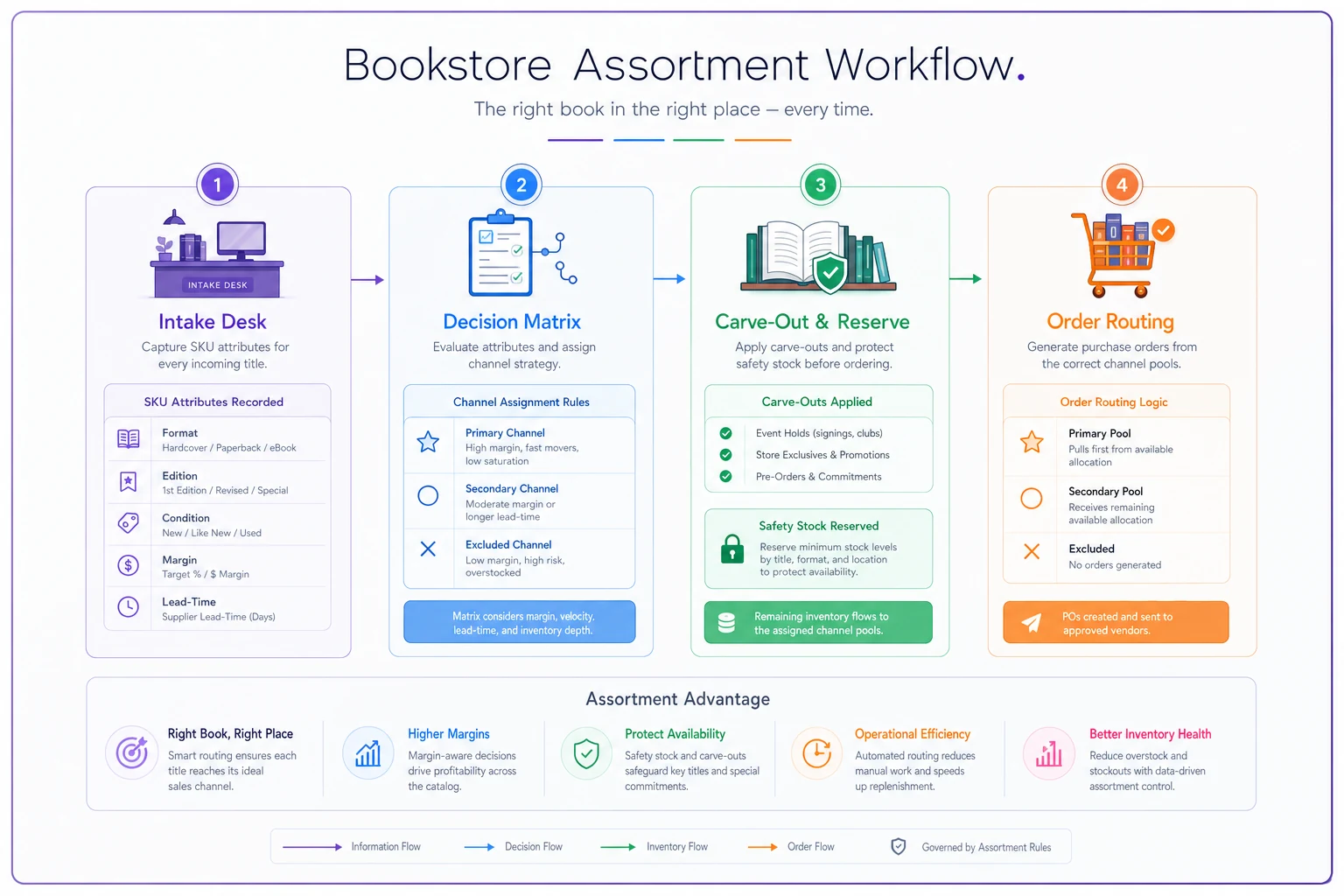
A simple workflow like this helps keep rules in the system, not someone's head.
The friction point is almost always the first step — attributes assigned at intake. If condition and real cost aren't captured cleanly when the book comes in, every downstream decision inherits the error. Stores that do this well treat intake as the moment assortment logic actually begins, not an afterthought. It's also where operational platforms that attach channel rules to SKU attributes earn their keep: instead of a human remembering the matrix, the system flags "this profile usually goes in-store only — confirm?" at the point of listing. The rule stops living in one person's head and starts living in the workflow, which is the only version that survives a holiday rush.
## The quarterly assortment review cadence
Any assortment system drifts. New channels launch, fees change, a format starts selling differently, a carve-out becomes permanent reality. If you never revisit the matrix, within a year you're enforcing rules written for a store that no longer exists.
-
Pull post-fee margin by channel for the quarter. Not list margin. Flag any profile whose real margin moved more than a few points.
-
Review the exclusion list. Did any excluded channel actually perform well on a test? Did any primary channel underperform?
-
Audit carve-out usage. How often was each carve-out triggered? A carve-out triggered constantly isn't an exception anymore — it should become a rule. One that never triggers can probably be retired.
-
Check lead-time assumptions. Supplier lead-times shift. A title you used to restock in two days might now take ten, which changes how scarce it should be treated.
-
Review aging thresholds. Are titles flipping channels at the right age, or sitting too long before they move to clearance channels?
-
Rewrite the matrix. Update profiles, re-sort the catalog against the new version, and note what changed and why.
The discipline that separates stores that keep this alive from ones that abandon it: they put a name and a date on the review, same as a monthly close. An assortment review that's "whenever we get to it" never happens.
## When this level of structure is worth it — and when it isn't
When it makes sense: You're running three or more channels, your catalog has meaningful format and condition variety, and you've caught yourself making channel decisions from memory. If you've ever had the same ISBN selling at wildly different margins in different places without a clear reason, you're past due. It's also worth it the moment you bring on help — a documented matrix is how you delegate assortment without delegating your margin.
When it's overkill: A single-channel store, or one with a tight, mostly-new catalog and little condition variety, doesn't need a seven-row matrix. Two or three simple rules will do. Building elaborate structure for a store that sells almost everything the same way is just ceremony.
Who should hold off: If your underlying data is a mess — duplicate ISBNs, no real post-fee margin numbers, condition not tracked at intake — fix that first. The matrix amplifies whatever data feeds it. A clean assortment system sitting on top of unreliable attributes will route confidently and wrongly, which is worse than routing by gut, because at least gut knows it's guessing.
## Quarterly assortment-policy checklist
Use this as the recurring review artifact.
-
- [ ] Post-fee margin pulled by channel; profiles with >3-point moves flagged
-
- [ ] Each channel's primary/secondary titles reviewed against actual sales
-
- [ ] Exclusion list validated — any channel ready to add or drop?
-
- [ ] Carve-out trigger counts reviewed; promote frequent ones, retire dead ones
-
- [ ] Supplier lead-times refreshed; scarcity treatment updated
-
- [ ] Aging thresholds checked — titles flipping channels at the right moment?
-
- [ ] Condition-floor rule confirmed still enforced at intake
-
- [ ] Matrix rewritten with change log (what changed, why)
-
- [ ] Routing rules checked to still match assortment intent
-
- [ ] Next review date set and assigned to a name
Keep it short enough that it actually gets done.
## Pulling it together
The stores that get assortment right aren't the ones with the most sophisticated matrix. They're the ones who moved the decision out of one person's instinct and into a written system that reads attributes, applies rules, respects a short list of deliberate exceptions, and gets revisited on a schedule. That shift — from remembering to routing — is what lets assortment survive growth, new channels, and a seasonal hire who's never heard of your front-table logic.
Start smaller than you think. Define six or eight profiles, write three carve-outs, get honest post-fee margins underneath it, and put a quarterly date on the calendar. The matrix will be rough the first time. That's fine — it's a living document, and the quarterly review is where it gets sharp. The goal isn't a perfect system on day one. It's making sure that six months from now, every version of every title is landing where it actually earns, whether or not you're the one making the call.