



Most bookstore cash problems don't announce themselves. They show up as a Tuesday morning where the publisher invoice is due, the Ingram statement came in higher than you remembered, payroll hits Friday, and the holiday buy you committed to in September is now landing in boxes you have to pay for. Nothing went wrong, exactly. The money just stacked up in the same two weeks, and you didn't see it coming because you were looking at your bank balance instead of your calendar.
A 13-week cash plan fixes that. It's not a budget, and it's not your P&L. It's a week-by-week map of money moving in and out over the next quarter, built around the specific rhythms of selling books — the buying windows, the co-op timing, the event cash swings, the return credits that show up two months after you expected them. The 13-week window matters because it's long enough to catch a seasonal buy landing but short enough that your estimates aren't pure fantasy.
This isn't about forecasting profit. Profitable bookstores run out of cash all the time. This is about never being surprised by a Tuesday.
Why bookstore cash flow breaks differently than other retail
Books have a few structural quirks that wreck generic cash templates. If you've ever downloaded a "13-week cash flow model" built for a general small business and tried to force your store into it, you already know it doesn't fit.
First, the buying windows are lumpy and front-loaded. You commit to fall and holiday titles months before the cash comes back through the register. A frontlist buy placed in August for October delivery means you're paying for inventory during your slowest selling weeks, right before your busiest ones. The cash out and the cash in are separated by the worst possible gap.
Second, returns are a cash input that nobody plans for correctly. Returnable stock is essentially a delayed refund, but the credit lands on your account weeks after you ship the returns back — and only if your backroom actually processed them. A store sitting on $6k of returnable overstock is sitting on $6k of cash it hasn't collected yet. Most owners treat that as "inventory," not "pending cash," and the distinction matters enormously when you're tight.
Third, events create cash spikes and cash holes that don't match the sales. A big author event might bring strong register sales on one night, but you pre-bought the signing stock, maybe paid a guarantee, printed materials, and staffed up. The money went out over the two weeks before, and the sales landed in a single evening — sometimes with consignment or publisher terms that delay when you actually keep the cash.
Fourth, co-op and promotional credits are real money, but they arrive on publisher timelines you don't control. If you're counting on co-op to offset a buy and it posts a quarter late, your cash plan was wrong from the start.
Generic templates assume smooth, predictable flows. Bookstores don't have those. That's why you need a model built around your calendar instead of a monthly average.
The core structure: a calendar, not a spreadsheet of guesses
The mistake people make with cash planning is building a static spreadsheet they fill out once and never touch. A 13-week rolling plan is a living document. Every week you drop the week that just ended, add a new week 13, and update actuals against your estimates. That rolling habit is what turns it from a planning exercise into an early-warning system.
Never miss a sale or stock shortage again.
Bookstorely helps you manage inventory, orders, and customer relationships seamlessly.
- Integrated inventory tracking
- Customer purchase history
- Sales reporting & analytics
No credit card required
Here's the backbone. Each of the 13 weeks gets a column. Down the side, you track:
-
Starting cash (the real number from your bank, not your accounting software's "cash" line)
-
Cash in broken into sources
in-store sales, online/marketplace, events, returns credits, co-op, school/library payments, subscription or membership billing
-
Cash out broken into
inventory payments (by vendor terms), payroll, rent, utilities, card processing fees, event costs, loan/line payments, sales tax remittance, software
-
Net movement
-
Ending cash (which becomes next week's starting cash)
The granularity on inventory payments is where bookstore plans live or die. You can't lump "inventory" into one line. You need to know which invoice is due which week based on actual vendor terms, because that's the lever you'll pull when things get tight. A net-90 publisher order and a net-30 distributor order placed the same week hit your cash in completely different weeks.
A realistic slice of the model
Here's what a few weeks might look like for a store doing somewhere around $45k–$55k a month in total revenue, heading into fall:
| Line | Wk 3 | Wk 4 | Wk 5 (event wk) | Wk 6 |
|---|---|---|---|---|
| Starting cash | $18,200 | $16,400 | $14,900 | $11,100 |
| In-store sales | $8,800 | $9,100 | $13,500 | $9,400 |
| Online/marketplace | $2,100 | $2,000 | $2,300 | $2,200 |
| Event sales | — | — | $4,200 | — |
| Returns credit | — | $1,800 | — | — |
| Co-op posting | — | — | — | $900 |
| Total in | $10,900 | $12,900 | $20,000 | $12,500 |
| Inventory (vendor invoices) | $6,100 | $7,300 | $9,200 | $14,800 |
| Payroll | $4,200 | — | $4,600 | — |
| Rent | — | $3,800 | — | — |
| Event costs | — | $1,400 | $3,800 | — |
| Other (fees, tax, software) | $2,400 | $1,900 | $6,400 | $2,100 |
| Total out | $12,700 | $14,400 | $28,000 | $16,900 |
| Net | -$1,800 | -$1,500 | -$8,000 | -$4,400 |
| Ending cash | $16,400 | $14,900 | $11,100 | $6,700 |
Look at week 6. Nothing dramatic happened in sales. But the fall inventory invoices came due, and ending cash dropped to $6,700 — getting close to the floor. If you only looked at your P&L, week 6 looks fine, maybe even good because the fall stock is sitting on shelves. The cash plan is the only thing that flagged week 6 as the squeeze, and it told you back in week 1 when you first built the forward view.
Setting your cash floor and your trigger lines
The single most useful thing this model gives you is a minimum cash floor — the number below which you don't let ending cash fall without taking action. For most small stores this is roughly 3–4 weeks of fixed operating costs (rent, payroll, the non-negotiables). If your fixed nut runs around $12k a month, your floor might sit somewhere near $9k–$12k.
Once you have a floor, you set trigger lines above it so you act before you hit the wall:
-
Green zone — ending cash comfortably above floor across all 13 weeks. Operate normally.
-
Yellow zone — any week's projected ending cash drops within ~20% of your floor. Time to pull defer levers (below) and tighten discretionary spend.
-
Red zone — any week projects below floor. You execute a playbook, not a panic. Deferral, collection acceleration, or emergency capital.
The point of defining these ahead of time is that you make better decisions when you're not scared. A store deciding whether to tap its line of credit at 11pm the night before payroll makes worse choices than one that saw the red week coming and had a calm conversation about it three weeks out.
The order-deferral decision rules
When you're staring at a yellow or red week, the fastest lever is almost always inventory timing. But "just don't buy stuff" is terrible advice — understocking during a strong selling window is how you turn a cash problem into a revenue problem. You need rules for which orders to defer.
Here's the decision order, from first to pull to last resort:
-
Defer backlist replenishment of slow movers first. Anything turning less than 3–4 times a year can wait two weeks without costing you a sale. This is your cheapest lever.
-
Delay speculative frontlist adds — the "I think this might do well" titles with no pre-orders and no event tied to them. Not the proven authors. The maybes.
-
Split large orders using partial-ship terms where your vendor allows it, so the cash impact spreads across two or three weeks instead of landing all at once.
-
Pull forward returns processing to convert returnable overstock into credit faster — this is cash in, not just cash saved.
-
Protect anything tied to a committed event or a confirmed school/library order. These are near-certain revenue. Deferring them creates a worse hole than the one you're trying to fill.
The sequence protects revenue-certain inventory and cuts the speculative stuff. The common mistake is doing it backwards — people panic-cancel the exciting new titles (which might sell through fast) and keep auto-replenishing dead backlist out of habit.
If you've built a disciplined quarterly buying rhythm, a lot of this deferral logic gets easier, because you already know your turn rates by category and you're not making reactive buys that blow up a random week.
Scenario playbooks: deciding before the pressure hits
A single-line forecast is a guess dressed up as a fact. Stores that manage cash well keep three versions of the forward 13 weeks and know what each one tells them to do.
Base case — your realistic expected numbers. This is what you operate against day to day.
Downside case — sales run 15–20% soft. A weak holiday, a slow regional economy, a construction project blocking your front door for six weeks — these things happen. Model it. The question the downside answers isn't "will we survive" — it's "in the downside, which week goes red, and what do we pull?"
Upside case — a surprise bestseller, a viral local moment, a huge event. Sounds like a good problem, but upside creates its own cash strain: you have to reorder fast to catch the demand, and that's a big cash-out right when you feel flush. A lot of stores blow their cushion chasing an upside surge without planning for it.
For each scenario, write a short playbook — three or four moves, pre-decided:
-
Downside hits
defer backlist replen weeks 5–8, delay the January co-op buy, hold one seasonal hire shift back, talk to the bank about the line before you need it.
-
Upside hits
reorder the hot title via fastest-ship terms even at a slightly worse margin, hold discretionary spend, bank the surge cash rather than reinvesting it immediately.
When the week goes sideways, you're executing a plan you made with a clear head, not inventing one under stress. That's the whole point.
Capital-allocation rules: what to do with cash above the floor
The flip side of a cash floor is knowing what to do when you're sitting comfortably above it. Cash that just piles up in checking isn't working for the store, but spending it reactively is how you end up tight again in six weeks.
-
Floor first. Nothing gets allocated until ending cash across all 13 weeks stays above floor in the base case.
-
Reserve build next. Until you've got a real cash reserve — roughly 6–8 weeks of fixed costs — a chunk of any surplus goes there. This is the money that makes the "emergency capital" trigger almost never fire.
-
Then growth and opportunistic buys. Co-op-backed buys, a strong event series, inventory for a proven category. Opportunity buys you make from surplus, not from the line of credit.
-
Then owner distributions or debt paydown. Last, and only against sustained surplus — not one good week.
Resist the urge to treat a strong November as permanent. A great holiday that empties into a dead January is the oldest cash trap in bookselling.
When emergency capital actually makes sense (and when it doesn't)
The emergency-capital trigger should fire on a projected red week, not an actual one. By the time your bank account hits the floor, your options are expensive and limited. By the time your model shows a red week three weeks out, you can have a calm conversation with your bank or line provider.
When tapping a line or short-term capital makes sense:
-
A timing gap, not a profitability problem — you have the revenue coming, it's just landing after the invoice is due. The classic fall-buy squeeze.
-
You've already pulled your defer and collection levers and still project below floor.
-
The cost of the capital is clearly less than the cost of the alternative (stockout during peak, missed payroll, damaged vendor terms).
When it's a bad idea:
-
The red week recurs in every scenario and every quarter. That's not a cash gap, that's a structural problem — your cost base is too high or your margins are too thin, and borrowing just delays the reckoning.
-
You're using it to fund speculative inventory you can't tie to real demand.
-
You haven't actually run the model and you're borrowing on a feeling.
The honest test: if your downside scenario shows red weeks you can't fix with deferrals and collections, the problem isn't cash management. It's the business model, and no 13-week plan fixes that. It'll just show you the truth earlier.
A real scenario
A used-and-new store doing around $50k a month ran into the same wall three falls in a row — tight to the point of stretching vendor payments in late October, every year, despite a strong holiday. They assumed they just needed a bigger line of credit.
Building the rolling 13-week plan showed the actual problem: they placed their entire fall frontlist buy in a single two-week window in September, so the net-30 and net-60 invoices all clustered in the last two weeks of October — the exact weeks before holiday cash started flowing. It wasn't a shortage of money. It was a pile-up of due dates.
The fix wasn't capital at all. They split the fall buy across three order dates spread three weeks apart, used partial-ship terms on the two biggest publisher orders, and pulled returns processing forward so a chunk of credit landed in October instead of December. The October squeeze went from a genuine scramble — the kind where you're deciding which invoice to pay late — to an ending-cash low of around $8k that stayed above their floor the whole way through. No new borrowing. Same sales, same vendors, different calendar.
Half the "we need more money" problems turn out to be "we scheduled our money badly" problems, and you can only see that when the cash is laid out week by week.
Making it a weekly habit instead of a one-time exercise
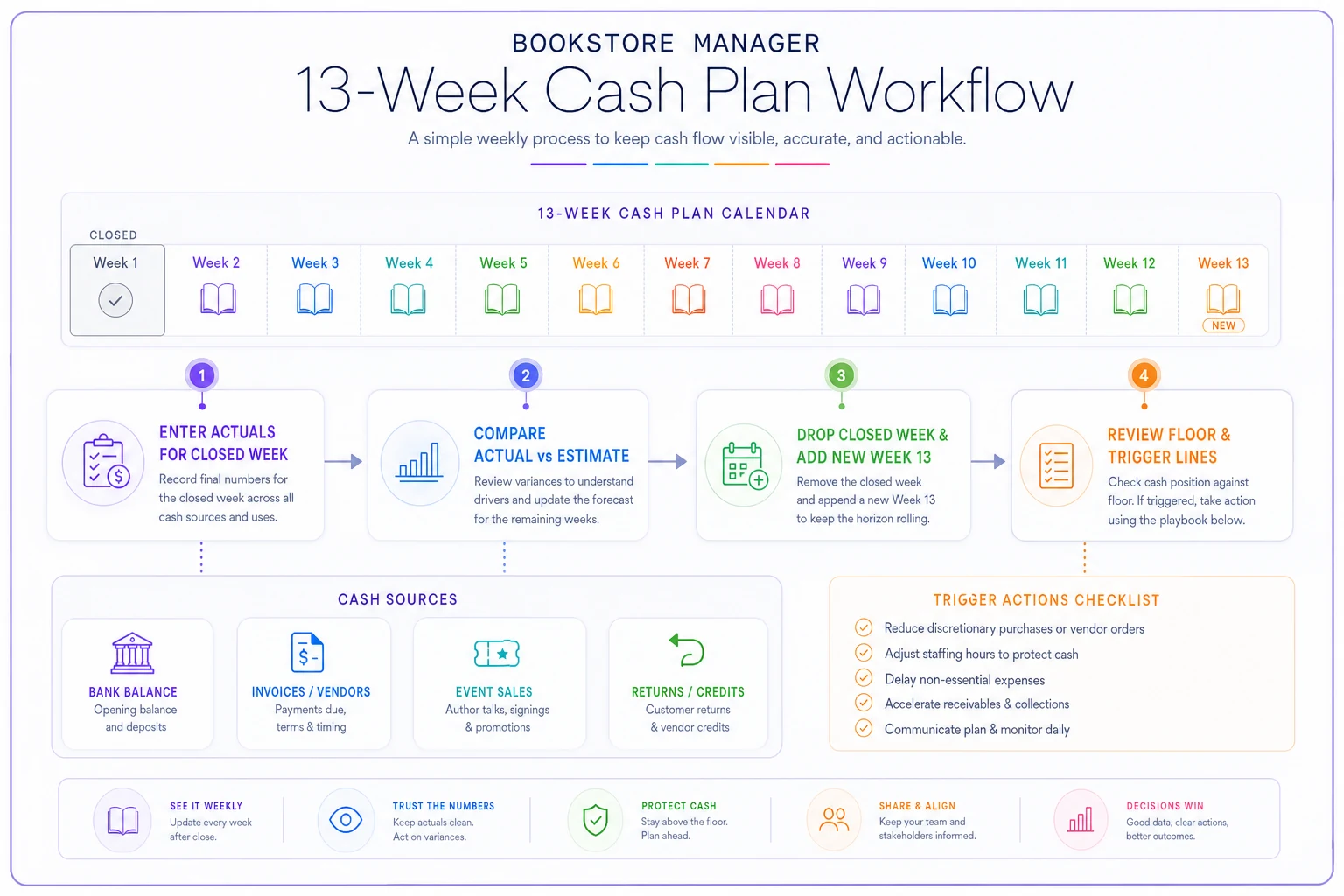
A cash plan you build once and abandon is worse than useless, because it gives you false confidence. The rolling update is non-negotiable. Once a week — pick a day and protect it — you do four things:
-
Enter actuals for the week that just closed (real cash in, real cash out)
-
Compare actual vs. your estimate, and note where you were off and why
-
Drop the closed week, add a fresh week 13
-
Re-check every week against your floor and trigger lines
Automate pulling actuals where you can to keep the weekly update sustainable.
This takes maybe 30–45 minutes once your template is set up. The "actual vs. estimate" step is the one people skip, and it's the one that makes your forecasts get better over time. If your event-sales estimates are consistently 20% high, you learn that and adjust. If returns credits always land two weeks later than you book them, you build that lag in.
This habit sits naturally alongside your monthly close process — the weekly cash update keeps you ahead in real time, and the monthly close gives you the reconciled, accurate numbers to calibrate against. One is your dashboard, the other is your odometer. You need both.
Here’s a quick visual of the weekly update workflow.
Where AI-powered operational software earns its keep here is pulling the actuals so you're not retyping them — sales by channel, vendor invoices and their due dates, event takings, returns credits as they post. The modeling logic stays yours, but the data entry that makes people quit after three weeks gets handled automatically. That's usually the difference between a plan that lives and one that dies in a spreadsheet nobody opens.
The template, stripped down
If you're building this from scratch, here's the minimum viable version to start with this week:
-
13 columns, one per week, dated.
-
Cash-in rows in-store, online, events, returns credit, co-op, school/library, memberships.
-
Cash-out rows inventory by vendor (list your real recurring vendors as separate lines), payroll, rent, utilities, processing fees, event costs, loan/line, sales tax, software.
-
A floor line = roughly 3–4 weeks of your fixed costs.
-
Trigger formatting — conditional coloring so yellow and red weeks jump out.
-
Three tabs base, downside (sales −15–20%), upside.
-
An actuals log so you can compare forecast to reality each week.
Don't over-engineer the first version. A rough model you actually update beats a beautiful one you build once and ignore.
The whole value of a 13-week cash plan is that it moves your cash decisions earlier — from the panicked morning of the due date to the calm week you spotted the squeeze coming. It won't make a thin-margin store profitable, and it won't conjure money that isn't there. But it will make sure that when the money is coming, you don't drown in the three weeks before it arrives. For most indie stores, that gap — the one between "profitable on paper" and "out of cash this Tuesday" — is exactly where this plan does its work.
Ready to elevate your bookstore’s operations?
Join 500+ bookstores using Bookstorely to boost sales, optimize stock, and delight book lovers.