

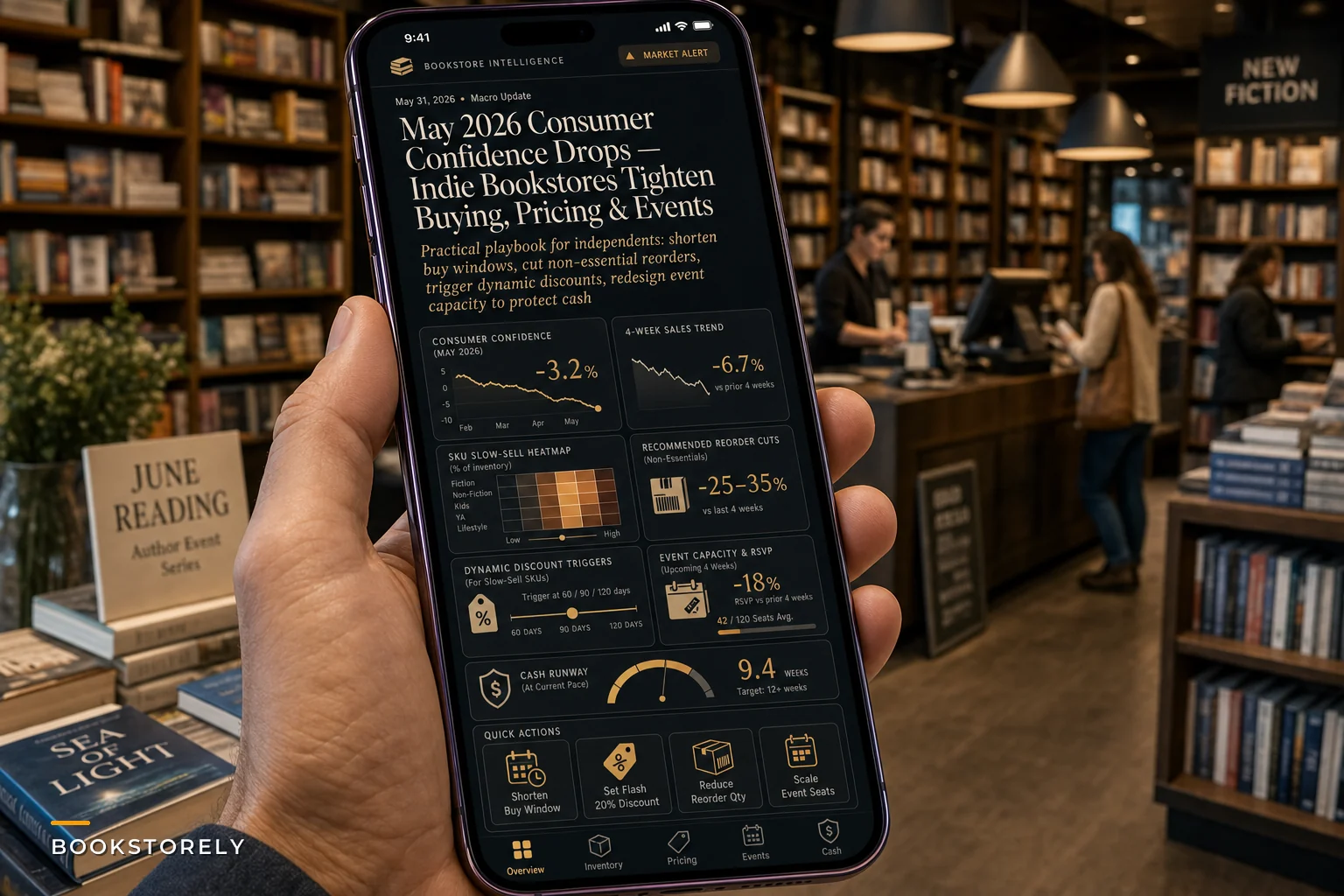

May's consumer confidence numbers just dropped, and if you're running an indie bookstore, you've probably already noticed. The couple who usually grabs three hardcovers now leaves with one paperback. Your Saturday afternoon browsers aren't converting like they did two months ago. That summer reading event you're planning? Better revisit those attendance projections.
Reuters reported the confidence slip late last week, confirming what many bookstore owners started feeling around Mother's Day—people are pulling back on discretionary spending. For indie bookstores heading into what should be prime summer reading season, this timing couldn't be worse.
But consumer pullbacks don't hit indie bookstores uniformly. Some stores barely notice while others see 20-30% revenue drops within weeks. The difference isn't location or luck—it's how quickly stores adjust their buying, pricing, and event strategy when spending patterns shift.
The $47 problem hiding in your June orders
Most indie bookstores place their big summer orders in late May and early June. Publishers push their beach reads, you stock up on vacation paperbacks, maybe grab extra copies of that buzzy literary fiction everyone's supposedly reading this summer. Standard practice.
When consumer confidence drops, your usual summer buying math breaks. That calculation where you order 12 copies because you sold 10 last summer? It assumes stable spending patterns. But spending isn't stable right now.
Order based on last year's numbers and customers buy less than expected, by mid-July you're sitting on inventory that won't move without heavy discounting. Each unsold $28 hardcover ties up roughly $17 of your cash (after wholesale costs). Multiply that across 200-300 slow movers, and you're looking at $3,400 to $5,100 locked up in dead stock.
The real killer? That trapped cash can't be used for the titles that actually are selling—the paperback mysteries, used classics, and kids' books that become recession-proof performers when consumers tighten up.
Your pricing spreadsheet is lying to you
Standard bookstore pricing feels straightforward. New hardcovers at cover price, paperbacks maybe discounted 10% if they're older titles, used books at 50% of cover. Simple enough.
Consumer confidence shifts completely scramble this formula. The $35 hardcover that sold fine in March now feels expensive to customers watching their spending. Meanwhile, that $8 used mystery flies off the shelf because it feels like a safe splurge.
-
Premium titles (new hardcovers, anticipated releases)
Hold the line on price but bundle aggressively.
-
Mid-tier inventory (older hardcovers, trade paperbacks)
Create a sliding scale.
-
High-velocity categories (used books, kids' books, paperback series): Keep prices stable but increase visibility.
Instead of discounting that $32 memoir, package it with a $6 bookmark and a $12 tote for $42—saving customers $8 while maintaining your average transaction value.
Books published 6-12 months ago get 15% off. 12-18 months get 20%. Over 18 months get 25%. This gives price-sensitive customers clear value tiers without training them to wait for deeper discounts.
When spending tightens, customers gravitate toward perceived value. Don't discount what's already selling—just make it easier to find.
Cancel your July author event (unless you do this first)
Book events during consumer downturns follow a predictable pattern. Attendance drops 30-40%. Book sales per attendee fall even more. You end up with 18 people in a space set for 50, selling 8 books instead of 25.
Consumer confidence shifts don't kill all events equally. Free events actually see increased attendance during downturns—people want entertainment but won't pay for it. Ticketed events crater unless they offer clear, tangible value beyond meeting an author.
-
Convert ticketed events to "book included" pricing. Instead of charging $15 for admission then hoping people buy the $28 hardcover, charge $35 for admission with the book included.
-
Shift format toward community value. A basic author reading struggles during downturns. But "Summer Reading Planning Workshop with Local Author" draws crowds because it solves a problem (keeping kids busy affordably) while featuring the author.
-
Bundle events with existing traffic. Saturday morning story time pulls consistent crowds regardless of economic confidence. Add your author event immediately after, when parents are already in-store.
-
Create artificial scarcity carefully. "Limited to 25 spots" works better than "hoping for 25 people." Small, sold-out events build momentum. Half-empty events, even with decent turnout, feel like failures.
Customers perceive better value, you guarantee sales, and your event P&L becomes predictable.
The Wednesday morning dashboard that predicts cash crunches
When consumer confidence drops, the lag between early warning signs and actual cash problems is typically 3-4 weeks. Customers start shifting behavior immediately, but you don't feel the squeeze until inventory piles up and receivables slow down.
Most stores track monthly sales, maybe weekly if they're diligent. But during confidence shifts, you need a Wednesday Warning Dashboard—five numbers you check every Wednesday morning that predict problems before they become crises:
| Metric | What It Tells You | Danger Zone |
|---|---|---|
| Conversion rate (browsers to buyers) | Customer hesitation levels | Below 22% |
| Average transaction value | Spending comfort | Down 15% from 3-week average |
| Paperback-to-hardcover ratio | Price sensitivity shifts | Above 3:1 |
| Special order cancellations | Commitment confidence | Above 2 per week |
| Event pre-registrations | Future traffic indicators | Below 60% capacity |
Wednesday matters because it gives you time to adjust for the weekend—your biggest sales days. Notice conversion dropping? Adjust your staff's handselling approach by Thursday. Transaction values falling? Roll out a weekend bundle promotion.
Follow a simple workflow each Wednesday to check metrics, decide on staffing and promotions, and schedule inventory actions before the weekend.
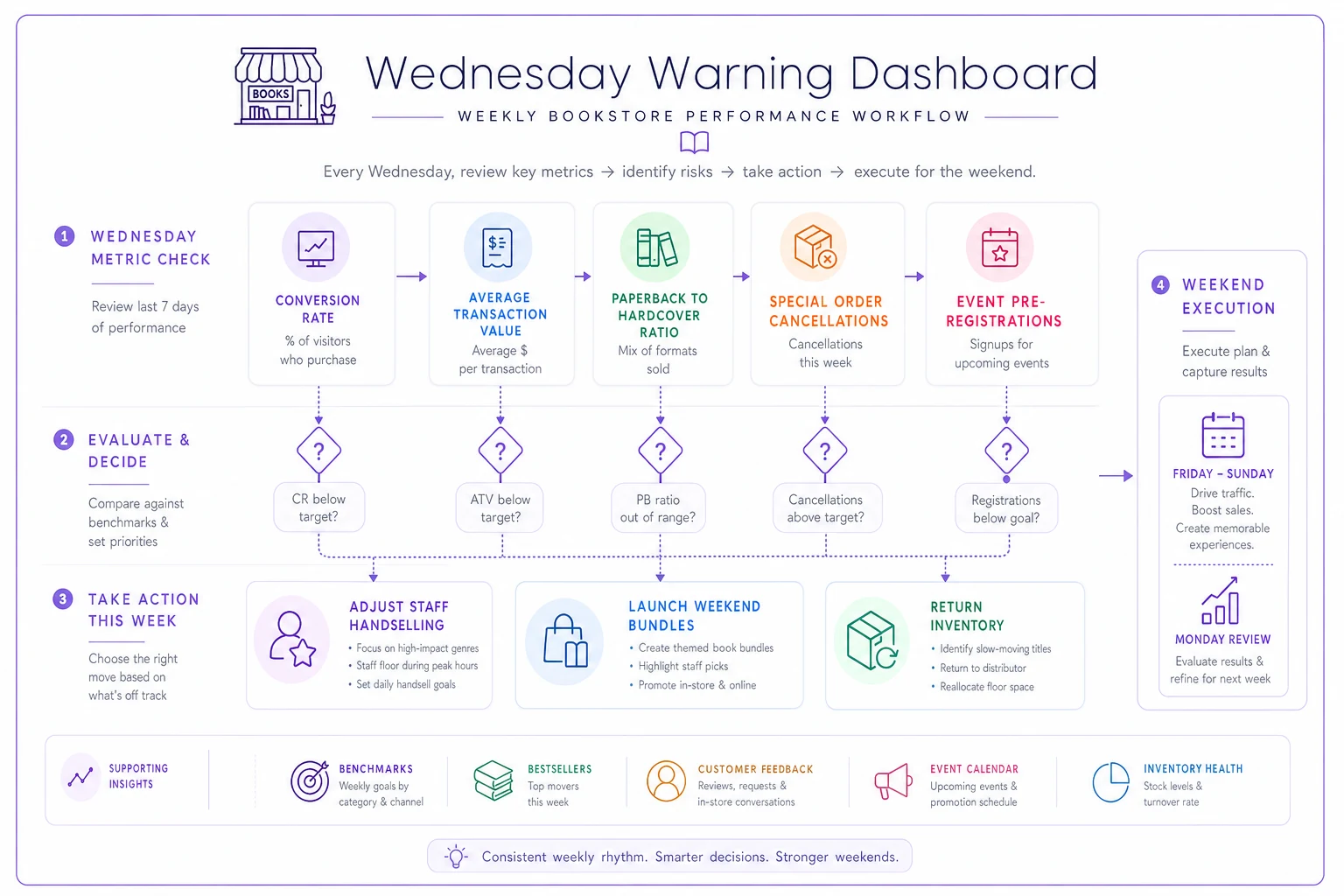
Use this as your weekly ritual: metrics, decisions, and weekend actions.
Strategic inventory triage (before you panic-discount everything)
The natural response to slowing sales is broad discounting. Twenty percent off everything, maybe 30% for members. Feels decisive. Looks active. Absolutely murders your margins while training customers to wait for deeper discounts.
Instead, use category triage based on velocity and margin protection:
-
Category A
Protect at all costs
(bestsellers, book club picks, local authors) -
Category B
Tactical flexibility
(mid-list fiction, older non-fiction, series books) -
Category C
Move it now
(anything over 18 months old with no recent sales) -
Category D
Return candidates
(returnable inventory not moving)
These drive traffic and credibility. Never discount beyond 10%, even if they're moving slowly. They're your anchor inventory—what customers expect you to have.
These can handle 15-25% discounts without damaging perceived value. Use them for targeted promotions—"Mystery Monday" with 20% off all mysteries, "Biography Bonanza" for the weekend.
These need aggressive action. But instead of straight discounting, try format shifting. Bundle five old hardcovers for $50. Create "surprise boxes" of slow-moving inventory. Convert them to event giveaways. The goal isn't maximizing revenue—it's freeing up cash and shelf space.
When confidence drops, returning inventory to publishers becomes a cash management tool, not an admission of failure. That display of 24 copies of last month's "big book" that sold 3 copies? Return 18 of them. Free up $300 in cash for inventory that's actually moving.
Prioritize returns for low-turn, low-margin titles first to free up the most working capital quickly.
The goal of triage is to protect margin and free cash, not to appear busy with needless discounts.
Why your competitors' panic helps you win
During confidence drops, about 60% of indie bookstores panic. Deep discounts, desperate events, frantic social media posts about "supporting local business." They create noise that actually helps disciplined stores stand out.
While competitors race to the bottom on pricing, you can position yourself as the stable, valuable option. Run "Price Protection Promise" campaigns—guarantee your members that core categories won't see panic discounting. Create "Summer Reading Investment" packages where customers prepay $200 for $250 in book credits, giving them confidence in future value while improving your cash position.
Stores that project stability during uncertainty become trusted advisors. Stores that project panic become risky purchases. This matters more than most owners realize.
The hidden winners in every downturn
Consumer confidence shifts create predictable category winners that most stores overlook while focusing on protecting traditional sellers:
-
Used books surge.
-
Series completions accelerate.
-
Kids' educational workbooks explode.
-
Classics rebound.
Customers who won't buy new will buy used. If you're not already taking in used inventory, start now. Set up weekend buying hours. The margin on used books—typically 60-70%—helps offset new book softness.
Customers avoid starting new series but will complete ones they're invested in. Check your series inventory—having books 3-7 in stock becomes more important than having the latest releases.
Parents cutting back on camps and activities need affordable summer engagement. Those $8 Summer Bridge workbooks? Order deep. The $12 learn-to-read sets? Stock up. Parents prioritize kid education even when cutting elsewhere.
When new hardcovers feel expensive, that $12 Penguin Classic looks reasonable. Barnes & Noble's leatherbound classics at $25? Customers perceive them as investments, not purchases.
Your August 1st recovery position
By August 1st, you'll have two months of consumer confidence impact in your numbers. This becomes your decision point: temporary adjustment or structural shift?
If sales are down 10-15% but margins held steady through smart pricing and inventory management, you're in adjustment territory. Maintain tactical changes through back-to-school season, then reassess.
If sales dropped 20%+ despite interventions, you're looking at structural shifts. This means renegotiating lease terms, adjusting staff hours, possibly restructuring your entire buying rhythm to operate with less working capital.
The stores that thrive through confidence drops aren't necessarily the biggest or best-funded. They're the ones that recognize early signals, adjust quickly without panicking, and maintain operational discipline when competitors get desperate. Sounds obvious, but execution separates winners from closures.
Building your confidence-responsive operations
Consumer confidence will fluctuate again. Maybe it rebounds by fall. Maybe it drops further. Building operations that can flex with confidence shifts becomes competitive advantage, not crisis management.
Track the right metrics weekly, not monthly. Build relationships with other local retailers—when the coffee shop owner mentions slower mornings, that's your early warning system. Monitor your special orders carefully; customers cancel special orders before they stop browsing.
Information only matters if it drives action. Create pre-planned responses for 10%, 20%, and 30% confidence-driven sales drops. Know exactly which inventory to return, which events to modify, which promotions to launch.
When confidence shifts hit, you're executing a playbook, not scrambling for solutions. This is where AI-powered operational platforms fundamentally change the game. Instead of manually tracking conversion rates and transaction values, modern bookstore management software monitors these patterns automatically, flagging concerning trends before they become critical problems.
The operational advantage extends beyond monitoring. AI automation can adjust pricing recommendations based on local market conditions and inventory levels. It identifies which titles to return for credit before they become permanent shelf-sitters. It even suggests optimal event formats based on historical attendance patterns during similar economic conditions. The real value isn't the technology itself—it's how it frees you to focus on what actually drives bookstore success during downturns: customer relationships, community connection, and careful curation.
Making smart bets when others freeze
Consumer confidence drops paralyze many bookstores. They stop ordering new inventory, cut marketing, eliminate events. This defensive posture might preserve cash short-term, but it accelerates customer loss.
The winning approach? Selective aggression. While competitors pull back, you double down on specific, high-confidence bets:
That local author with a dedicated following? Host their launch event when other stores cancel programming. You'll get their entire network.
The book club that meets monthly? Offer them 25% off their selections plus free meeting space. Lock in twenty guaranteed sales monthly while building community anchors.
Used book inventory? Buy aggressively when other stores stop accepting trades. Your buying dollar goes further when sellers have fewer options. These aren't random investments. They're calculated moves in categories with predictable returns during downturns.
The confidence recovery profit window
When consumer confidence eventually recovers, the snapback is violent and profitable—but only for stores positioned to capture it.
Customers who delayed purchases for 3-6 months suddenly release pent-up demand. The challenge? If you've cut inventory too deep or alienated customers with desperate discounting, you miss the recovery window entirely.
Smart stores use downturn periods to strengthen customer relationships without sacrificing margins. Email lists grow when you offer value content, not just discount codes. Event attendance builds when programs focus on community value, not just sales. Social media engagement increases when you share expertise, not panic.
This patient positioning pays off when confidence returns. Customers remember who provided value during uncertainty. They reward stability with loyalty. And stores with intact margins and strong community connections capture disproportionate share of recovery spending.
Consumer confidence dropped this May. It might drop again. Or it might recover by July. The point isn't predicting the future—it's building operations that thrive regardless of consumer mood swings. Your competitors will either panic or freeze. You'll adjust intelligently, protect margins carefully, and emerge stronger when stability returns.
That's not optimism. That's operational excellence. And in the indie bookstore world, operational excellence beats everything else, every time.