

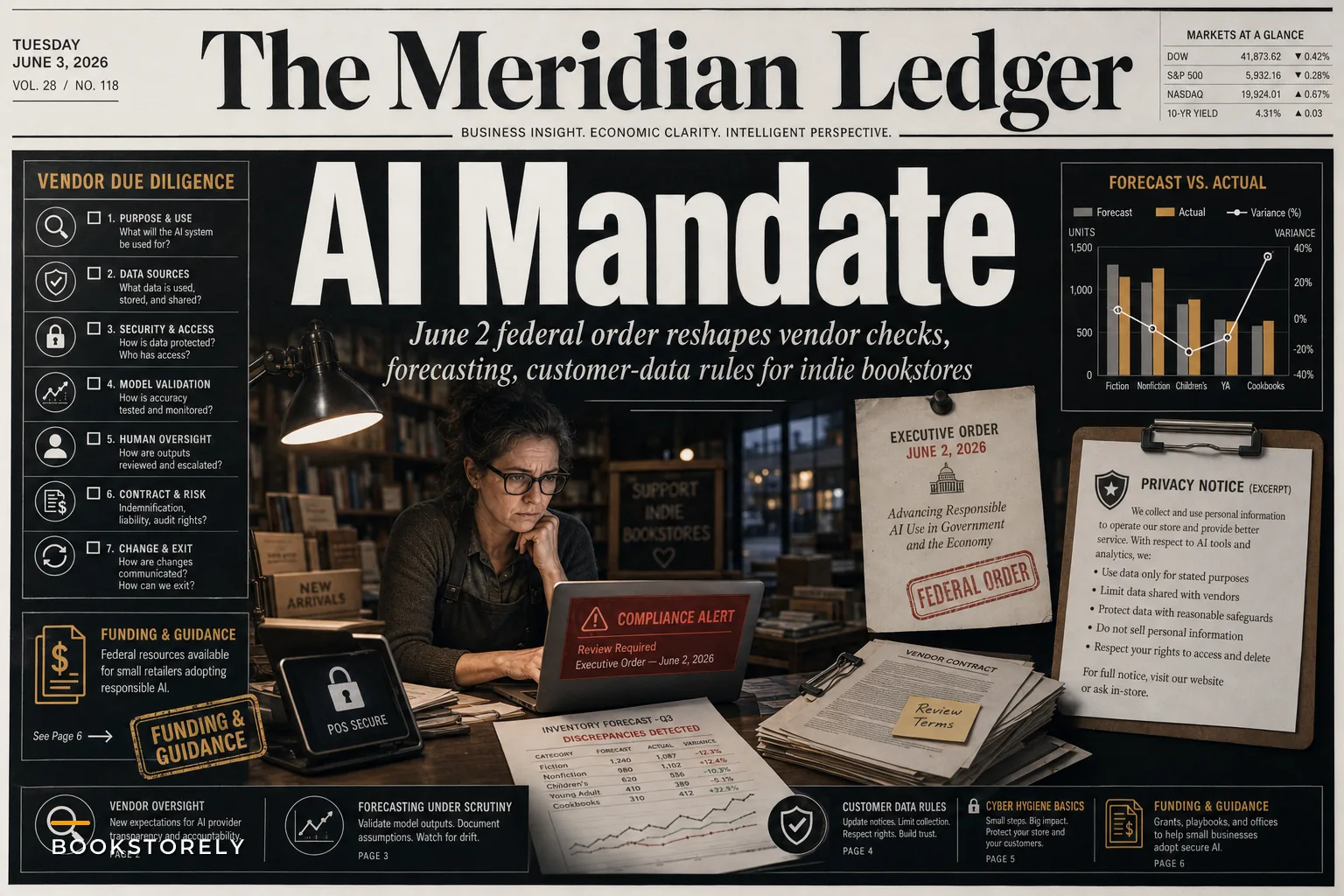

The White House dropped a new executive order on June 2nd pushing federal agencies to create AI guidelines and security standards. According to CNBC, the order asks companies building frontier AI models to give the government early access for testing, while also directing agencies to develop cybersecurity guidance and identify funding channels for securing AI systems.
For bookstore owners using AI-powered inventory forecasting or customer recommendation tools, this signals something bigger than just another tech regulation. The order creates voluntary frameworks for now, but these things tend to become baseline expectations — ones that vendors, and eventually their customers, end up needing to meet.
Bookstores have been adopting AI tools steadily over the past few years, starting with simple chatbots and moving into more sophisticated inventory prediction systems. Most owners treat these as black boxes: plug in your sales data, get back ordering suggestions. That worked when AI was just another software feature. But we're entering a phase where you actually need to understand what your vendors are doing with your data — not in a technical sense, but enough to ask the right questions and actually get useful answers.
The vendor transparency problem hiding in your tech stack
What makes AI compliance particularly tricky for bookstores is that you're probably using AI without fully realizing it. That inventory management system suggesting reorder quantities? The email platform automatically segmenting customers? The POS flagging unusual transaction patterns? They're all running some form of machine learning underneath.
The executive order's emphasis on model transparency and security means vendors will start getting pressed for documentation — data sources, training approaches, security measures. Smart vendors will get ahead of this. Others will scramble.
A bookstore in Portland found out their inventory forecasting tool was training on aggregated data from all their customers, including competitor stores in the same market. The vendor framed it as an accuracy improvement, but it raised obvious questions about competitive intelligence and data leakage. Under emerging AI compliance standards, that kind of opaque data sharing becomes a real liability.
Your first move isn't panic. It's mapping out which systems actually use AI and understanding what data flows through them. Most bookstores run somewhere between 8 and 12 software platforms across operations. Probably half use some form of AI or automated decision-making, even if the vendor doesn't advertise it that way.
Customer data becomes a bigger minefield
Bookstores collect surprisingly rich customer data. Purchase history, browsing patterns, email engagement, event attendance, special order requests — it builds detailed profiles fast. When you feed this into AI-powered marketing or recommendation systems, you're creating new privacy obligations whether you intended to or not.
Never miss a sale or stock shortage again.
Bookstorely helps you manage inventory, orders, and customer relationships seamlessly.
- Integrated inventory tracking
- Customer purchase history
- Sales reporting & analytics
No credit card required
The federal order focuses on cybersecurity and vulnerability response, which matters because AI systems become attractive targets. A basic customer database breach is bad enough. A breach that exposes an AI model's training data or decision logic is exponentially worse — especially if the system has learned behavioral patterns that you don't even explicitly track yourself.
A bookstore in Austin ran into exactly this. Their AI-powered email segmentation tool got compromised, and hackers didn't just steal email addresses. They got the behavioral models predicting which customers would buy certain genres, attend specific events, or respond to price promotions. That kind of data has real competitive value on the wrong market.
The operational burden here isn't just about securing systems. You need clear policies about what customer data feeds into AI tools, how long it's retained, and who can access it. Staff need to understand why typing customer emails into an AI tool to draft a response creates a data handling problem. And your privacy policy probably needs updating to actually reflect AI-specific uses of customer information — most bookstore privacy policies were written before any of this was relevant.
Due diligence gets technical (and expensive)
Small bookstores aren't equipped to audit AI systems. You're running on thin margins with limited tech expertise. But AI compliance will increasingly require asking vendors tough questions and keeping records of their answers.
Start with basics:
-
Where does the training data come from?
-
Can the model be audited or explained?
-
What happens to your data after you stop being a customer?
-
How often is the model retrained?
-
What security certifications does the vendor hold?
The answers matter less than having them documented. When AI regulations tighten, you'll need paper trails showing you did reasonable due diligence. Think of it like food safety certifications for your café — you're not personally testing every batch, but you need documentation that someone reputable did.
One bookstore chain created a simple vendor scorecard, rating each AI-enabled vendor on three things: transparency (do they explain their methods?), data handling (where does information live?), and portability (can you export your data?). Vendors scoring poorly either provided better documentation or got replaced.
| Vendor Scorecard Dimension | What to Assess |
|---|---|
| Transparency | Do they explain their model methodology? |
| Data Handling | Where does your data live and who accesses it? |
| Portability | Can you export your data if you leave? |
| Security Certifications | What third-party audits have they passed? |
| Incident Response | Do they have a documented process for breaches? |
Running this kind of evaluation doesn't take weeks. A focused afternoon reviewing vendor documentation and drafting a few emails gets you most of the way there.
Keep vendor responses in a single shared folder so you can quickly produce documentation for audits.
The process also revealed that their "AI-powered" staff scheduling tool was basically running Excel formulas with a fancy interface. Not necessarily bad, but it meant they were overpaying for basic automation dressed up as something more impressive.
The bias and accuracy audit nobody wants to do
Book recommendation algorithms shape what customers discover and buy. Inventory forecasting determines what stays on shelves. These AI decisions directly impact your store's cultural footprint and financial health. But most bookstores never audit these systems for accuracy or bias.
The federal push for AI transparency will likely extend to algorithmic accountability. Can you explain why your system recommended one book over another? If your inventory AI consistently under-orders books by certain authors or on specific topics, is that a data problem or a bias problem?
Inventory forecasting systems can consistently underestimate demand for translated fiction when their training data comes from stores in less diverse markets. The AI isn't intentionally biased — it's just pattern-matching against incomplete data. But the result is inventory gaps that make the store seem less thoughtful than ownership intended.
Running accuracy audits doesn't require a data science background. Pick a category you know well — local authors, cookbooks, whatever you have strong instincts about. Compare what the AI suggests against your judgment and actual sales. Document the gaps. If the system consistently misses in certain areas, you need manual overrides or better training data.
Some stores build what they call "challenge sets" — intentionally difficult inventory decisions where they compare AI recommendations against experienced buyers' calls. Over time, this builds real institutional knowledge about where AI helps and where human expertise still wins.
Building an AI incident response plan
The executive order emphasizes coordinated vulnerability response, which sounds very enterprise but actually matters at the bookstore level. What happens when your inventory system starts making bizarre recommendations? When customer data might have leaked through an AI chatbot? When a vendor's model gets fed bad data?
Most bookstores discover AI problems by accident. A customer complains about weird email recommendations. Staff notice the system suggesting 500 copies of an obscure title. The chatbot starts giving wrong store hours. By then, damage is already done.
A basic incident response plan for AI systems:
-
Unusual patterns in AI recommendations
-
Customer complaints about personalization
-
Sudden changes in system behavior
-
Vendor security notifications
Immediate actions:
-
Document the issue with screenshots
-
Check if customer data is involved
-
Disable affected AI features if necessary
-
Notify your vendor immediately
Follow-up requirements:
-
Get written explanation from vendor
-
Document any customer impact
-
Update staff on changes
-
Review if similar issues could occur elsewhere
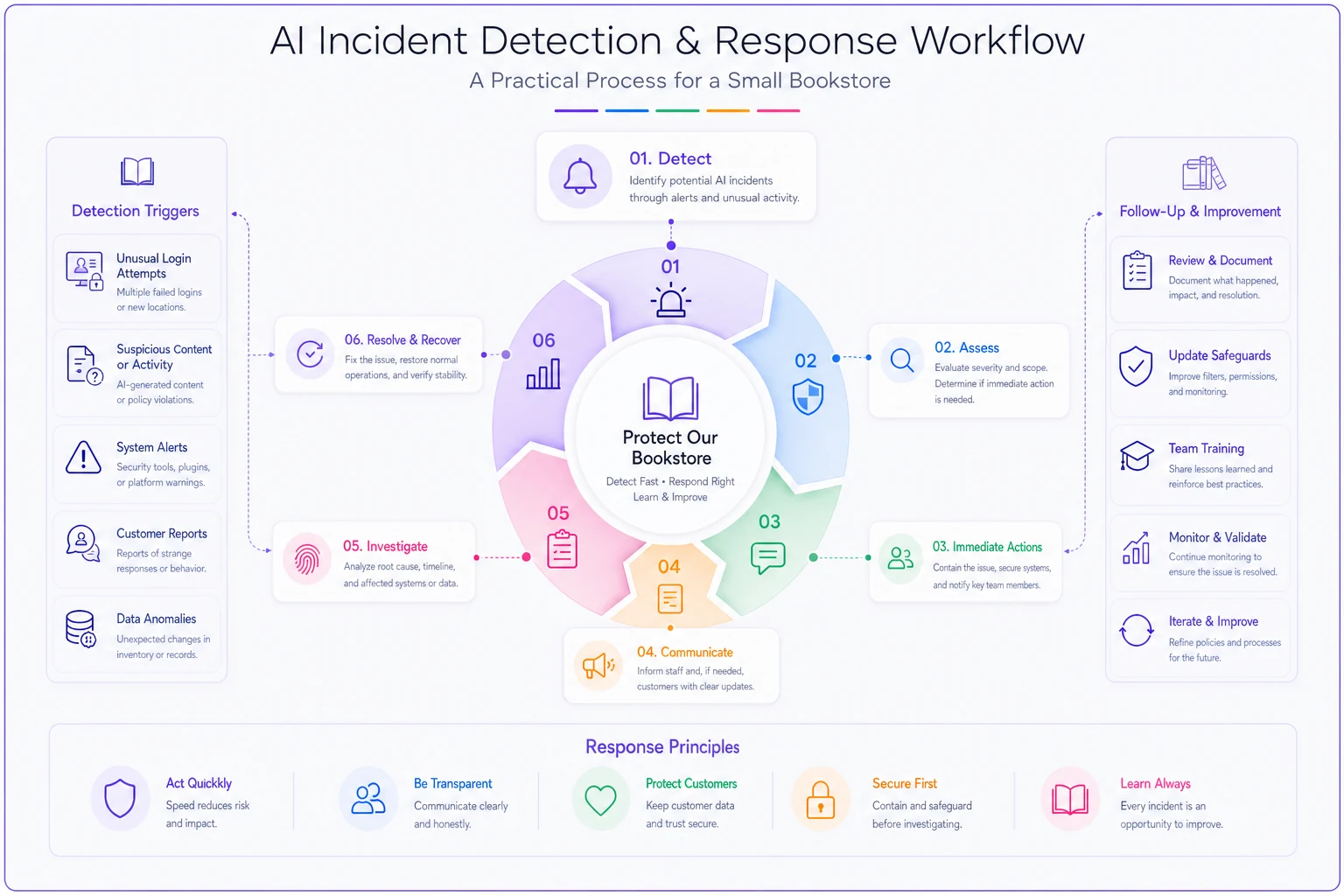
A bookstore in Denver caught their recommendation engine surfacing inappropriate titles to young readers within hours rather than days because they had something like this in place. Quick response meant fixing it before it became a PR problem.
Practical compliance without paranoia
AI compliance for bookstores doesn't mean abandoning useful technology. It means being thoughtful about implementation and keeping records. The federal order creates momentum toward standardization, which could actually benefit small businesses by forcing vendors to be clearer about what they're doing.
A reasonable playbook for the next six months:
Immediate actions (next 30 days):
-
List every software tool you use
-
Mark which ones mention AI or machine learning
-
Check their privacy policies and security pages
-
Document what you find in a simple spreadsheet
Vendor conversations (next 60 days):
-
Email each AI vendor asking about their compliance preparation
-
Request documentation about data handling and model training
-
Ask about their incident response procedures
-
Save all responses, even vague ones
Operational adjustments (next 90 days):
-
Update your privacy policy to mention AI use
-
Train staff on AI data handling limits
-
Create simple accuracy checks for critical AI systems
-
Document your AI decision-making process
Ongoing monitoring:
-
Set Google Alerts for your vendors + "AI" + "security"
-
Join one bookstore tech forum to share experiences
-
Review AI vendor contracts annually
-
Keep logs of any AI-related issues
None of this requires a compliance team or a legal budget. It mostly requires someone being willing to spend a few hours documenting things that should already be documented.
The opportunity inside the compliance burden
While everyone focuses on the risk side, auditing your AI tools forces you to understand what they're actually doing — and often, you'll find you're using maybe 20% of the capabilities or paying for "AI" features that aren't particularly sophisticated.
More importantly, demonstrating responsible AI use becomes a real differentiator. Customers increasingly care about data privacy and algorithmic fairness. Being able to say "we audit our recommendation systems for bias" or "we can explain how our inventory AI makes decisions" builds a kind of trust that Amazon genuinely can't match at the local level.
The White House order emphasizes both innovation and security — the goal isn't to restrict AI use but to make it more transparent and accountable. For bookstores, that translates to better vendor accountability, clearer capabilities, and potentially lower costs as the market standardizes around common practices.
The order also mentions funding channels for AI security improvements. Details are still vague, but small business grants for AI compliance and security upgrades are likely coming. Bookstores that document their current AI use now will be better positioned to access those funds when they materialize.
Connecting compliance to operational reality
The same discipline needed for AI compliance tends to improve general business management too. When you map data flows for privacy reasons, you often uncover redundant systems or manual processes that could be tightened up. When you audit AI accuracy, you develop better instincts about inventory patterns and customer behavior.
This connects directly to the comprehensive KPI tracking we've covered before. The metrics you need for AI auditing — forecast accuracy, recommendation relevance, customer engagement rates — are the same ones that drive better business decisions anyway. AI compliance isn't a separate burden sitting on top of operations; it's part of running a data-informed store.
Bookstores that thrive in an AI-regulated environment won't necessarily be the ones with the best lawyers or the biggest compliance budgets. They'll be the ones who understand their technology stack, maintain decent vendor relationships, and document their decisions. That's achievable for any bookstore willing to put in reasonable effort now rather than scrambling when requirements tighten.
Moving forward without the fear
Every bookstore owner who hears "AI compliance" initially responds with some version of "great, another thing to worry about." That's understandable. But you're already using AI tools, already handling customer data, already dependent on vendor security. The executive order just makes explicit what should have been good practice from the start.
Start small. Pick your most critical AI system — probably inventory forecasting or your POS — and actually dig into how it works. Ask your vendor questions. Document what you learn. Build from there.
Perfect compliance isn't the goal. Reasonable, documented effort is. Show that you're taking AI seriously, asking appropriate questions, making informed decisions. That's enough for a small bookstore — and honestly, it's more than most are doing today.
The stores that act now, not from fear but from basic operational discipline, will be the ones in a much better position when compliance stops being voluntary.
Ready to elevate your bookstore’s operations?
Join 500+ bookstores using Bookstorely to boost sales, optimize stock, and delight book lovers.