

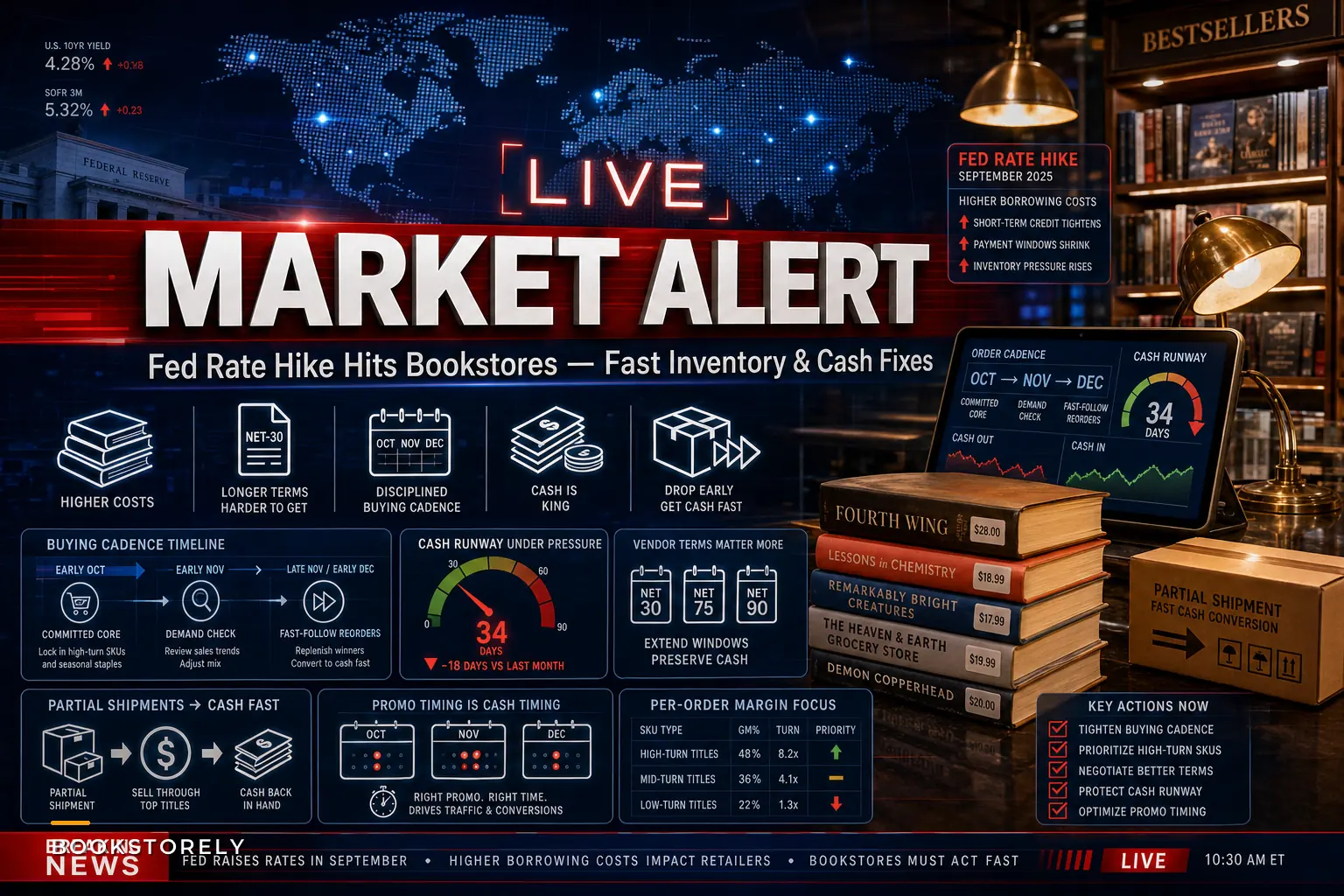

The Fed bumped the federal funds rate another 25 basis points on September 16, landing it in the 3.75%–4.00% range, and signaled at least one more hike could come before year-end. For most people that's a line in the business news they scroll past. For a store owner about to place the biggest inventory orders of the year, it's a number that quietly changes what you can actually afford to stock in November.
What most coverage misses is that the rate move itself is small. The problem is timing. You're heading into the one stretch of the year where you have to commit cash months before you collect it — and now the cost of fronting that cash just went up at the same moment consumer spending tends to get jumpier. The stores that get squeezed aren't the ones with bad books. They're the ones whose buying cadence assumes cheap, flexible money that no longer exists.
The real exposure isn't the interest — it's the gap between pay-out and pay-in
A quarter-point on a $40k line of credit is roughly $100 a month in extra interest. Annoying, not fatal. If that were the whole story, nobody would need to change anything.
The deeper issue is the cash gap — the weeks (sometimes months) between when you pay a distributor and when a customer actually buys the book off your table. In a normal month that gap is manageable. In Q4 it balloons, because you front-load inventory in September and October to be ready for a sales spike that doesn't fully land until December. You're carrying your largest inventory investment of the year during the exact window when borrowing against it costs the most and sells the slowest early on.
What tends to happen across small retailers is that the pain shows up not as "we couldn't afford the interest" but as "we were cash-locked in late November." The money was all sitting on the shelves. A single slow week, a late consignment check, or a publisher pulling a co-op reimbursement later than promised, and suddenly payroll for your seasonal hires is tight. The rate hike doesn't cause that — it just removes the cushion that used to absorb it.
So the question isn't "how do I pay less interest." It's "how do I need less borrowed money to run the same holiday season."
A quick diagnostic: how exposed are you actually?
Before touching buying plans, figure out where you actually sit. Run through this honestly:
Never miss a sale or stock shortage again.
Bookstorely helps you manage inventory, orders, and customer relationships seamlessly.
- Integrated inventory tracking
- Customer purchase history
- Sales reporting & analytics
No credit card required
-
What percentage of your Q4 inventory buy is funded by credit vs. cash on hand? If more than 40% rides on a line of credit, you're rate-sensitive.
-
How many days, on average, between paying a vendor and selling the stock? If you don't know, that's your first problem.
-
Do any of your vendors offer dating terms (net-60, net-90, seasonal dating) that you're not currently using?
-
What's your draw pattern on the credit line — do you tap it steadily or spike it in October?
-
How much of your holiday revenue is already committed via preorders, events, or standing institutional orders vs. hoped-for walk-in traffic?
If you answered "credit-heavy, long gap, not using dating terms, spike in October, mostly walk-in hope" — you're the store this article is for. The good news is every one of those is adjustable without cutting your assortment to the bone.
Where the cash actually leaks during the holiday buy
Most owners assume the fix is "buy less." Sometimes that's right. But blanket cutting your buy is how you create stockouts on the exact titles that would've carried you. The smarter move is to look at where cash gets trapped and loosen those specific knots.
Here's a breakdown of the common trap points and what each one is really costing you:
| Cash trap | What it looks like | Why it gets worse under higher rates | Adjustment |
|---|---|---|---|
| Front-loaded single buy | One giant October order | Maximum borrowing at the worst time | Split into two or three staged drops |
| Deep backlist "just in case" stock | 6+ copies of slow movers | Dead cash sitting on credit all season | Cut depth, keep breadth |
| Ignored dating terms | Paying net-30 when net-90 was offered | You're financing with your line instead of the vendor's | Ask for seasonal dating on every big order |
| Free-ship threshold too low | Eating shipping on small online orders | Thin margin now has higher cost of capital behind it | Recalculate the threshold |
| Seasonal payroll fronted on credit | Hiring before revenue arrives | Borrowing to staff a slow early-December | Phase hires to traffic, not the calendar |
None of these are "stop buying good books." They're about when money leaves and whose balance sheet it sits on in the meantime.
Push the financing onto your vendors, not your bank
This is the single highest-leverage move available right now, and it costs nothing but a phone call. Every dollar of inventory a distributor lets you hold on net-90 dating is a dollar you don't borrow at 4%-plus.
Publishers and distributors routinely offer seasonal dating around the holidays — they want their books on your shelves in November. Many stores just never ask, or take the default terms on the invoice. In practice, the difference between net-30 and net-90 on a $25k holiday order can mean not drawing on your line at all during the tightest weeks.
A simple script that works: "I want to go deeper on my fall order this year, but cash is tight with borrowing costs up. Can you do extended dating — net-75 or net-90 — on this one? I'd rather commit to more inventory with you than hedge."
"I want to go deeper on my fall order this year, but cash is tight with borrowing costs up. Can you do extended dating — net-75 or net-90 — on this one? I'd rather commit to more inventory with you than hedge."
You're not asking for a discount. You're asking them to carry the float, and framing it as more business for them. That's a much easier yes.
With stronger vendor relationships, you can layer in partial shipments too — commit to the full quantity but have it arrive in two drops so you're not paying for all of it before Thanksgiving. This is also the backbone of a steadier purchasing approach year-round; if you haven't restructured how you place orders through the year, the logic in building a quarterly buying rhythm that cuts stockouts and frees up cash applies directly here — the holiday buy is just the highest-stakes version of the same cadence problem.
Stage the buy instead of one big swing
A single October mega-order feels efficient. It's also the most expensive way to finance a holiday season when money costs more.
HOLIDAY BUYING RHYTHM — STAGED CASH FLOW [Early October] [Early November] [Late Nov / Early Dec] Committed Core → Demand Check → Fast-Follow Reorders Proven sellers See 3–4 weeks of Quick-turn on what's Big frontlist real traffic first moving; converts to Gift perennials Lean on vendor dating cash in days Fund w/ cash Correct what isn't moving
Here's a staged approach that keeps shelves full while shrinking how much you borrow at once:
-
Early October — the committed core. Order the titles you know sell: your proven backlist, the big fall frontlist with real demand, gift-y perennials. This is the stock you'd buy in any economy. Fund it from cash where possible.
-
Early November — the demand check. By now you've seen three or four weeks of fall traffic. Reorder what's actually moving, cut what isn't. This second drop is where you lean on vendor dating, because it's closer to the sales window.
-
Late November / early December — the fast-follow. Short, quick-turn reorders on anything selling through. These convert to cash in days, so even borrowed money barely sits. Keep this bucket nimble.
A quick visual of the staged buying workflow:
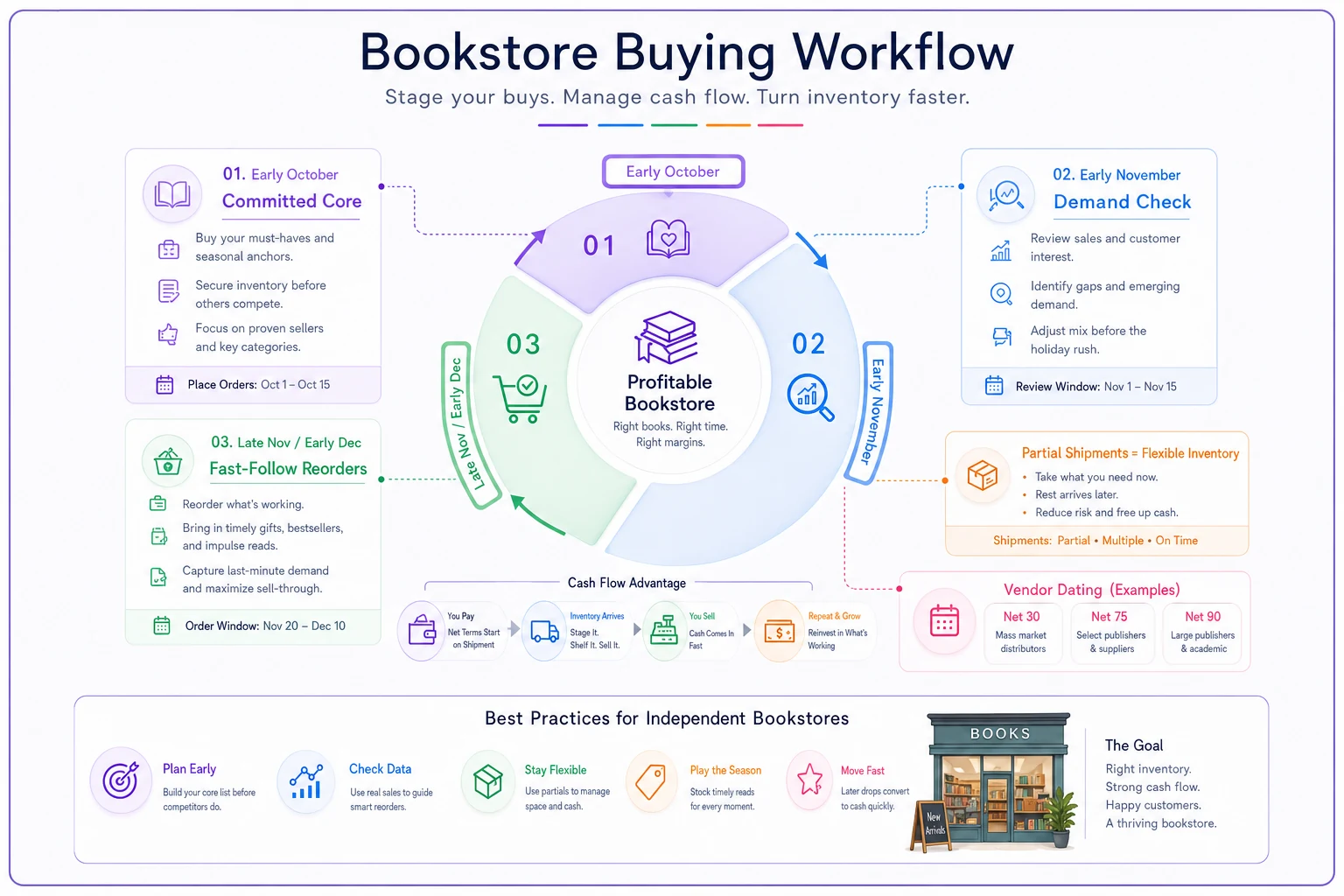
The logic is simple: your earliest-committed dollars have the longest, most expensive hold. Your latest dollars sell almost immediately. By staging, you shift more of the buy into that fast-turn window and pull less from the line during the dead weeks of mid-November.
A store doing roughly $18k–$22k in holiday inventory as one October order might instead run $10k early, $7k in November, $4k in December. Same total assortment on the shelf by peak, but peak borrowing drops meaningfully, and you've got two chances to correct for what's actually selling instead of one guess in October. That second chance alone is worth the extra coordination.
Revisit the free-ship threshold and your event cash timing
Two smaller levers people forget.
Free shipping. If your online free-ship threshold was set two years ago, higher cost of capital quietly makes every subsidized small order worse. When your margin on a $19 paperback is already thin and the dollars funding your operation now cost more, eating $5–$7 in shipping on sub-$30 orders bleeds in a way it didn't before. Nudging the threshold from $35 to $45 won't cost you many sales but tightens the leak. Test it, watch cart abandonment, adjust.
Event timing. Author events and ticketed happenings are one of the few places you collect cash before you spend much. A ticketed December event where attendees prepay, or a holiday gift-wrapping fundraiser, pulls cash forward into your tight window. It's not a huge number, but in a season where timing is everything, a few hundred dollars of prepaid event revenue in late November lands exactly when the line of credit is stretched thinnest.
When cutting your buy is actually the right call — and when it's a trap
"Buy less" is lazy advice half the time.
Cutting depth makes sense when:
-
You've been clearing backlist at markdown every January — that's a signal you over-bought depth.
-
A chunk of last year's holiday stock didn't sell through by Valentine's Day.
-
You're carrying slow categories "for completeness" rather than demand.
Cutting is a trap when:
-
You'd be thinning your proven top sellers to save cash — those are the titles that generate the cash.
-
You're cutting breadth (fewer unique titles) instead of depth (fewer copies each). Breadth is what makes browsers buy; depth is where cash gets trapped.
-
You haven't tried vendor dating first. Don't cut good inventory to avoid borrowing when the vendor would've floated it for free.
The owners who get this wrong usually trim the exciting frontlist that drives foot traffic and keep the comfortable backlist they're used to ordering. Flip that instinct.
A short real scenario
A two-person neighborhood shop — annual revenue somewhere around $340k — ran its holiday buy as one October order every year, roughly $24k, most of it on a line of credit. By mid-November they were routinely cash-locked, scrambling to make their seasonal hire's payroll, and a couple of times had to delay a vendor payment and eat a late fee.
Going into this season, with borrowing costs up, they did three things: split the buy into October/November/December drops, asked their two biggest distributors for net-75 dating (both said yes), and moved their free-ship threshold up by ten dollars. Nothing dramatic.
Holiday sales landed about where they usually do. But peak borrowing on the line dropped by a little over half, they stopped the late-payment fees, and for the first time in years they went into January without a cash-flow panic. The assortment on the shelf in December looked basically the same to customers. The difference was entirely in when money moved.
What to actually do this week
If you take nothing else from this, do these before your fall order goes in:
-
Call your top two or three distributors and ask for seasonal dating — net-75 or net-90 — framed as wanting to commit to more inventory.
-
Split your holiday buy into at least two staged drops instead of one.
-
Pull last January's markdown list and cut depth on anything that was still sitting there.
-
Recalculate your free-ship threshold against your real per-order margin.
-
Phase your seasonal hire's start date to when traffic actually picks up, not an arbitrary early-December date.
Higher rates are a reminder, not an emergency. The stores that run tight cash timing year-round barely feel a 25-basis-point move. The ones that lean on cheap, flexible credit to paper over a lumpy buying cadence feel it right in the ribs — in late November, every year, rate hike or not.
Fix the cadence and the Fed's decisions stop being something you have to react to.
Ready to elevate your bookstore’s operations?
Join 500+ bookstores using Bookstorely to boost sales, optimize stock, and delight book lovers.