


Most bookstore inventory advice assumes you have staff to spare. Close the store for a Sunday, pull four people, count everything, argue about discrepancies, reopen Monday exhausted. That model works fine for a chain with a district manager and a budget for overtime. For a shop with an owner, one full-timer, and a couple of part-time booksellers, an annual full count is a once-a-year panic that tells you almost nothing useful the other 360 days.
The whole point of a bookstore cycle count program is to stop treating counting as an event and start treating it as a habit. Small, boring, daily. Twenty minutes at a time. You never close, you never pull the whole team, and by the end of a month you've touched every part of the store that actually matters.
This isn't about counting more. It's about counting smarter — in slices — so the numbers stay close to reality without eating your labor budget.
Why full annual counts quietly fail small stores
The trouble with an annual count isn't the day itself. It's everything that happens in the eleven months where your system inventory and your shelf inventory slowly drift apart and nobody notices.
A book gets sold but the POS scan misfires. A customer reshelves a hardcover in the wrong section and it becomes invisible. A used-book trade-in gets shelved before it's fully cataloged. A damaged return gets pulled but never written off. None of these are dramatic. Each one is a small lie in your data. By the time your annual count catches them, you've been reordering off bad numbers for most of a year.
Shrink and drift in bookstores are almost never one big theft event. They're a thousand tiny discrepancies that accumulate quietly. A once-a-year count is structurally incapable of catching accumulation — it wipes the slate clean and starts the drift over again the next morning.
Cycle counting fixes this by keeping the gap small enough that when something's off, you can still remember why. Count a section this week and find it short, you have a decent shot at reconstructing what happened. Count it eleven months later and the trail is stone cold.
The sampling logic: don't count everything, count what moves and what walks
You don't have the hours to count the whole store every month with equal attention. You also don't need to. Not every section carries the same risk.
Two things drive how often a section deserves counting: turn velocity (how fast it sells) and shrink exposure (how likely it is to walk out or get miscounted). High-velocity sections drift fast because volume creates scan errors. High-shrink sections — small, expensive, easy to pocket — drift because things disappear.
Sort your sections into a simple tier system:
| Tier | What goes here | Count frequency | Why |
|---|---|---|---|
| A | Front-table bestsellers, new releases, high-theft categories (graphic novels, art books, certain manga) | Every 2 weeks | Fast turn + high shrink = fastest drift |
| B | Core fiction, popular nonfiction, kids, staff picks | Monthly | Steady movement, moderate risk |
| C | Backlist, reference, slow niche sections, sidelines | Every quarter (rotated) | Rarely moves, low error rate |
The thing most owners miss: you're not trying to count everything equally often. You're trying to match counting frequency to how quickly each section lies to you. A quarterly touch on your poetry backlist is plenty. Your front graphic-novel spinner probably needs eyes on it every two weeks, because that's where both velocity and shrink concentrate.
A rough rule that holds up in practice — A-tier is usually 15–20% of your titles but drives more than half your discrepancies. Weight your minutes accordingly.
The 20-minute daily slot
The engine that makes this run is a single, protected, 20-minute block each day. Not "when we get around to it." A fixed slot — say, the slow stretch between the morning rush and lunch, or right after open before foot traffic builds.
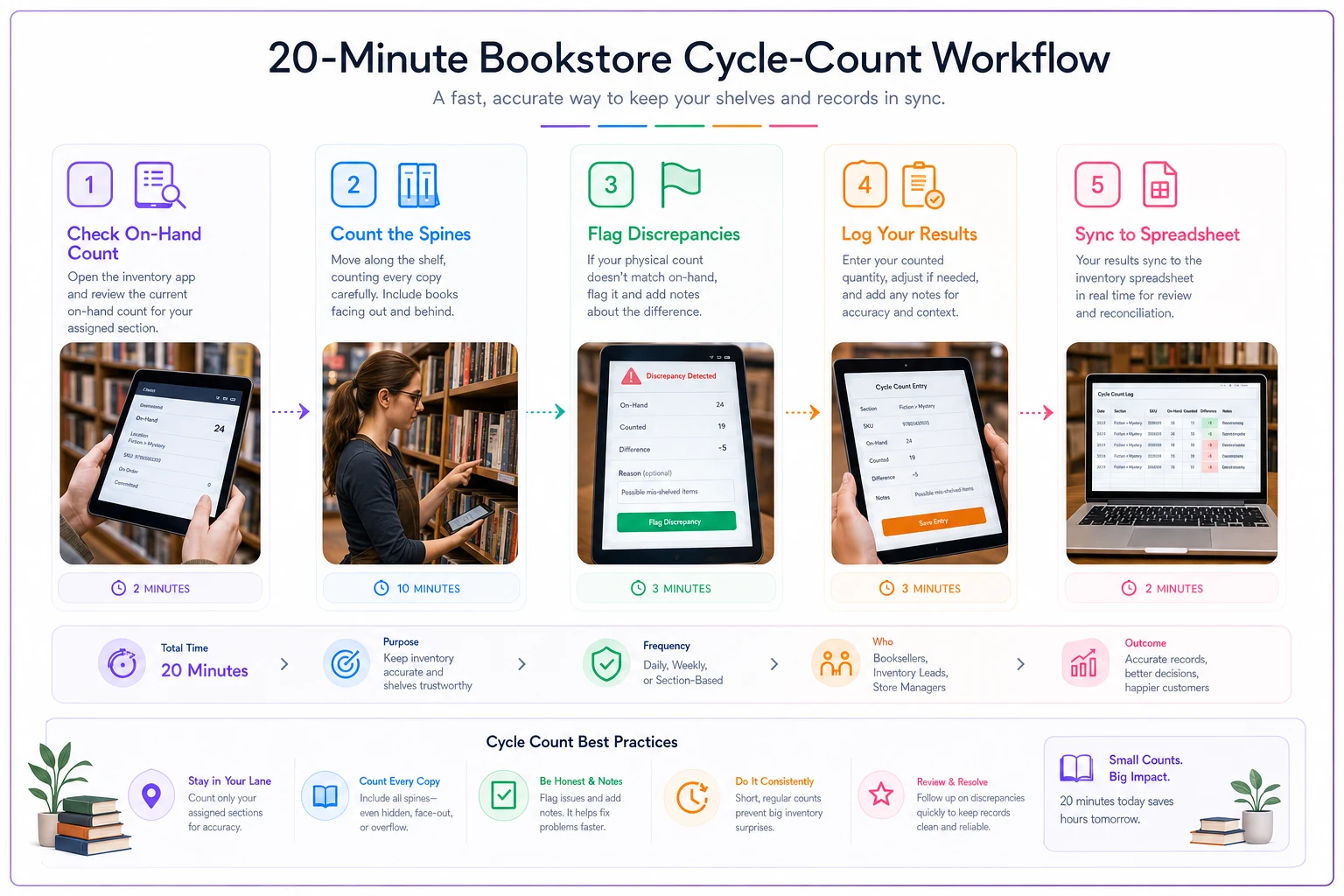
Twenty minutes is deliberate. Short enough that a part-timer can do it without derailing the day, long enough to properly count one shelf section or one spinner. You're not counting the whole A-tier in one sitting. You're counting a slice.
Here's how a single slot actually goes:
-
Pull up the expected on-hand for the assigned section (a printed count sheet or a tablet works).
-
Physically count what's on the shelf, spine by spine.
-
Mark matches, note discrepancies with the actual number.
-
Flag anything odd — misshelved titles, damaged copies, duplicates that shouldn't exist.
-
Log it. Hand it off or enter it. Done.
Choose the same time each day so the slot becomes a stable routine rather than a task you keep postponing.
Over a month, those daily slices add up to full coverage of A and B tiers plus a rotating chunk of C. Roughly 20–22 working days a month, one section each, and you've quietly audited the store without ever closing or scheduling a big count.
The behavioral trick: because it's the same length every day, it becomes routine instead of a project. Projects get postponed. Routines get done.
Building the monthly cadence
Lay the month out as a rotation, not a to-do list. Assign each working day a section, front-load the A-tier so it gets hit twice, and let C-tier fill the gaps.
A workable four-week skeleton looks like this:
-
Week 1 All A-tier sections (front tables, new releases, high-theft categories), one per day.
-
Week 2 First half of B-tier (core fiction, kids), plus one A-tier re-count.
-
Week 3 Second half of B-tier (nonfiction, staff picks), plus another A-tier re-count.
-
Week 4 Rotating C-tier block (this month: reference; next month: poetry; and so on), plus a buffer day for re-counts of anything that came up short.
That buffer day matters more than it looks. Discrepancies aren't useful if you never resolve them. Building a catch-up slot into the cadence means exceptions actually get closed instead of piling into a backlog you'll eventually give up on.
By quarter's end, every C-tier section has been touched once, every B-tier three times, and every A-tier six or seven times. Dramatically better coverage than one annual sweep, for a fraction of the labor spike.
Exception handling: what to do when the count is wrong
A count that finds a discrepancy and does nothing about it is just paperwork. The exception SOP is where cycle counting either earns its keep or becomes theater.
When a section comes up off, resist the urge to immediately "fix" the number in your system. A quick correction hides the cause, and the cause is the thing you actually want. Instead, run a short triage:
-
Off by one or two, high-traffic section Almost always a scan miss or a misshelve. Re-count once, check the adjacent sections for the missing copy, then adjust.
-
Off by several, or a full title missing Check recent sales, returns, and used-intake logs before touching the number. A title that vanished may have been sold under the wrong ISBN or shelved uncataloged.
-
Same section short repeatedly This is your signal. Repeat shrink in one spot means either a theft pattern or a broken process at that shelf. Escalate — move it closer to the counter, or dig into how stock flows through that section.
A lot of phantom discrepancies actually trace back to catalog problems — the same book living under two ISBNs, or a duplicate record splitting your on-hand across two entries. If you keep finding "shortages" that resolve into the same title appearing twice in your system, the fix isn't more counting, it's cleaning up the underlying records. Working through a proper metadata cleanup on your catalog will kill a surprising share of your recurring exceptions.
Give every exception a status: open, investigating, resolved, or written off. Nothing gets silently corrected. The paper trail is what turns random discrepancies into a pattern you can actually act on.
The shrink-tracking log
Counting without logging trends is like weighing yourself and never writing it down. You need a running record so patterns surface.
Keep it simple — a spreadsheet is fine. Each exception gets a row:
-
Date counted
-
Section
-
Title / ISBN (if a specific one)
-
Expected vs. actual
-
Discrepancy value (units × cost)
-
Suspected cause
-
Status
-
Who counted
The value column is the one owners tend to skip and shouldn't. Two missing units means nothing until you multiply by cost. Two missing art books at $38 wholesale is a different conversation than two missing mass-market paperbacks. Tracking dollar value tells you where to spend your attention.
Once you've got a few months logged, sort by section and by value. You'll usually find a small handful of sections generating most of your shrink dollars. That's not a surprise, but seeing it in your own numbers changes how you merchandise — maybe those high-value graphic novels move behind the counter, maybe the spinner near the door gets swapped for something cheaper to lose.
The log also feeds your ordering. If a section consistently shows real shortages (not catalog errors), your reorder points are running lean and you're probably stocking out silently. The count data doubles as a demand signal.
A real scenario
A two-and-a-half-person shop — owner, one full-timer, a weekend part-timer — was running annual counts and consistently found themselves 3–4% short on inventory value at year end, with no idea where it went. Reordering felt like guesswork, and the graphic novel section in particular seemed to be a black hole.
They switched to a monthly cycle program. Twenty minutes each morning before open, A-tier sections counted every two weeks. Within the first six weeks the log made the pattern obvious: the front graphic-novel spinner and the small art-book shelf near the entrance accounted for the bulk of their real shortages. Not fiction, not the backlist they'd worried about — two specific high-value, high-exposure spots by the door.
They moved the pricier graphic novels behind the counter and left face-out displays with lower-cost titles up front. Over the next quarter, tracked shrink on those sections dropped by more than half. Annual shrink for the whole store came down from that 3–4% range to around 1.5%. On their inventory value, that recovered roughly a couple thousand dollars a year — real money for a shop that size — and maybe more importantly, they stopped reordering blind because their on-hand numbers finally tracked reality within a week or two instead of drifting all year.
Nobody worked a Sunday count. Nobody closed the store. Just twenty minutes a day, logged.
Small-team accountability rules
With two or three people, accountability is tricky. You can't have a whole loss-prevention department, and you don't want counting to feel like everyone's being policed. A few rules keep it fair and functional:
-
One counter per section per day. No shared counts — if a number's wrong, you know whose slot it was. Not to blame anyone, but to ask what they saw.
-
Rotate who counts what. Don't let the same person always count the same section. Fresh eyes catch drift the regular counter has stopped seeing.
-
The counter doesn't resolve their own big exceptions. If a section is short by real value, someone else verifies before it's written off. Not distrust — just a second look, and it catches honest mistakes.
-
The log is visible to the whole team. Everyone sees the running exceptions. Shared visibility does more for accountability than any policy, because patterns become common knowledge.
The mistake small stores make is treating accountability as a trust issue. It's a process issue. Clear ownership of each count slot removes ambiguity, and ambiguity is what lets discrepancies hide.
When this program makes sense — and when it doesn't
Cycle counting isn't universal. A few honest caveats.
It makes sense when you're running lean on staff, your inventory value is meaningful, and you're tired of year-end surprises. If you've got a mix of high-turn and high-shrink sections, the tiered approach pays off fast.
It's a bad idea when your catalog is a mess. If your ISBNs are duplicated and your on-hand numbers are already garbage, counting against bad data just generates noise. Clean the catalog first, then count. Same goes if your POS and your online channels aren't reconciled — you'll chase phantom shortages that are really just sync lag. Getting your marketplace inventory sync tightened up before you start counting will save you from blaming shrinkage for what's actually a data problem.
Who should skip it: a true micro-shop with a few hundred titles and one person who knows the whole inventory by heart. At that scale, you already have a live count in your head. The program earns its value once you're big enough that no single person can track everything, but small enough that you can't afford to close for a full count.
Getting started this month
Don't over-engineer the launch. Pick your A-tier sections first — the fast, expensive, near-the-door stuff. Build a rough count sheet. Block the 20-minute slot on tomorrow's schedule. Count one section. Log what you find.
The first two weeks will feel bumpy. You'll find catalog errors, misshelves, and old ghosts in your data. That's normal — it's the accumulated drift finally surfacing. Push through it, keep the log honest, and by the second month the counts start matching and the whole thing settles into background rhythm.
The stores that stick with this don't do so because they love counting. They stick with it because their reorder numbers stop lying, their year-end stops surprising them, and they finally know where their money is walking out the door. Twenty minutes a day, one section at a time, is a small price for that.
The stores that stick with this don't do so because they love counting. They stick with it because their reorder numbers stop lying, their year-end stops surprising them, and they finally know where their money is walking out the door. Twenty minutes a day, one section at a time, is a small price for that.