

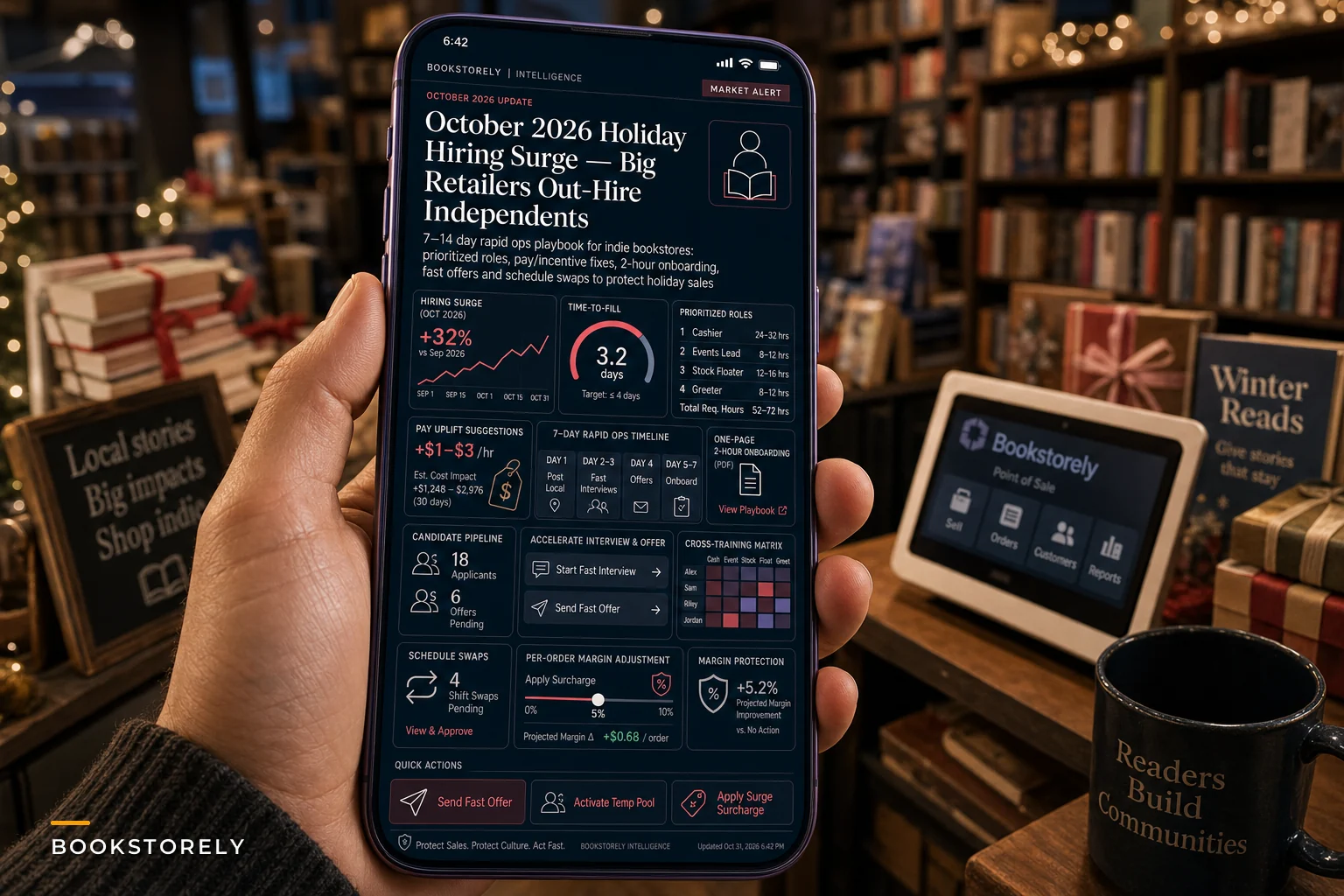

Amazon just announced it's recruiting more than 300,000 workers for the 2026 holiday season — its first hiring increase in three years, according to Reuters. Target, UPS, and the usual national players are moving in the same direction. For a bookstore owner trying to staff a December that's already tight, that number isn't abstract. It means the warehouse 20 minutes down the highway is dangling signing bonuses and guaranteed hours at exactly the moment you need two reliable seasonal hires who can gift-wrap, run a register, and not panic during a 40-person author event.
The headline number barely matters on its own. What matters is what it does to your local labor pool and your per-order labor math — and that's the part most people aren't writing about.
The real squeeze isn't headcount — it's timing and wage anchoring
When a mega-retailer ramps hiring in your area, two things shift at once.
First, your candidate pool thins fast, but unevenly. You're not losing career applicants — those people were never applying to a 12-person bookstore for six weeks of work. You're losing the exact profile you depend on: the college student home for break, the retiree who wants part-time hours, the person between jobs who'd happily shelve and wrap for $16–$18 an hour. That's the same pool Amazon fishes from, and they can afford to overpay for six weeks because they amortize it across a billion-dollar quarter.
Second — and this is the sneakier problem — big retailers anchor the wage expectation for your whole market. Once the fulfillment center posts "$20.50/hr plus $1,500 sign-on," every applicant who walks into your store has that number in their head. You don't have to match it. But you do need an answer for it, and most indie owners walk into interviews with nothing prepared.
A CNBC analysis of the 2026 season described the broader hiring picture as sending "mixed signals" — some sectors pulling back while logistics and big-box retail expand. For bookstores, "mixed" is almost worse than "hot," because you can't assume there's a wave of desperate applicants. You have to compete deliberately.
Start with the math most owners skip: what a seasonal hire actually costs you per order
Before you post a single job listing or adjust your wage, figure out your per-order and per-event labor load. Most indie owners carry this number in their gut, and the gut is usually wrong during peak weeks.
Never miss a sale or stock shortage again.
Bookstorely helps you manage inventory, orders, and customer relationships seamlessly.
- Integrated inventory tracking
- Customer purchase history
- Sales reporting & analytics
No credit card required
A typical holiday scenario looks something like this. Say you're a single-location store doing roughly $55k–$70k in December across in-store, web, and events. Your fulfillment labor — picking web orders, packing, wrapping, running them to USPS — eats a chunk of hours that nobody tracks precisely. If a seasonal hire costs you $17/hr fully loaded (wage plus payroll taxes plus the owner-hours spent training them), and that person packs and ships around 11–14 orders an hour once they're up to speed, your labor cost per web order lands somewhere around $1.25–$1.55.
That sounds manageable. But the trap is this: for the first three to five shifts, that same hire processes maybe five to seven orders an hour while asking questions, mis-scanning ISBNs, and double-checking gift notes. Your real early-stage cost per order is closer to $2.50–$3.00. If you hire late and your season is only six weeks long, you might never get that person to efficient output before the rush ends. You pay the training cost and miss the payoff.
That single pattern — late hiring compressing the payoff window — is the most expensive mistake in holiday staffing, and the big-retailer surge makes it worse because it pushes your hiring date later by thinning the early pool.
The three levers you actually control
You can't outspend Amazon. You can out-structure them. There are three levers, and most stores only pull one.
| Lever | What most stores do | What actually works |
|---|---|---|
| Pay | Match the big-box wage, panic-raise mid-season | Lead with a modest premium on a shorter commitment + non-cash perks |
| Schedule | Post rigid 8-hour blocks nobody wants | Offer short, predictable shifts that beat warehouse unpredictability |
| Onboarding speed | "Shadow someone for a week" | Compress to-productive time to under 2 hours with role cards |
Pay is the lever everyone reaches for first and it's the weakest one you have. You will lose a pure wage war every time. What you can win is flexibility and experience. A warehouse offers more money and brutal, variable, physically punishing shifts. You can offer a calm environment, a predictable Tuesday/Thursday/Saturday pattern, an employee discount on books, and the simple fact that the work is pleasant. For a significant slice of the seasonal pool — students, retirees, book people — that trade is genuinely competitive.
The schedule lever is underused and powerful. Offer shifts the big guys structurally can't: short 4-hour blocks, same-day-of-week consistency, the ability to pick up event shifts for a little extra. People will take $2/hr less for a schedule that fits around a class or grandkids.
The onboarding lever is where indie stores win — if they're ready
The retailer who gets a new hire productive in two hours beats the one who needs a week, even if the slow one pays more. When your season is six weeks, every day of slow onboarding is roughly 2–3% of the whole window burned.
This is where having your onboarding already built before the hiring crunch matters more than almost anything else. If you're improvising training in mid-November while short-staffed, you've already lost a significant chunk of your productive window. The stores that handle this well walked in with a documented, repeatable system — role cards, a fixed sequence, a clear two-week ramp plan. We've laid out exactly that approach in our two-hour onboarding script and surge plan for small bookstores, and the core principle is simple: don't train a seasonal hire to do everything. Train them to do one narrow thing flawlessly, fast.
A new wrapper doesn't need to understand consignment accounting. A seasonal web-order packer doesn't need to run the author event. Narrow the role, document it on a single card, and you cut training time by more than half.
Keep a laminated role card at each station so seasonal hires can self-check during their first shifts.
A new wrapper doesn't need to understand consignment accounting. A seasonal web-order packer doesn't need to run the author event. Narrow the role, document it on a single card, and you cut training time by more than half.
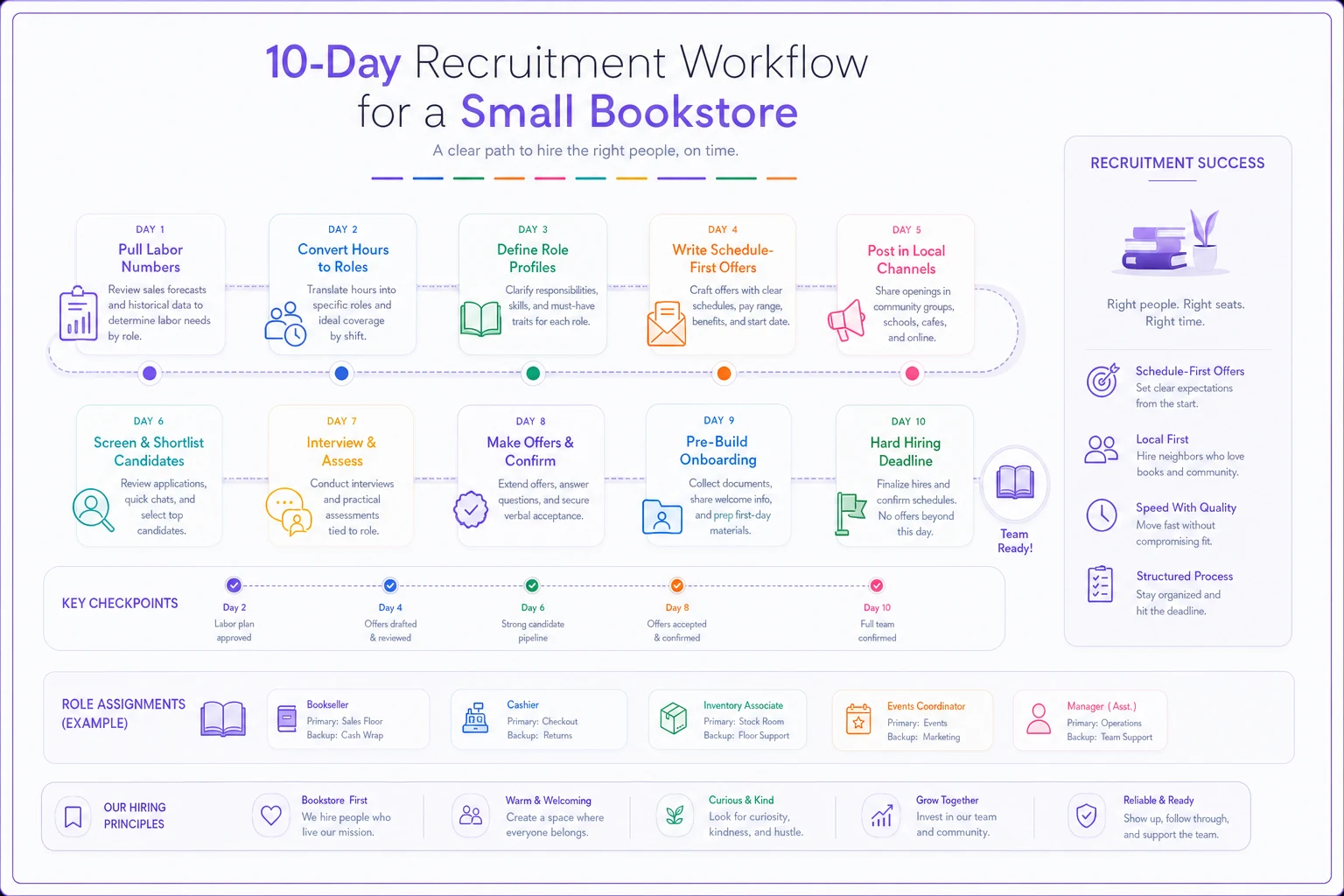
A fast recruitment sequence for the next 10 days
If the big-retailer surge caught you flat, here's a tight order of operations — not a vague "start hiring earlier."
Here’s a quick workflow that maps the essential steps from numbers to hires; follow it in order over ten days.
-
Pull your real labor numbers. Last December's web order count, event count, and peak-day in-store traffic. You need to know how many shift-hours you're short, not how many "people."
-
Convert hours to roles, not headcount. You might not need two full hires. You might need one 20-hour packer and one event-only floater. Flexible structure widens your applicant pool.
-
Write offers around the schedule, not just the wage. Lead with the shift pattern and perks. State the pay honestly, but don't make it the headline.
-
Post where book people are, not where everyone is. Your regulars' email list, local college job boards, the community board in-store. Your best seasonal hires are often already customers.
-
Pre-build the onboarding before the first interview. Role cards printed, register logins staged, packing station labeled. Day one should be productive, not orientation theater.
-
Set a hard hiring deadline. Count back six weeks from your peak and treat that date as non-negotiable. A slightly-less-ideal person hired on time beats the perfect person hired two weeks late.
A slightly-less-ideal person hired on time beats the perfect person hired two weeks late.
Protecting margin when labor costs climb
Even if you nail recruitment, you're probably paying more per hour this year than last. That has to show up somewhere in your numbers or it quietly eats your December profit. A few moves that don't require raising shelf prices across the board:
-
Reprice your highest-velocity gift items by small amounts. A $0.50–$1.00 bump on your top 20 holiday sellers covers a surprising amount of added wage cost and almost no customer notices on a $24 hardcover.
-
Add a modest handling consideration to web/gift-wrap orders rather than absorbing rising per-order labor silently.
-
Batch your fulfillment. Two dedicated packing windows a day beat packing orders one-at-a-time between customers. Batching is the single biggest per-order labor reducer, and it costs nothing.
-
Reserve your experienced staff for events and peak hours, and slot seasonal hires into the predictable, trainable tasks. Mismatching skill to task is a hidden labor cost.
The batching point deserves emphasis. A store that packs web orders reactively — stopping mid-task every time the door chimes — can easily run 40–50% slower on fulfillment than one that batches into two fixed windows. That inefficiency gets more expensive as wages rise, which makes this the year to actually fix it.
A short real scenario
A two-person-plus-seasonal shop doing roughly $60k in December had always hired its seasonal helpers in late November. Last year, with a regional fulfillment center hiring hard nearby, both of their usual go-to applicants took warehouse jobs by early November. The store scrambled, hired later, and spent the first two weeks of December training instead of selling. The owner estimated they left somewhere around $3k–$4k on the table in slower fulfillment and missed event capacity.
The fix wasn't paying more. It was moving the hiring deadline to mid-October, narrowing the roles to "web packer" and "event floater," and having a one-page role card ready so each hire was useful within the first shift. Same wage budget, same two hires — but the productive window roughly doubled. The difference was entirely timing and structure, nothing fancy.
When to just not hire
Worth saying plainly: not every store should add seasonal staff in a tight labor market. If your December web volume is low and your events are small, you may be better off cross-training your existing team and extending hours slightly than paying a premium for a hire you can't keep busy. A seasonal worker who's idle half their shift costs more than the overtime you're avoiding.
Hiring makes sense when you have a clear, repeatable task volume — consistent web fulfillment, multiple events, reliable foot traffic — that one person can own. It's a bad idea when you're hiring out of vague holiday anxiety with no defined role for the person to fill. The surge in big-retailer hiring makes the math stricter either way: if you're going to compete for the pool, you'd better know exactly what that hire does every hour.
Where this leaves you
The national hiring surge isn't a crisis for indie bookstores — it's a forcing function. It punishes the stores that improvise their staffing and rewards the ones that walk into the season with their labor math done, their roles defined, and their onboarding already built. You will not win on wages. You can absolutely win on speed-to-productive, schedule flexibility, and the simple fact that packing books in a warm store beats a fulfillment center for a lot of good people.
Do the three things that actually move the needle: set a hard hiring deadline and beat it, narrow your seasonal roles to one trainable task each, and protect your margin through batching and small price adjustments rather than absorbing rising wages in silence. Get those right and the 300,000 jobs down the road become someone else's headline, not your December problem.
Get those right and the 300,000 jobs down the road become someone else's headline, not your December problem.
Ready to elevate your bookstore’s operations?
Join 500+ bookstores using Bookstorely to boost sales, optimize stock, and delight book lovers.