

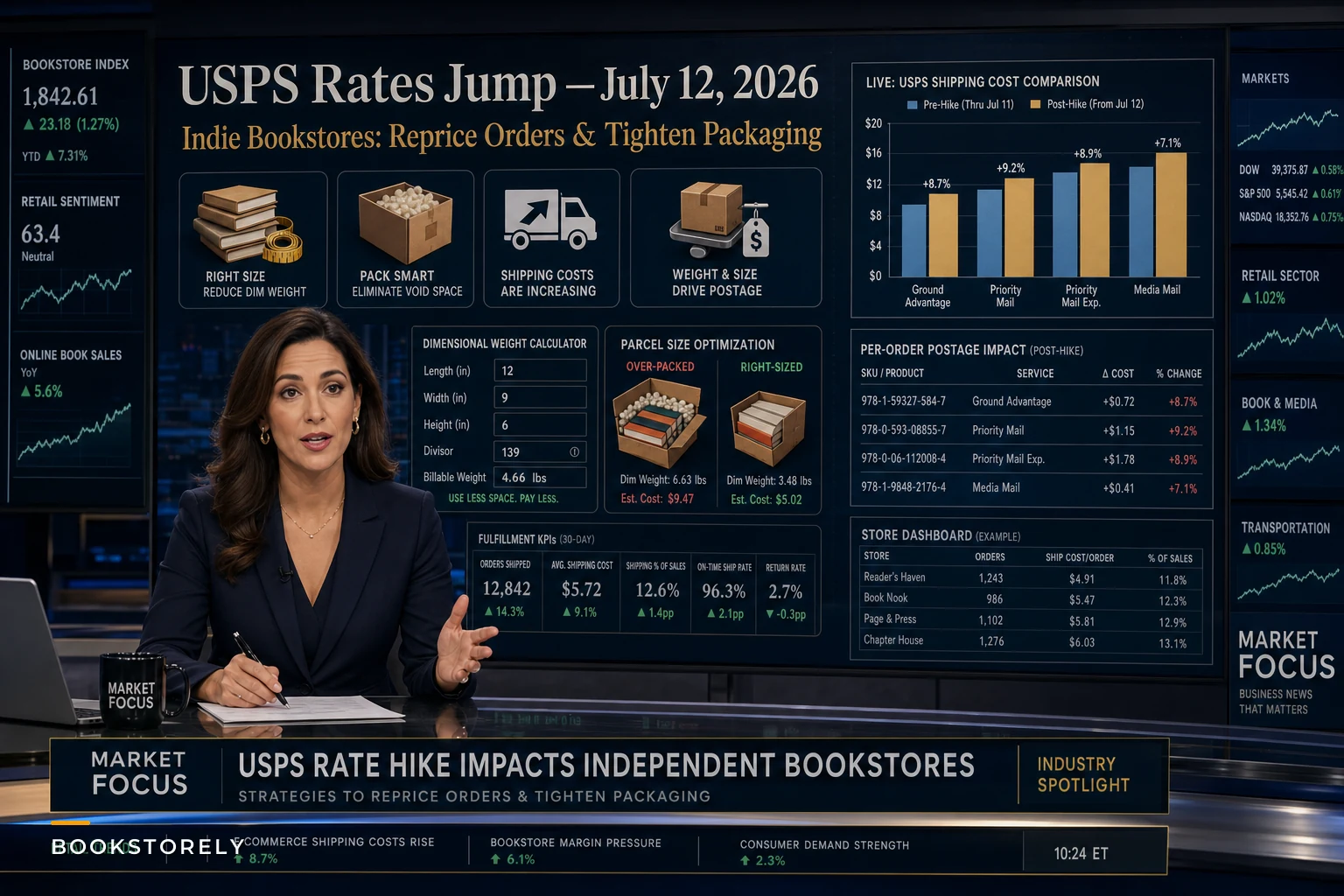

The USPS rate increase July 2026 hits in less than two weeks. Media Mail jumps 4%, Priority Mail goes up around 5%, and that Forever stamp you use for thank-you notes climbs to $0.82. For bookstores shipping 30-40 orders daily, even those modest percentage bumps translate to several hundred dollars monthly in extra fulfillment costs.
What kills margins though isn't the postage line item. Most indie bookstores are already losing money on single-book orders when you factor in packaging time, materials, and carrier fees. This rate bump just makes that worse.
I pulled shipping data from three bookstores last month. One in Portland shipping mostly fiction paperbacks. Another in Austin focused on art books and graphic novels. A third in Burlington doing a lot of children's board books. All three showed the same pattern—orders under $35 were barely breaking even on shipping, and that was before this increase.
The Austin store had it worst. Their average graphic novel order weighs 1.8 pounds packed. With dimensional weight pricing, they're paying for 3-pound packages on anything over 12 inches long. Add the July increases and their $28 graphic novel orders start costing money once you include the 12 minutes of pick-pack labor.
Why bookstores bleed margin on small orders (hint: it's not just postage)
Your checkout probably shows shipping at $4.95 or offers free shipping over $50. Meanwhile your actual costs look nothing like that flat rate.
A single paperback order typically runs:
-
USPS Media Mail base rate
$3.65 (going to $3.80)
-
Padded mailer
$0.55
-
Packing slip and tape
$0.15
-
Staff time (8 minutes at $18/hour)
$2.40
-
Payment processing on shipping charge
$0.20
That's $6.95 in actual cost on an order you charged $4.95 to ship. And that assumes nothing goes wrong—no address corrections, no reships for damage, no back-and-forth emails about tracking.
Hardcovers and box sets are worse because of dimensional weight. That illustrated Harry Potter collection looks great at $89.99 until you realize it ships in a 16x12x4 box that USPS treats as 8 pounds dimensional weight, costing $18 to ship Priority Mail.
We tracked around 400 recent orders across multiple stores. Single trade paperback orders lost an average of $2.10 per shipment. Orders with multiple hardcovers lost closer to $4.80. Only orders above $65 consistently covered true shipping costs—and that's at current rates.
Crunch your real per-package cost (not the fantasy number on your rate card)
Most bookstore owners quote their Media Mail rate when asked what shipping costs them. That number means almost nothing operationally.
Pull last month's actual shipping data and include everything:
-
Base postage paid
-
Packaging materials used
-
Labor time from pick to handoff
-
Platform fees on shipping charges
-
Customer service time on shipping issues
-
Damage and reship costs
One Vermont bookstore thought they spent $4.20 average per package. Real number after doing this: $7.35. Their free shipping threshold of $35 was quietly hemorrhaging cash on every order.
The labor component surprises people every time. Your bookseller spending 6 minutes finding a book in the backroom, 3 minutes packing it, 2 minutes printing labels and updating tracking—that's real cost. At $16/hour plus taxes and benefits, you're already at $3.50 in labor alone.
Dimensional pricing hits harder than most people realize. USPS uses a dimensional divisor of 166 for Priority Mail. A 14x10x4 inch package—typical for 2-3 hardcovers—calculates to 3.4 dimensional pounds. Even if the books weigh 2.5 pounds actual, you pay for 4.
The packaging audit that actually saves money
Before you panic-raise all your shipping charges, audit your packaging. Most stores stock 3-4 box sizes, which forces books into packages with extra space that triggers dimensional penalties.
According to Mail Processing Associates' analysis, dimensional weight surcharges affect nearly 40% of retail packages. For bookstores shipping mixed formats, it's probably higher.
Here's what actually works:
Expand to 6-8 package sizes:
-
6x9 bubble mailers for single mass market paperbacks
-
9x12 flat mailers for single trade paperbacks
-
10x13 flat mailers for larger paperbacks and thin hardcovers
-
12x9x3 boxes for 2-3 trade paperbacks
-
14x10x4 boxes for multiple hardcovers
-
16x12x6 boxes for sets and large format books
-
18x14x8 boxes for bulk orders
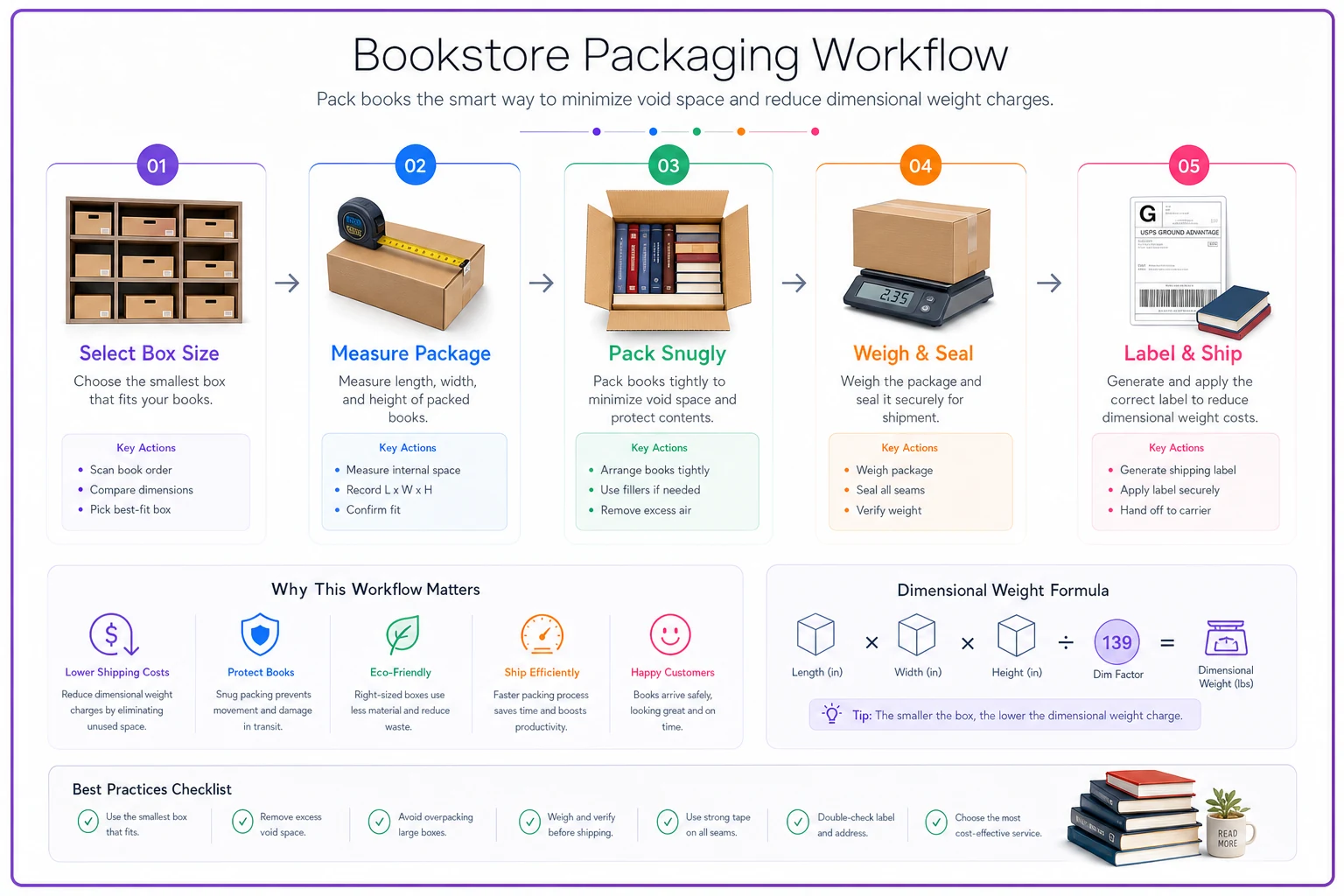
This visual shows the basic steps staff should follow to choose the right box and avoid dimensional surcharges.
Order two intermediate box sizes that match your most common order profiles to reduce dimensional weight surprises.
Each size jump carries dimensional pricing consequences. A book that fits in a 10x13 mailer (dimensional weight 0.78 lbs) jumps to 2.17 lbs dimensional weight in a 12x9x3 box.
Weight matters less than size:
Five paperback novels might weigh 3 pounds but need a 14x10x4 box. That's 3.4 dimensional pounds, so you pay for 4. A 2-pound art book in the same box costs the same to ship despite being lighter.
The Burlington store saved $380 monthly just by adding two intermediate box sizes and tightening up how staff packed orders. Damage rate stayed flat, but dimensional weight charges dropped 22%. If you want to get into the specifics, there's more detail on packing standards that actually reduce costs.
Repricing matrix for July 12 (zone-based, not flat)
Flat-rate shipping hasn't worked for profitable operations in a long time. You need zone-based pricing that reflects what you're actually paying.
Here's a working matrix based on current store operations:
| Order Value | Zones 1-4 | Zones 5-8 | Weight Threshold | Free Ship Option |
|---|---|---|---|---|
| Under $25 | $6.95 | $8.95 | 2 lbs max | Not offered |
| $25-$39 | $5.95 | $7.95 | 3 lbs max | Not offered |
| $40-$59 | $4.95 | $6.95 | 4 lbs max | $75+ in zones 1-4 |
| $60-$79 | $3.95 | $5.95 | 5 lbs max | $65+ all zones |
| $80+ | Free | $4.95 | 6 lbs max | Free all zones |
Pay attention to those weight thresholds. A customer ordering three hardcover art books might hit $85 but weigh 8 pounds. That order needs either an override to actual shipping cost or a defined weight cap for free shipping eligibility.
Your shopping cart needs rules for this. Most platforms support basic weight/price matrices, but edge cases like oversized books or heavy sets often need custom logic.
Also worth setting up: package consolidation rules. Two orders from the same customer within 48 hours should combine automatically. The Portland store did this and cut shipping costs about 8% just from reduced package count.
What to tell customers starting Monday
Transparency beats surprise charges every time. Update your shipping page now with something like:
"Shipping rates update July 12 to reflect USPS increases. Orders placed before July 12 ship at current rates. Our new free shipping threshold of $65 helps offset these increases for most orders."
Don't apologize or over-explain. Customers understand that shipping costs go up. What irritates them is hitting checkout and finding out their $28 book costs $9 to ship with no warning.
Add shipping estimates to product pages for heavy or oversized items. That coffee table book about modernist architecture needs a note: "Due to size and weight, shipping typically runs $12-18 depending on location."
For regulars and subscribers, a shipping membership is worth considering. $39 annually for free shipping on orders over $35. Even at 50% adoption, it provides predictable revenue and nudges people toward bigger orders. The Austin store launched one and watched average order value climb from $42 to $58.
Operational triage for the next 10 days
Less than two weeks. Here's the priority order:
This week:
-
Update checkout shipping rates for July 12 go-live
-
Order intermediate box sizes if you need them
-
Train staff on tighter packing standards
-
Update free shipping thresholds
-
Adjust shipping messaging on the website
-
Email frequent customers about the changes
By Friday:
-
Audit and update charges for heavy and oversized items
-
Set up zone-based pricing if you haven't already
-
Create a shipping FAQ for customer service
-
Update automated email templates with new rates
-
Review marketplace shipping settings
Weekend before July 12:
-
Double-check all rate updates are staged correctly
-
Process any bulk mailings at current rates
-
Clear backlog to avoid confusion
-
Brief all staff on new policies
AI-powered operational software for bookstores can handle rate updates automatically through carrier API connections. But whether you're updating manually or using software with integrated packing standards, the point is having clear rules before the increase hits—not scrambling the morning of.
The uncomfortable truth about bookstore shipping economics
Physical books are heavy, oddly shaped, and low-margin. Unlike clothing or electronics with 60%+ margins, your 40% margin on books leaves very little room to subsidize shipping.
A bookstore in Denver showed me their numbers. Average order value: $34. Average margin after cost of goods: $13.60. Average true shipping cost: $7.85. Average shipping charged: $4.95. They're losing $2.90 per order on shipping, leaving $10.70 gross margin. After overhead, maybe $2 net per order.
The July increase pushes that true shipping cost to around $8.40. Now they're underwater on most orders.
This is why getting the operational details right actually matters. Every minute saved packing, every dimensional pound avoided, every damaged shipment prevented—these aren't minor optimizations. They determine whether you make money on an order at all.
Some stores try to compete with Amazon on shipping. That's a losing game. Amazon loses money on shipping too, subsidized by AWS and ad revenue. You don't have that backstop.
Focus on what you actually do better: curation, community, expertise, events. Customers who value those things will pay real shipping costs. Customers who only care about price and speed were probably never your customers to begin with.
Building shipping costs into your pricing strategy
The stores that handle this best don't treat shipping as a separate problem. They build it into overall pricing from the start.
Instead of selling at publisher's suggested retail and charging shipping on top, price 5-8% above MSRP and offer free shipping at a lower threshold. Customers prefer the simplicity, and you protect margins.
This works especially well for titles you're known for. A specialty cookbook store in Seattle prices 10% above MSRP across all titles. Their customers pay for expertise and curation. That premium funds free shipping on orders over $45.
For used books, there's even more flexibility. That first edition you bought for $8 and priced at $24? Try $27 with free shipping instead of $24 plus $3 shipping. Same cost to the customer, better perception.
Keep an eye on what other stores are doing too. If indie bookstores in your region are all charging $5.95 base shipping, matching that might make sense even if it costs you $7.40 to fulfill. But if everyone's raising rates post-July 12, move with the market.
Making sure this doesn't compound into bigger problems
Shipping cost increases cascade. Higher shipping means fewer impulse purchases, lower order frequency, reduced cash flow, more pressure on events and in-store sales.
Disciplined operations create the opposite effect. Better packaging reduces damage claims. Clear shipping policies reduce customer service time. Accurate costing improves pricing decisions. All of it compounds into better margins despite higher base costs.
One more thing worth sitting with: July 12 won't be the last increase. USPS faces structural challenges that guarantee continued rate pressure. Building tighter shipping operations now means less scrambling every time it happens.
The bookstores that survive long-term don't pretend shipping is free or treat it like an afterthought. They acknowledge the cost, price accordingly, and focus on delivering value that justifies it. Your knowledge, your curation, your community—that's what customers are actually buying. The books are just the physical part.
Take the next week to fix your shipping economics. Not just for this increase, but because a bookstore losing money on every shipment won't be around to serve its community, no matter how much that community loves it.