

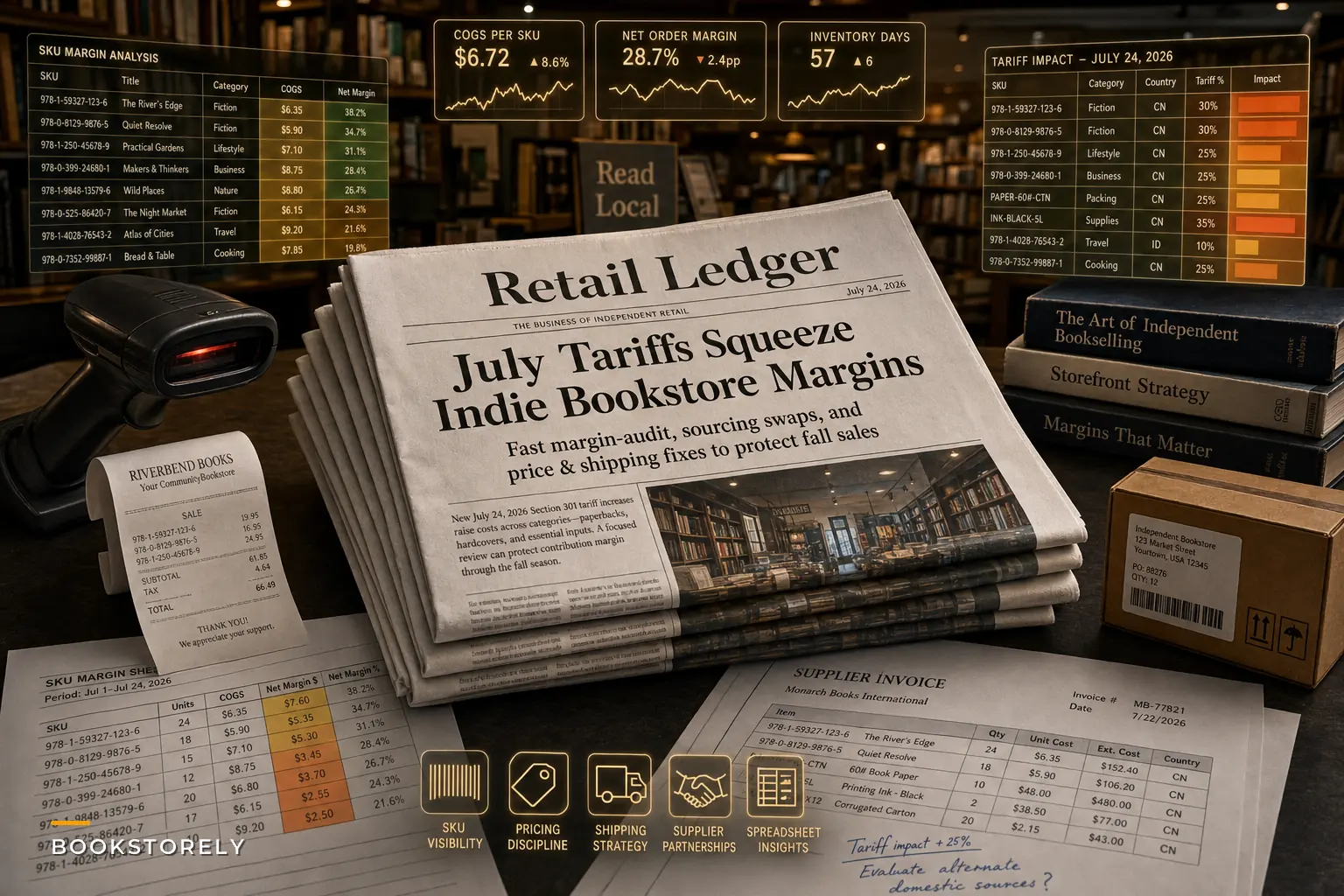

Last Thursday morning, bookstore owners across the country opened vendor invoices to find a nasty surprise. That imported Italian art book series you've been selling steadily for three years? Wholesale price jumped 11%. Those gorgeous Japanese manga editions flying off your YA shelves? Up 12.5%. Even the kraft paper bags you use for every purchase now cost 10% more per case.
The new Section 301 tariffs that took effect July 24 hit sixty trading partners with duties between 10% and 12.5%, replacing the expiring global tariff structure. For bookstores, this creates an immediate problem: you've got fall orders already placed, holiday inventory commitments locked in, and event calendars set through December — all priced on cost assumptions that just became obsolete.
What makes this particularly brutal for indie bookstores is that unlike big chains with annual pricing agreements and some currency hedging, most independents work on net-30 or net-60 terms with distributors who pass through cost increases immediately. You're absorbing these July 2026 U.S. tariff hits in real-time, without pre-negotiated contracts or any real leverage to push back.
The hidden cascade effect
Most bookstore owners are focused on the obvious hit — imported titles cost more. But after running the numbers on actual vendor invoices from a few different stores this week, the real damage runs deeper than sticker shock on foreign publishers.
Domestic publishers are eating tariff increases on their own inputs. That hardcover from a U.S. publisher? The paper might be domestic, but the binding cloth comes from India (12.5% tariff), the foil stamping materials from South Korea (10%), and the dust jacket uses Canadian paper stock (10%). One mid-size university press told me their average unit cost jumped $0.87 on domestically printed titles — purely from imported components.
Then there's the packaging squeeze. Poly mailers in 5,000-unit cases? Made in Vietnam, now 10% more expensive. Void fill? Imported. Branded tissue paper for gift wrapping? Imported. Even thermal labels for your shipping printer probably just went up. A bookstore in Portland ran their packaging costs and found roughly a $340 monthly increase on shipping supplies alone — before selling a single additional book.
The timing couldn't be worse. August is when most indies place their big holiday orders, locking in inventory for the October–December rush that generates 35–40% of annual revenue. You're committing capital at inflated prices while still working through pre-tariff inventory that customers can price-compare online against competitors who might have deeper old-stock reserves.
Why your current margin calculations just became fiction
Pull your last P&L right now. See that gross margin percentage you've been targeting? The 42% benchmark you've held for three years? It's not wrong — it's measuring the wrong thing at the wrong level.
Never miss a sale or stock shortage again.
Bookstorely helps you manage inventory, orders, and customer relationships seamlessly.
- Integrated inventory tracking
- Customer purchase history
- Sales reporting & analytics
No credit card required
Traditional bookstore margin math goes:
-
List price minus wholesale cost equals gross profit
-
Gross profit divided by list price equals margin percentage
-
Hit 40–43% and you're healthy
That formula assumes stable wholesale costs and predictable freight charges. When input costs spike overnight by 10–12%, your realized margins compress faster than you can adjust retail prices. And unlike a restaurant that can tweak portion sizes or a clothing store that can shift fabric blends, you can't make a book 10% smaller or print it on cheaper paper. The product is fixed.
What actually matters now is contribution margin per order after all variable costs — not per book, per order. Whether someone buys one book or five, you're paying the same payment processing percentage, generating the same pick-and-pack labor, burning the same packaging materials. The per-order margin waterfall becomes your navigation system when input costs destabilize like this.
A store in Austin showed me their breakdown: a $28 hardcover that contributed $4.20 to overhead in June now contributes $2.15 after factoring in new landed costs, higher packaging expenses, and unchanged credit card fees. Multiply that across 300 transactions a week and you're looking at roughly $32,000 less contribution margin annually. On the exact same unit volume.
The three-bucket supplier audit you need to run this week
Forget strategic planning for now. You need tactical triage. Start by bucketing every supplier relationship into three categories based on tariff exposure and your ability to find alternatives.
Bucket 1: Direct-import publishers
These are foreign publishers you buy from directly or through exclusive U.S. distributors — Thames & Hudson, Taschen, Phaidon for art books; Kodansha, Yen Press, Seven Seas for manga; European academic presses for philosophy and criticism. These face the full tariff hit with no buffer.
For each publisher in this bucket, pull your last 90 days of sales data and calculate the revenue and margin contribution. Then run a simple test: if wholesale costs increase 12%, what retail price would maintain your current dollar contribution? A $40 art book wholesaling at $20 needs to retail at $44.50 to hold the same $8 contribution after a 12% cost increase. Will your customers pay $44.50 for a book they can find online at $40? That's your decision point.
Bucket 2: Hybrid suppliers
Domestic publishers and distributors with mixed supply chains — Ingram, Baker & Taylor, most university presses, larger independent publishers. These will see partial cost increases as imported components get pricier, but not the full tariff impact.
This is where you need to get granular. Call your reps. Ask specifically:
-
What percentage of their catalog is printed overseas?
-
Which product lines use imported materials?
-
When will tariff-adjusted pricing hit your invoices?
-
Are they eating any of the increase or passing it all through?
One distributor rep told me they're seeing 3–7% increases on domestically printed books depending on component sourcing, versus 11–14% on fully imported titles. That variance matters for your buying decisions.
Bucket 3: Replaceable commodities
Packaging, supplies, branded merchandise, sideline gifts. Anything you can source from multiple vendors without disrupting your brand identity. This is where you have maximum flexibility and should be most aggressive.
Start calling domestic alternatives today. A bookstore in Seattle found a U.S. poly mailer manufacturer that was actually 2% cheaper than their pre-tariff imported supplier — but minimum orders were 10,000 units. Can you warehouse that volume? Can you split an order with another store? These are the moves that preserve margin without requiring you to renegotiate your entire vendor list.
Start your audit with the top 20 SKUs in Bucket 1 to capture the biggest immediate margin impact.
For each publisher in this bucket, pull your last 90 days of sales data and calculate the revenue and margin contribution. Then run a simple test: if wholesale costs increase 12%, what retail price would maintain your current dollar contribution? A $40 art book wholesaling at $20 needs to retail at $44.50 to hold the same $8 contribution after a 12% cost increase. Will your customers pay $44.50 for a book they can find online at $40? That's your decision point.
Reworking your fall buying plan without destroying cash flow
Your open-to-buy budget just became a more complicated problem. The old approach — spreading dollars across categories based on historical sales mix — breaks when cost bases shift asymmetrically.
Instead, rebuild your buying plan around contribution dollars per inventory dollar invested. Calculate your new fully-loaded wholesale cost for each category: take the invoice price, add the tariff impact (actual or estimated), add inbound freight, add your per-unit allocation of packaging costs. That's your real inventory investment.
Then project your maintainable retail price — not what you'd like to charge, but what you can actually get. Check Amazon, Barnes & Noble online, your nearest chain. If you're more than 10% above online prices on commodity titles, you'll lose the sale. For curated or unique selections, you might have 15–20% pricing power. Be realistic about which of your titles fall into which bucket.
Rank categories by contribution margin per inventory dollar. If art books now require $30 of inventory investment to generate $8 of contribution, that's a 26% return. If literary fiction requires $12 to generate $4, that's 33%. Buy more fiction, less art.
But watch your cash conversion cycle. Those beautiful $85 photography books that used to turn four times a year might now turn twice at $95. Your inventory investment stays frozen longer, which kills cash flow. One store cut their coffee-table book selection by about 60% and used the freed-up cash to triple their romance paperback depth. Same shelf space, higher contribution margin, faster turns.
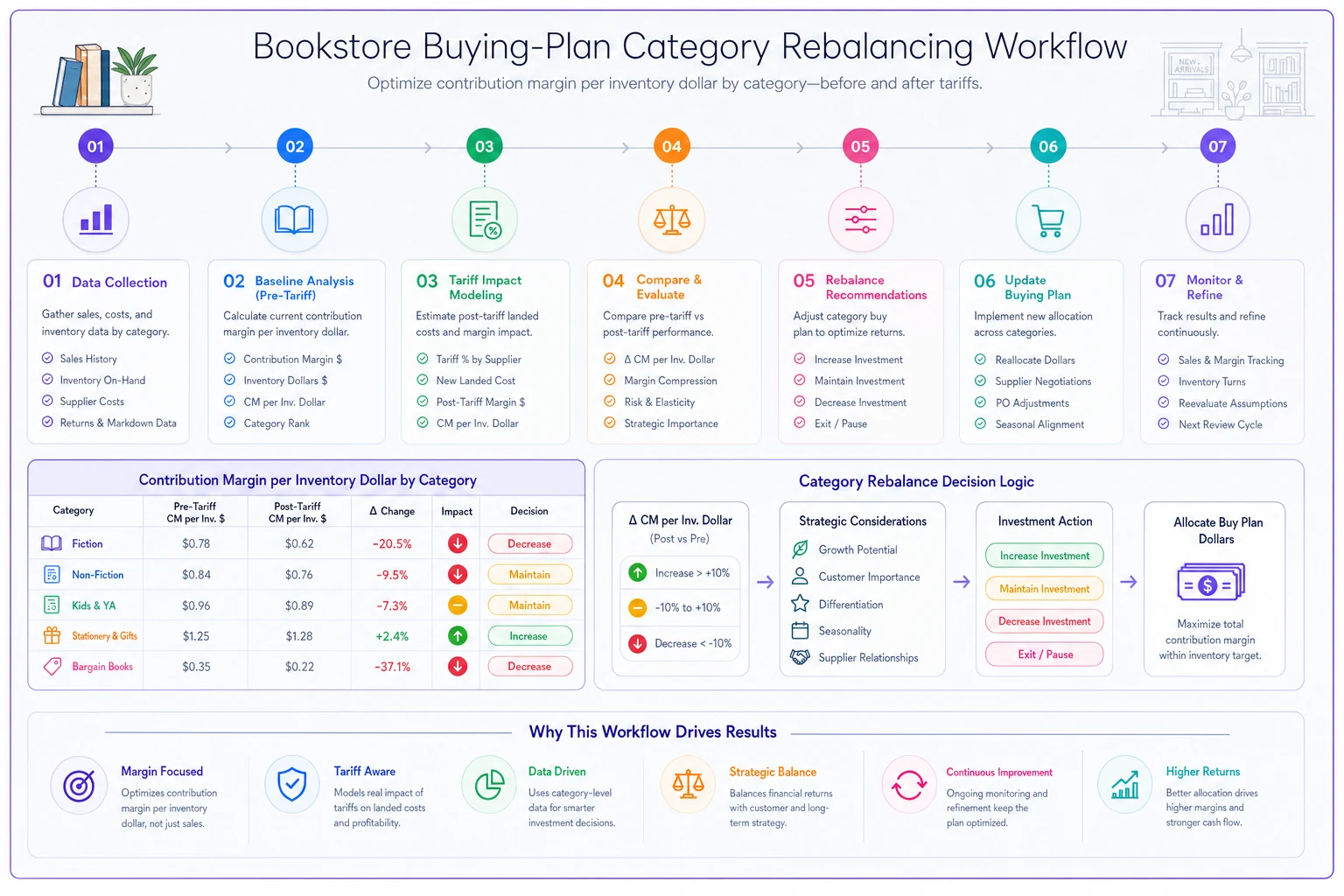
Here's a simplified comparison of what this category shift looks like in practice:
| Category | Avg. Wholesale (Post-Tariff) | Avg. Retail | Contribution $ | Inv. Turn/Year | Return on Inv. $ |
|---|---|---|---|---|---|
| Art/Photo Books | $30.00 | $55.00 | $8.00 | 2x | 26% |
| Literary Fiction | $12.00 | $22.00 | $4.00 | 6x | 33% |
| Romance Paperback | $7.00 | $14.00 | $3.50 | 10x | 50% |
| Imported Manga | $9.50 | $15.00 | $2.20 | 5x | 23% |
| Domestic Graphic Novel | $10.00 | $20.00 | $4.50 | 6x | 45% |
The numbers don't lie. The categories that feel the most "bookstore-y" are often the worst performers on a return-per-inventory-dollar basis right now.
The domestic alternatives nobody tells you about
Print-on-demand is having a moment, but not for the obvious reasons. Yes, avoiding inventory risk matters when costs are volatile. The real opportunity is accessing domestic printing for titles traditionally only available as imports.
Lightning Source and IngramSpark now print a large portion of backlist academic titles on demand in Tennessee and Pennsylvania. That Cambridge University Press philosophy text? You can get it printed domestically, sidestepping the tariff entirely. The print quality isn't identical — the paper's slightly different, the binding is functional rather than beautiful — but for books where content matters more than production values, most customers won't notice or care.
Several manga publishers have started offering POD versions of older series through Ingram. Reproduction quality isn't as sharp as offset Japanese printing, but for a reader who just wants Volume 7 to complete their collection, paying $12.99 for a POD version beats $18.99 for the imported edition.
For special orders, this changes things significantly. Instead of automatically quoting customers the new tariff-inflated price on imported editions, check POD availability first. You might be able to offer a lower price while protecting your margin. A store in Denver now checks POD availability on every special order over $30 before quoting anything. It takes an extra two minutes and has saved them real money on margin.
Automation opportunities when every dollar counts
When margins compress this fast, operational efficiency stops being a nice-to-have. The stores weathering this best have cut manual work that doesn't directly serve customers or drive sales.
Automate invoice ingestion first — it pays back quickly and uncovers hidden tariff line items.
Stop hand-entering vendor invoices. Even small distributors now offer EDI or at minimum CSV downloads. Set up automated ingestion that flows directly to your inventory system. The few hours weekly you save can go toward hand-selling higher-margin titles instead.
Price updates need to happen faster than a pricing gun allows. When wholesale costs change, your POS should flag items needing retail price review based on your margin rules. A bookshop using cloud-based inventory management updated around 1,200 prices in thirty minutes last week — what would have taken two days of manual shelf-checking.
Build rules-based reorder points that factor in your new cost reality. That art book selling reliably at $45 might not move at $52. Your reorder trigger of two units might need to drop to one, or zero. Let your system calculate these breakpoints based on turn rates and contribution margins rather than gut feel.
The deeper opportunity is demand forecasting that accounts for price elasticity. When you raise prices 10%, how much does demand drop? AI-powered inventory tools can now model this at the SKU level, factoring in local competition, online prices, and seasonal patterns. Instead of guessing whether customers will absorb $3 more on a bestseller, you can model the likely volume impact before placing orders — which is exactly the kind of information you need before committing to holiday inventory right now.
Your margin preservation checklist
Run this audit by Friday. Start with the highest-impact moves, not everything at once.
Invoice forensics:
-
Pull three recent invoices from your biggest suppliers
-
Check line-by-line for tariff surcharges or cost increases
-
Calculate the actual percentage increase by product category
-
Flag surprises for follow-up with your rep
Retail price reality check:
-
Export your top 100 SKUs by revenue
-
Spot-check current retail prices against Amazon and B&N.com
-
Mark items where you're more than 10% above online pricing
-
Decide
reprice, reduce stock, or accept lower turns?
Supplier diversification:
-
List your top 10 suppliers by purchase volume
-
Identify their primary manufacturing locations
-
For each imported line, research one domestic alternative
-
Get quotes even if you don't switch immediately
Category rebalancing:
-
Calculate contribution margin per category post-tariff
-
Identify your three lowest-margin categories
-
Can you reduce shelf space without losing traffic?
-
What higher-margin categories could expand?
Packaging alternatives:
-
Inventory all packaging and supplies
-
Get quotes from three domestic suppliers
-
Calculate switching costs including setup and minimums
-
Switch immediately if payback is under 60 days
Cash flow protection:
-
Model your OTB at new cost bases
-
Reduce depth on slow-turning expensive titles
-
Negotiate extended terms with supportive suppliers
-
Consider factoring receivables if you do B2B sales
Run this audit by Friday. Start with the highest-impact moves, not everything at once.
What this means for indie bookstore economics
The tariff shock is really an acceleration of pressure that was already building. Bookstores have been managing compressed margins for years. This just pushed the fast-forward button.
Stores that survive won't necessarily be the ones that find clever workarounds — though those help. They'll be the ones that restructure operations around contribution margin per transaction rather than gross margin percentage. Fewer SKUs, faster turns, tighter category management, relentless focus on operational efficiency.
The old model of bookstore-as-cultural-curator may not generate enough cash flow anymore. The new model looks more like a highly curated retailer that happens to sell books. You still champion literature and create community — you just do it while managing inventory like a grocer and pricing like someone who's actually run the numbers.
For some stores, this is the push to finally add serious sidelines — gifts, games, stationery — where margins run 50–60% instead of 40%. Others will double down on used books, where sourcing is hyperlocal and tariff-proof. A few will lean into events and experiences, using books as the draw but monetizing through tickets, workshops, and membership programs.
Eighteen months from now, the stores still standing will look different. Smaller literature sections, deeper romance and mystery. Less imported manga, more domestic graphic novels. Fewer $100 art books, more $30 gift books. Not because owners wanted these changes, but because the math demanded it.
Your immediate job isn't to solve the tariff problem. It's to survive it long enough to benefit when things stabilize. Run the numbers, make the cuts, find the alternatives, protect cash. The stores that get through the next six months will have learned to run leaner and smarter — and when the macro environment eventually shifts, they'll be expanding from a stronger base. That's next year's problem. This week, audit your invoices, call your suppliers, and reprice your inventory.
The margin preservation starts now.
Ready to elevate your bookstore’s operations?
Join 500+ bookstores using Bookstorely to boost sales, optimize stock, and delight book lovers.