


Buying faith titles is its own animal. The category has its own distribution structure, its own return quirks, its own metadata gaps, and — if you're not careful — its own way of quietly eating 4–6 points of margin before you notice. A general trade wholesaler and a dedicated Christian distributor don't behave the same way, and the stores that get burned usually get burned during onboarding, not during the buying itself.
This is a working playbook for that onboarding. Not a "why faith books matter" think piece — you already know your customers. This is about the operational mechanics: which distributor to pick, what to put in writing, how to map their data into your POS without duplicating SKUs, and how to reconcile returns so credits don't vanish.
Why faith distribution trips up otherwise well-run stores
The core issue is that the Christian book supply chain is fragmented in a way general trade isn't. You've got the big consolidators (Ingram carries plenty of faith titles), denominational publishers who sell direct, curriculum houses operating on academic calendars, and specialty distributors who carry gift, church supply, and Bible editions alongside books.
-
Overlapping catalogs. The same devotional shows up from three sources with three different discount schedules and three slightly different ISBNs (paperback vs. deluxe vs. "church edition").
-
Bible SKU chaos. A single Bible translation can have dozens of bindings, cover colors, thumb-index variants, and gift-box configurations. Metadata rarely distinguishes them cleanly.
-
Return terms that look generous but aren't. Some faith distributors offer wide return windows on books but treat gift, seasonal (Easter/Christmas), and curriculum as non-returnable — and that carve-out is where stores get stuck holding dead stock.
What tends to happen is the buyer negotiates a decent discount, feels good about it, and then loses the gain three months later on returns friction and duplicate receiving. The money doesn't leak at the negotiation table. It leaks in the workflow.
The money doesn't leak at the negotiation table. It leaks in the workflow.
Step 1: Build a distributor evaluation scorecard before you talk terms
Don't evaluate Christian book distributors on discount alone. Discount is one line. The scorecard below weighs the things that actually determine whether the relationship stays profitable.
Never miss a sale or stock shortage again.
Bookstorely helps you manage inventory, orders, and customer relationships seamlessly.
- Integrated inventory tracking
- Customer purchase history
- Sales reporting & analytics
No credit card required
| Criteria | Weight | What a 5 looks like | What a 1 looks like |
|---|---|---|---|
| Base discount tier | 20% | 43–46% on trade books | Under 40% with no ramp |
| Return policy clarity | 15% | Written window, defined carve-outs, no restocking fee | Vague "case by case" language |
| Metadata quality (ONIX) | 15% | Clean ONIX 3.0 feed, distinct SKUs per binding | CSV only, merged Bible variants |
| Fill rate / backorder honesty | 12% | 90%+ fill, real-time stock status | Ships partials with no notice |
| Payment terms | 12% | Net 60, or Net 30 with early-pay discount | COD or Net 15 |
| Freight structure | 10% | Free freight over a low threshold | Freight on everything |
| Curriculum/dated-goods handling | 8% | Clear seasonal return calendar | Non-returnable, no warning |
| Rep responsiveness | 8% | Named rep, replies same day | Ticket queue only |
The metadata row surprises people. It's weighted at 15% for a reason — a distributor with a messy data feed will cost you hours every week in receiving corrections and will actively create the duplicate-edition problem you're trying to avoid.
A pattern worth flagging: distributors offering the highest headline discount often score lowest on return clarity and freight. The 46% shop that charges freight on every box and won't take back seasonal stock frequently nets worse than the 43% shop with free freight over $150 and clean returns.
Step 2: Get the right clauses in writing
Handshake terms with faith distributors are common because the relationships feel relational. That's exactly why you should still write it down — relational vendors change reps, get acquired, or update policies without much warning. Here are the clauses worth pinning.
> "Buyer will submit standing restock orders on a [weekly / biweekly] cadence. Distributor confirms availability within [2] business days and flags any line falling below [90%] fill before shipment."
> "Returnable titles may be returned for full credit within [12] months of invoice, in saleable condition, with no restocking fee. Non-returnable categories are limited to: dated curriculum, seasonal gift, and clearance-flagged SKUs, each of which must be identified as non-returnable on the invoice at time of order."
That last phrase — identified on the invoice at time of order — is the one that saves you. It forces the non-returnable flag to appear before you commit, not after the box arrives.
> "Net 60 from invoice date. Early payment within 15 days earns a [2%] discount. Disputed lines may be short-paid without penalty pending resolution."
> "Distributor will not split an order into more than [2] shipments without written approval. Freight on any distributor-initiated split is borne by distributor. Backordered lines cancel automatically after [30] days unless renewed by Buyer."
Uncontrolled partial shipments are a quiet margin killer — every extra box is freight you didn't plan for and a receiving event you didn't staff. Capping splits is one of the highest-leverage clauses in the whole agreement.
If you're negotiating discount tiers or partial-ship logic more broadly, the mechanics carry over from general trade — the cash-flow math is the same even when the catalog is faith-specific.
Step 3: The 30/60/90-day onboarding checklist
Onboarding is where the profitability you negotiated either sticks or evaporates. Run it in phases.
Run it in phases.
First 30 days — plumbing
-
[ ] Load the distributor's ONIX or CSV feed into a staging area, not straight into live POS
-
[ ] Map their product fields to your POS fields (see mapping section below)
-
[ ] Set up the vendor record with negotiated discount, terms, and freight threshold
-
[ ] Place one small test order (15–25 titles) across multiple categories, including one Bible variant and one seasonal item
-
[ ] Time the receiving process on that test order and log every metadata mismatch
Days 31–60 — validate
-
[ ] Run your first real restock at normal volume
-
[ ] Reconcile the test-order invoice line-by-line against what physically arrived
-
[ ] Confirm non-returnable flags actually printed on the invoice
-
[ ] Check that no duplicate SKUs were created against existing stock
-
[ ] Establish the standing order cadence and put it on a calendar
Days 61–90 — optimize
-
[ ] Pull first-90-day sell-through by category from this distributor
-
[ ] File your first return and time the credit turnaround
-
[ ] Review fill rate against the contract's stated number
-
[ ] Decide
expand, hold, or renegotiate
The single most-skipped step is timing the receiving process on the test order. That number tells you the real labor cost of the relationship, and it's the difference between a distributor that saves you money and one that just looks cheap on paper.
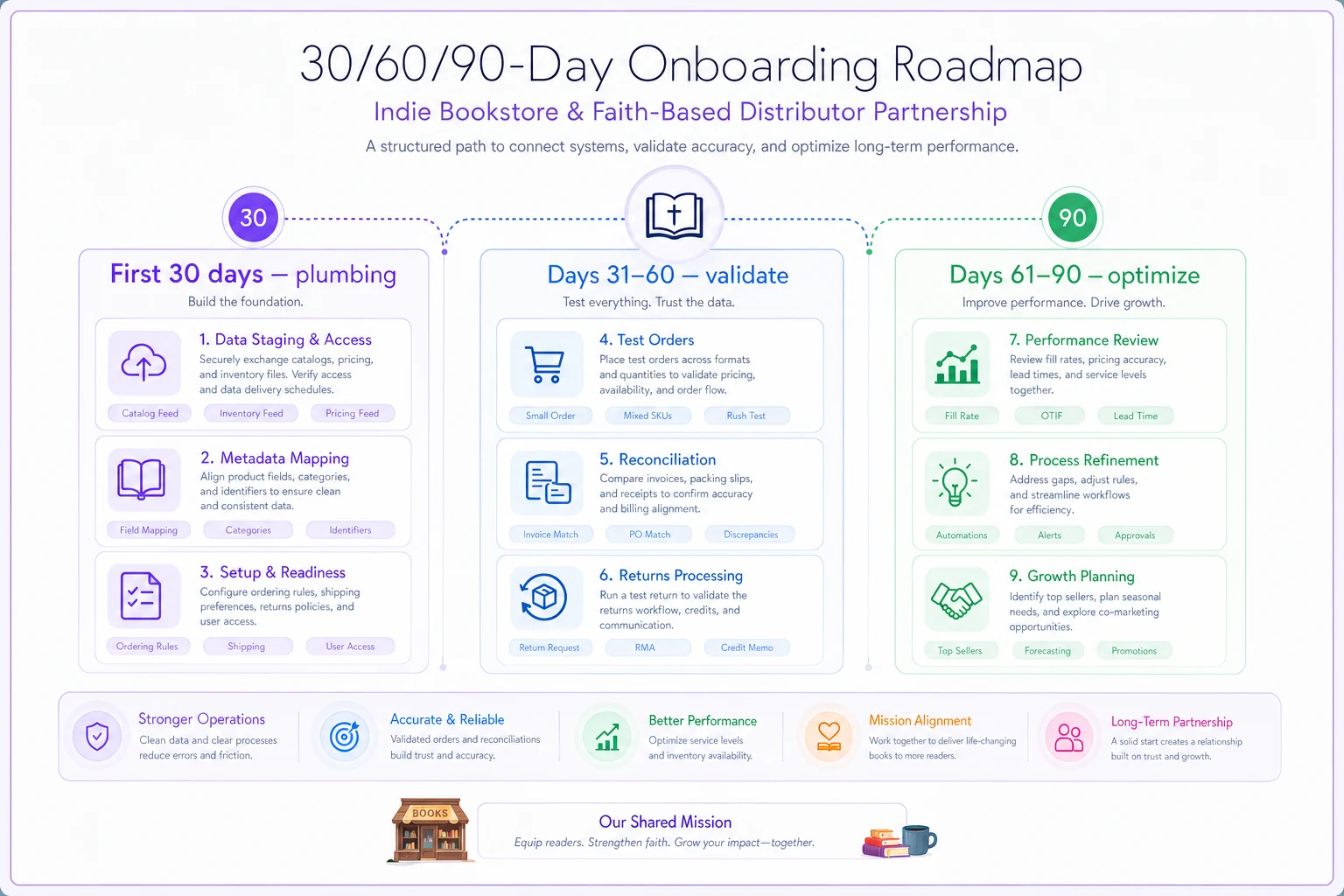
A simple visual of the phases helps teams run the checklist without skipping the plumbing steps.
Step 4: Metadata and POS mapping — where duplicate editions are born
This section prevents the majority of the chaos. Faith titles, especially Bibles and gift editions, generate duplicate SKUs faster than any other category because bindings and configurations aren't consistently coded across sources.
Map these fields explicitly before the first bulk import:
-
Primary ISBN-13 → your primary product ID (never trust the distributor's internal SKU as your key)
-
Binding/format (paperback, hardcover, imitation leather, genuine leather) → a required attribute field, not buried in the title
-
Translation/edition for Bibles (ESV, NIV, KJV, CSB, etc.) → dedicated attribute
-
Variant descriptors (cover color, thumb-index, gift box, large print) → separate attribute fields, never appended to the title string
-
Returnable flag → a POS field you can filter and report on
-
Category → your taxonomy, not theirs (their "Christian Living" may split across three of your shelf sections)
The rule that stops duplication: match incoming products against your existing catalog on ISBN-13 before creating anything new. If the ISBN exists, update the existing record — don't let the import create a second one just because the distributor's title string reads slightly differently.
Run the ISBN-13 matching process in a sandbox import first so you can catch edge cases before anything goes live.
A concrete example of how this goes wrong: you already stock an ESV Study Bible, hardcover, as ISBN 9781433544:15. The new distributor's feed lists the same book but titles it "ESV Study Bible (Hardback, Black)." A naive import creates a brand-new SKU. Now you've got two records, split inventory counts, and a customer-facing search that shows the same book twice at possibly different prices. Multiply that across a Bible section with 200+ variants and you understand why some stores can't trust their own on-hand numbers.
Step 5: Reconciliation and returns workflows
Faith distributors' return quirks make reconciliation non-optional. Here's the workflow that keeps credits from going missing.
Receiving reconciliation (every shipment):
-
Scan received against the packing slip, then packing slip against the invoice
-
Flag any line where invoice quantity ≠ received quantity
-
Immediately confirm non-returnable flags on the invoice match what you agreed to order
-
Log short-ships and overships in a running vendor log — do not resolve them by memory
Returns workflow:
-
Pull candidates by age and velocity — anything past your markdown threshold that's still returnable
-
Verify each title's returnable status against the invoice it came in on (this is why you kept the invoices)
-
Generate the return authorization, then photograph the outbound cartons
-
Log expected credit amount per line before shipping
-
Track credit against expectation — a credit that lands 12% short is your signal that a line was reclassified as non-returnable somewhere along the way
The "log expected credit before shipping" step is the one stores skip, and it's exactly why return credits go unclaimed. If you never wrote down what you were owed, you'll never notice when the credit comes back light.
Handling this well also feeds cleanly into your monthly financial close and your per-channel sales-tax picture — returns credits and short-pays touch both, so a clean vendor log saves you time at month-end too.
Step 6: Merchandising and event partnership templates
Faith distributors are often willing partners on merchandising and events in ways general wholesalers aren't — they'll co-op display units, provide author tour support, and sometimes fund launch quantities for a signing. Worth asking about directly.
> "We're planning a [season/theme] endcap running [dates] and would like to feature [3–5 titles] from your list. Do you offer co-op display allowance or POP materials for these titles? We can share a photo of the finished display and sell-through numbers afterward."
Author event partnership terms to nail down:
-
Consignment vs. firm-sale on event stock (get this in writing — event returns are a classic gap)
-
Who covers freight on unsold event copies
-
Signed-copy policy (signed usually becomes non-returnable — plan quantities accordingly)
-
Restock lead time if the event outsells the initial order
The signed-copy detail matters more than people expect. Signing kills returnability. Order event quantities against a realistic attendance estimate, not optimism, because every unsold signed copy is now firm stock you own.
A worked per-order margin example on faith titles
Numbers make this concrete. Say you place a restock order of faith trade paperbacks:
-
Order 40 units, retail $18.99 each = $759.60 retail value
-
Discount 44% off retail → cost $10.63/unit = $425.38 net cost
-
Freight free over $150 threshold → $0
-
Payment Net 60, take the 2% early-pay → save $8.51
-
Adjusted cost ~$416.87
-
If you sell all 40 at full retail, revenue is $759.60, gross margin roughly $342.73 — about 45%. Clean.
-
Now the realistic version. Say 6 units don't sell and go back as returns
-
- Return credit on 6 units at cost
~$63.78 recovered
-
- But you paid receiving labor twice (in and out) and freight on the return carton (~$9)
-
- Effective margin on the sold 34 units drops to roughly 41–42% once return handling is loaded in
-
And the bad version — if 4 of those 6 unsold units turn out to be seasonal, flagged non-returnable at order time (which you'd have caught if the invoice flag was checked):
-
- You eat ~$42.52 in dead stock
-
- Margin on the batch falls toward 35%
That six-point swing is the whole ballgame. It's not the discount — the discount was fine. It's the returnability flag and the receiving labor. Which is precisely why the contract clauses and the reconciliation workflow above earn their keep.
When a dedicated faith distributor makes sense — and when it doesn't
It makes sense when:
-
Faith titles are more than roughly 15% of your sales and you're buying deep in the category
-
You need Bible and gift breadth a general wholesaler carries thinly
-
You run regular faith-focused events and want co-op and author support
It's a bad idea when:
-
You'd be adding a fourth overlapping vendor for titles you already get cleanly from Ingram
-
Their metadata is CSV-only and your team is already stretched thin on receiving — the labor cost will outrun the discount
-
Your faith category is small enough that consolidating with one existing wholesaler keeps your SKU count clean
Who should not do this: a one- or two-person store with no staging process for imports. If every new feed goes straight into live POS, adding a faith distributor with messy Bible data will duplicate SKUs faster than you can clean them. Fix your import workflow first, then onboard.
A quick real scenario
A small church-adjacent bookstore, around $340k annual revenue with faith titles at roughly 30% of sales, was buying from two overlapping sources plus Ingram. Their on-hand counts for Bibles were unreliable — search showed the same NIV thumb-index edition three times at two prices.
The fix wasn't a new distributor. It was consolidating to one primary faith distributor with a clean ONIX feed, forcing ISBN-13 matching on import, and separating binding and translation into real attribute fields. Duplicate Bible SKUs dropped from somewhere around 90 down to the teens over a couple of months. Return credits started reconciling because they finally logged expected credit before shipping — they'd been quietly losing a few hundred dollars a quarter on light credits and short-ships nobody tracked.
Margin didn't jump dramatically. It just stopped leaking, and the buyer stopped spending Saturday mornings untangling receiving errors. That's the real win with faith distribution — not a bigger discount, but a relationship that doesn't quietly cost you back what you negotiated.
The through-line
Stores that stay profitable with Christian book distributors treat onboarding as an operations project, not a purchasing decision. The discount is the easy part and rarely where you lose. You lose on duplicate Bible SKUs, on seasonal stock that turned non-returnable without a flag, on partial shipments you didn't cap, and on return credits nobody logged.
Get the scorecard, the clauses, the metadata mapping, and the reconciliation workflow right in the first 90 days, and the category does what it should — steady margin, loyal customers, and a distributor relationship that actually pulls its weight on events and merchandising. Skip those steps, and no discount will save you.
Stores that stay profitable with Christian book distributors treat onboarding as an operations project, not a purchasing decision. The discount is the easy part and rarely where you lose. You lose on duplicate Bible SKUs, on seasonal stock that turned non-returnable without a flag, on partial shipments you didn't cap, and on return credits nobody logged.
Get the scorecard, the clauses, the metadata mapping, and the reconciliation workflow right in the first 90 days, and the category does what it should — steady margin, loyal customers, and a distributor relationship that actually pulls its weight on events and merchandising. Skip those steps, and no discount will save you.
Ready to elevate your bookstore’s operations?
Join 500+ bookstores using Bookstorely to boost sales, optimize stock, and delight book lovers.